


Questions over clinical data from at least two Indian manufacturers of generic medicines bought by the NHS threaten to undermine British public confidence, top inspector sIndian manufacturers of cheap generic drugs prescribed by the National Health Service may not be trusted because several have altered the testing data submitted to Britain’s regulator, according to the agency’s director of inspections.
At least two Indian pharmaceutical firms which supply British chemists and hospitals had either failed to submit original data from tests on the drugs or actually changed the data on which the regulatory body decides whether they meet the required manufacturing standards and can remain on sale in Britain.
The disclosure was made by Gerald Heddell, director of inspections at the Medicines and Healthcare Products Regulatory Agency which inspects all plants manufacturing drugs for use in Britain, in an interview with the Economic Times of India.
His comments follow the recall of five drugs manufactured by Wockhardt, one of India’s largest producers of cut-price generic medicines. They also follow the record fine against Ranbaxy, the largest Indian supplier of generics to Britain, by the United States’ Food and Drugs Administration (FDA) earlier this year.
Generic drugs are cut price versions of branded medicines and their increasing use in Britain saves the National Health Service billions of pounds every year. Around 20 per cent of medicines sold in Britain are generics from India.
Related Articles
• Britain ignored warnings of Indian whistleblower at heart of drugs scandal
13 Jun 2013
• Ranbaxy Labs’ Singh dynasty ends
24 May 2009
• Patent row settlement boosts UK giant
16 Apr 2008
• Giving big pharma a headache
24 Oct 2004
• India’s generic prescription for Big Pharma
22 Jun 2008
Their use however has come under intense scrutiny since Ranbaxy, the largest Indian supplier to Britain, was fined £330 million by the FDA – a record for a generic manufacturer – earlier this year. It accepted seven charges of selling improperly prepared drugs, failing to report that its drugs did not meet specifications and submitting false information. The FDA and Britain’s MHRA had been alerted by a whistleblower who revealed that the company had used a testing lab which submitted falsified data on the shelf-life of the medicines. Britain’s MHRA also found significant deficiencies in its Indian operations including poor test record keeping, mixing different strengths of tablets and failing to properly test for storage conditions and shelf-life.
In the interview, Mr Heddell said while the British public had not lost confidence in Indian medicines it might yet if its manufacturers do not become more transparent in their handling of testing data and avoid further controversies.
According to the Economic Times, Mr Heddell said there had been concerns about 90 products made by Wockhardt, one of the largest Indian medicines suppliers to Britain, and that 60 of them were recalled.
“The issue, the biggest single issue that we are concerned about, is the degree to which we can trust their data which they produce. There are other GMP (good manufacturing practice) non-compliances, but the thing that concerns us the most, at the top of the list is, that can we trust data from this company?” he told the paper.
There had been cases where the firms had rewritten damaged test data documents and submitted them as clean copies, he said. “You cannot do that. You have to retain original records. So it went on from just being wanting to please to actually changing some of the data. It was not just the Wockhardt case, but an earlier case. So yes, there is an element of wanting to please. But the best way to please us is to recognise that there is an issue, to deal with it, and to prevent it from recurring and make sure everybody has confidence on those documents,” he added.
His mission in India was in part to encourage its drugs manufacturers to operate more openly and honestly and “don’t just tell us what we want to see”, he said.
Both Ranbaxy and Wockhardt have insisted that they have not misled the British regulator nor put British patients’ health and safety at risk. They noted that regulators had confirmed they had found no evidence that the medicines concerned were unsafe or defective. However Ranbaxy pleaded guilty in May to violations of US federal drugs safety regulations and agreed to pay a $500 million fine.

Yes, India now has a minister of yoga — and he and his government want their cultural bliss back.
Indian yogic tradition appears in Hindu texts written thousands of years ago. But the discipline bears scant resemblance to the popular exercise regime that has become a multibillion-dollar industry in the West, home of $90 Lululemon stretch pants and Mommy and Me fitness classes.
In recent weeks, Indian officials have begun efforts to reclaim yoga for the home team, making plans for a broad expansion of the wellness practice into all facets of civic life — including more than 600,000 schools, and thousands of hospitals and police training centers. They are spearheading efforts to promote and protect India’s most famous export, even quietly weighing a “geographical indication” for yoga, a trade protection normally given to region-specific goods such as Champagne from France or oranges from Florida.
“There is little doubt about yoga being an Indian art form,” Naik said. “We’re trying to establish to the world that it’s ours.”
Prime minister, Narendra Modi, is pushing the effort. The 64-year-old premier rises at 5 a.m. daily for yoga stretches and deep breathing, and he credits this regimen with his ability to sleep just a few hours each night.
“I am equally energetic from morning till night,” Modi told fans during a Google Hangout. “I guess the secret behind it is yoga and [breathing exercises]. Whenever I feel tired, I just practice deep breathing and that refreshes me again.”
Modi’s devotion to the practice is so heartfelt that during his first speech to the United Nations General Assembly as prime minister in September, he discussed peace, global development — and International Yoga Day.
This disappointed some of his followers, who had hoped that he would use the grand occasion to say something more significant; also, there already was a World Yoga Day. But more than 130 countries have signed on to Modi’s proposal, which the U.N. General Assembly is set to consider Dec. 10.
Although yoga has been a part of India’s heritage for centuries and Westerners flock to the country’s ashrams for enlightenment, it was only in the past two decades or so that yoga became trendy in India, with studios opening and Bollywood celebrities making fitness videos.
Some of the credit goes to Baba Ramdev, the saffron-robed guru who popularized yoga and what he says are its health effects — he claims it can reverse homosexuality and cure cancer and swine flu — on a morning TV program watched by millions. Baba Ramdev also is a close ally of Modi’s.
“The saints and gurus practiced in the Himalayas but never took it to the general public,” Naik said. “Only Baba Ramdev knew how to take it to the people. Now it’s our turn to promote it more vigorously.”
India’s new embrace comes during an ongoing public debate over the genesis of yoga and whether the bastardized and secular versions practiced in the West — nude yoga, rave yoga, kickboxing yoga — are even yoga at all. The discussion was fueled by The Washington Post’s On Faith blog in 2010, when a board member of the Hindu American Foundation (HAF) exhorted Hindus to “take back yoga and reclaim the intellectual property of their spiritual heritage.” Mega-guru Deepak Chopra fired back, saying that “yoga belongs to the whole world.”
Sheetal Shah, a senior director of HAF, which spearheaded the “Take Back Yoga” campaign, said: “Nobody owns yoga. Our idea was not to claim ownership; it was just to acknowledge that the philosophy behind yoga is based in Hinduism.”
The Indian government has not been pleased when Western practitioners of holistic medicine have tried to patent or copyright the traditional practices. First, there was the great turmeric war of 1997, after the University of Mississippi Medical Center patented the healing properties of turmeric, a spice used in every Indian kitchen and known for medicinal qualities. The Indian government filed a complaint, and the patent was revoked. Then Bikram Choudhury, the Indian-born founder of hot yoga who practices in Los Angeles, tried to copyright his yoga series.
He was not successful, but Indians learned a lesson. For more than a decade, they’ve been building a vast compendium of age-old medicines and practices, the Traditional Knowledge Digital Library, which is now available to patent offices worldwide. They are documenting 1,500 yoga poses, some by videotape, which will be added online next year to help prevent the “misappropriation” of yoga by commercial enterprises, said Archana Sharma, the project’s leader.
Meanwhile, Modi, has started a “Make in India” campaign to boost manufacturing and attract foreign investors to opportunities in the country, including its $8 billion wellness industry. Modi said the country had missed the opportunity to market its industry of yoga and herbal medicine globally.
In recent days, a new energy enlivened the normally quiet halls of New Delhi’s Morarji Desai National Institute of Yoga, the government’s premier yoga academy, which is helping implement the regimen’s expansion throughout India’s public sphere.
Students and office workers gathered for lunchtime sessions at the institute, which is named after an Indian prime minister who once told Dan Rather on “60 Minutes” that he drank his own urine for medicinal purposes. The practice rooms were decidedly sparse — not a candle or top-brand yoga mat in sight — and near a library holding volumes of ancient Vedic texts.
In one room, several students in their 20s who are studying to be instructors went through a series of asanas, or poses, and breathing exercises.
They said they were happy that India had begun to promote yoga.
“The West has manipulated yoga for their own benefits. It’s more like exercise. But traditional yoga is much more than that; it’s ultimately about achieving enlightenment for the soul,” said Tarosh Rao, 25. “It is making us aware of something that is ours, part of our heritage.”
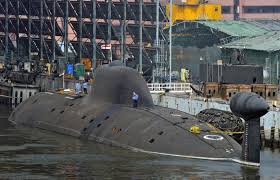
and leaning on its neighbors to curb Chinese submarine activity in the Indian Ocean, as nations in the region become increasingly jittery over Beijing’s growing undersea prowess.
Just months after a stand-off along the disputed border dividing India and China in the Himalayas, Chinese submarines have shown up in Sri Lanka, the island nation off India’s southern coast. China has also strengthened ties with the Maldives, the Indian Ocean archipelago.
China’s moves reflect its determination to beef up its presence in the Indian Ocean, through which four-fifths of its oil imports pass, and coincides with escalating tension in the disputed South China Sea, where Beijing’s naval superiority has rattled its neighbours.
“We should be worried the way we have run down our submarine fleet. But with China bearing down on us, the way it is on the Himalayas, the South China Sea and now the Indian Ocean, we should be even more worried,” said Arun Prakash, former chief of the Indian navy.
“Fortunately, there are signs this government has woken up to the crisis,” he said. “But it will take time to rebuild. We should hope that we don’t get into a face-off with the Chinese, that our diplomacy and alliances will keep things in check.”
Prime Minister Narendra Modi’s government has ordered an accelerated tendering process to build six conventional diesel-electric submarines at an estimated cost of Rs 50,000 crore ($8.1 billion), in addition to six similar submarines that French firm DCNS is assembling in Mumbai port to replace a nearly 30-year-old fleet hit by a run of accidents.
The country’s first indigenously built nuclear submarine – loaded with nuclear-tipped missiles and headed for sea trials this month – joins the fleet in late 2016. India leased a nuclear-propelled submarine from Russia in 2012 and is in talks to lease a second one, navy officials told Reuters.
The government has already turned to industrial group Larsen & Toubro Ltd, which built the hull for the first domestic nuclear submarine, to manufacture two more, sources with knowledge of the matter said.
Elsewhere in the region, Australia is planning to buy up to 12 stealth submarines from Japan, while Vietnam plans to acquire as many as four additional Kilo-class submarines to add to its current fleet of two. Taiwan is seeking U.S. technology to build up its own submarine fleet.
Japan, locked in a dispute with China over islands claimed by both nations, is increasing its fleet of diesel-electric attack submarines to 22 from 16 over the next decade or so.
OUTNUMBERED
In addition to the leased Russian nuclear-propelled submarine, India’s navy currently has 13 ageing diesel-electric submarines, only half of which are operational at any given time due to refits. Last year, one of its submarines sank after explosions and a fire while it was docked in Mumbai.
China is estimated to have 60 conventional submarines and 10 nuclear-powered submarines, including three armed with nuclear weapons.
Ma Jiali, an expert at the China Reform Forum’s Centre for Strategic Studies which is affiliated with the Central Party School, said Beijing’s top concern in the Indian Ocean was safeguarding the passage of its commodities, especially oil.
“There are many voices in India who believe the Indian Ocean belongs solely to India, and no other country belongs there. That line of thought is common – but of course it shouldn’t be viewed like that. Our (China’s) view is that there should be dialogue and discussion between China and India.”
With India building its navy to about 150 ships, including two aircraft carriers, and China holding around 800 in its naval fleet, the two are more likely than not to run into each other, naval officials and experts say.
David Brewster, a strategic affairs visiting fellow at the Australian National University, said India will do everything it can to recover its dominant position in the Indian Ocean.
It may seek naval cooperation with Japan and Australia, and expand a military base on the Andaman Islands which lie about 140 km (87 miles) from the Malacca Straits, he said.
“India sees the presence of any Chinese naval vessel as an intrusion. There is a big ramp-up in their presence, which is clearly intended to send a message to India,” said Brewster.
India has engaged in intense diplomacy with Sri Lanka about the Chinese submarine presence, reminding it that New Delhi must be informed of such port calls under a maritime pact they signed this year along with the Maldives.
India has also muscled into an $8 billion deep water port that Bangladesh wants to develop in Sonadia in the Bay of Bengal, with the Adani Group submitting a proposal in October. China Harbour Engineering Company, an early bidder, was the front-runner.
“If China continues down this path and continues with this level of presence in the Indian Ocean then the Indians will feel they need to respond,” said Brewster.
![Online [Free Watch] Full Movie Bobbi Jene (2017)](http://www.realnewsofindia.com/wp-content/uploads/2014/12/wildlife-610x380.jpg)
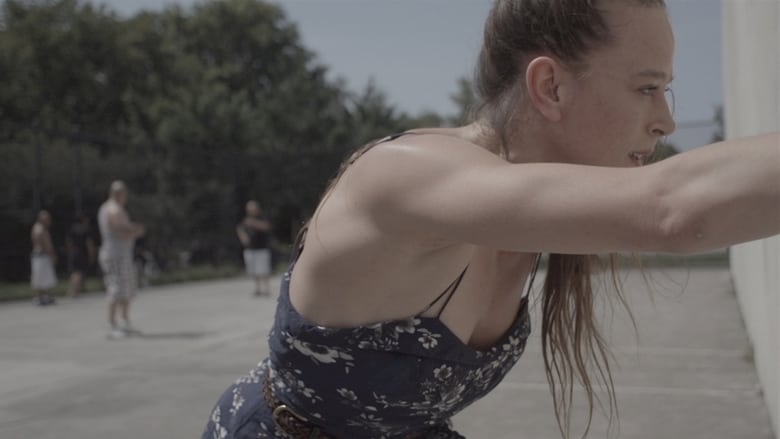
Bobbi Jene (2017)
| Release | : | 2017-09-22 |
| Country | : | United States of America,Denmark,Sweden,Israel |
| Language | : | English |
| Runtime | : | 95 |
| Genre | : | Documentary |

Synopsis
Watch Bobbi Jene Full Movie Online Free. Movie ‘Bobbi Jene’ was released in 2017-09-22 in genre Documentary.
A love story, portraying the dilemmas and inevitable consequences of ambition. It is a film about a woman’s fight for independence, a woman trying to succeed with her own art in the extremely competitive world of dance.
Streaming Movie Bobbi Jene
(2017) Online
Incoming search term :
Watch Bobbi Jene Full Movie Online Free Streaming In HD Quality, watch full Bobbi Jene movie, Watch Bobbi Jene 2017
Online Free Viooz, Watch Bobbi Jene 2017 Online Free, Watch Bobbi Jene 2017 Online Putlocker, film Bobbi Jene
online, Streaming Bobbi Jene 2017 For Free Online, streaming movie Bobbi Jene 2017, Bobbi Jene film trailer,
Bobbi Jene movie trailer, live streaming film Bobbi Jene 2017, Streaming Bobbi Jene 2017 Online Free Megashare,
movie Bobbi Jene streaming, Watch Bobbi Jene 2017 For Free online, film Bobbi Jene 2017 online streaming,
download Bobbi Jene 2017 movie now, movie Bobbi Jene 2017 download, watch full movie Bobbi Jene 2017, trailer
film Bobbi Jene 2017, Watch Bobbi Jene 2017 Online 123movies, Watch Bobbi Jene 2017 Online Free 123movie, Watch
Bobbi Jene 2017 Online Free Putlocker, movie Bobbi Jene 2017 trailer, Watch Bobbi Jene 2017 Online Free
netflix, watch Bobbi Jene film online now, Bobbi Jene 2017 movie streaming, Bobbi Jene 2017 Watch Online, Watch
Bobbi Jene 2017 Online 123movie, download movie Bobbi Jene, Watch Bobbi Jene 2017 Online Free megashare, watch
Bobbi Jene movie now, Watch Bobbi Jene 2017 Online Free hulu, Watch Bobbi Jene 2017 Online Viooz, live streaming
movie Bobbi Jene 2017, Bobbi Jene live streaming film online, movie Bobbi Jene 2017, Watch Bobbi Jene 2017 Online
Megashare.
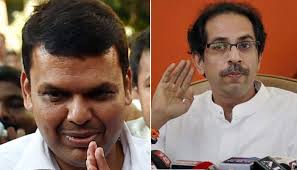
Shiv Sena has finally decided to join the Devendra Fadnavis-led government in Maharashtra on Tuesday. The Shiv Sena will get 12 portfolios in the Maharashtra Cabinet and is also likely to get another berth in the Union Cabinet.
The swearing-in ceremony is likely to take place on Wednesday. The Uddhav Thackeray-led party will not get the deputy CM post but is almost certain to get the PWD ministry.
There were reports that the Shiv Sena which had been demanding the post of the deputy chief minister and crucial Home Ministry, had toned down the demand and was ready to settle for other ministerial posts but nobody from either side confirmed the same.
The hint that the deal is almost sealed between ruling BJP and Sena came from the chief minister on Monday.
“Talks with Shiv Sena are going on. Even yesterday we had very positive talks. We are moving in the right direction. I am very sure we will be able to successfully conclude these talks. We can say that 70-80 per cent talks have been completed where both the parties agree. Some things are left on which we are still discussing,” Fadnavis said.
His statement was echoed by senior BJP minister Vinod Tawde who said the final outcome will emerge in a day or two.
“The chief minister has made it clear that we wanted Sena with us in power. Talks on this issue have started. Whatever proposals have to be given to each other, that process has also started,” he said in Ratnagiri.
According to the Sena leader the demands put forward by the party before BJP are “logical” and have no resemblance to media reports that Sena is asking certain ministries considered to be money spinners. “We have only demanded ministries through which we can connect to the people,” the leader said.
“When we were in power, we had given similar ministries to the BJP. Today when we are demanding the same ministries, what is wrong in that?” the Sena leader questioned.
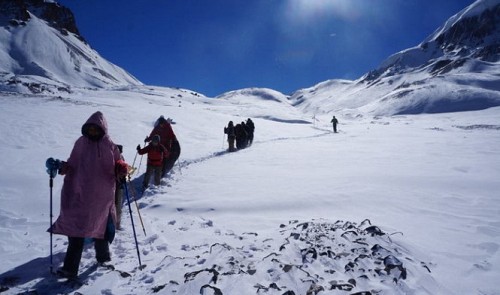
Two European climbers have been swept away by an avalanche while a veteran Japanese mountaineer has plunged to his death in a separate tragedy in the Himalayas, officials said Saturday.
A European team of elite mountaineers were 100 meters (328 feet) shy of summiting the world’s 14th-highest peak — China’s 26,335-foot Shisha Pangma peak — when Wednesday’s avalanche hit.
“Two climbers — one German, the other Italian — were swept away in an avalanche on Shisha Pangma,” said Ang Tshering Sherpa, president of the Nepal Mountaineering Association.
Mountaineering equipment company Dynafit, which sponsored the team, named the two dead men as Italian Andrea Zambaldi, 32, and German Sebastian Haag, 35.
In a separate accident, Japanese climber Yoshimasa Sasaki fell to his death on Friday when he slipped during an ascent of Mount Manaslu, the world’s eighth-highest peak, located in northwest Nepal, according to a tourism ministry statement.
The 59-year-old, an experienced mountaineer, lost his footing at 24,000 feet after summiting the 26,759-foot peak.
“Rescuers are working to recover the body… (which) will be brought to Kathmandu as soon as possible,” the tourism ministry said.
‘Snow is killing us’
Dynafit said the force of the Shisha Pangma avalanche threw the two victims, along with German teammate Martin Maier, across steep glaciers, dragging them down for around 2,000 feet before landing them in an inaccessible section of the mountain.
Their teammates attempted a rescue but were forced to turn around because they could not reach the victims, the company said.
“Sebastian and Andrea disappeared with the avalanche and their bodies could not be found.”
Maier, who miraculously survived the accident, was receiving medical attention.
Haag, a former veterinary surgeon, had accomplished several speed climbs and high-altitude ski challenges during his mountaineering career. Zambaldi worked in the sales and marketing division of Dynafit.
Switzerland’s Ueli Steck, the most experienced mountaineer in the team, made headlines last year when he and two other Western climbers traded blows with a group of furious Nepalese guides over a climbing dispute on Mount Everest.
The Dynafit team had planned to speed-climb and ski down Shisha Pangma and the 26,906 foot Cho Oyu peak, located on the Nepal-China border, via foot, ski, and bicycle in under a week.
Haag and Zambaldi had been forced to turn back during their first attempt ten days ago due to heavy snowfall and the threat of an avalanche, according to the official expedition blog.
As they neared the summit last Tuesday night, Zambaldi blogged: “The snow makes progress really tough. In steep sections we sometimes sink in up to the hip or chest.”
“Let’s hope the mountain gives us a chance.”
By early Wednesday the weather was worsening, with teammate Benedikt Boehm writing: “We are so close, but… the avalanche situation is still a bit tense and the deep, windblown snow is killing us.”
Shrouded in mystery and closed to westerners until 1978, Shisha Pangma is considered a relatively accessible peak to summit with many expeditioners recommending that climbers attempt it as part of their training before turning their attention to higher mountains.
At least two dozen climbers have died on Shisha Pangma, including US mountaineering legend Alex Lowe, who was killed in a massive snow and ice avalanche in October 1999 while attempting the first American ski descent of an 26,000-foot peak.
Sixteen Nepalese guides were killed last April in an ice avalanche on the world’s highest mountain, Mount Everest, in the worst disaster to strike the 29,029-foot peak.

ROME, Italy — Call it “Divorce Italian Style” version 2.0.
In Pietro Germi’s Oscar-winning 1961 comedy of that name, the unfaithful protagonist, unable to divorce his smothering wife, plots to kill her. If it had been set in 2014, he could have just let her stumble upon his WhatsApp account.
The instant messaging service acquired by Facebook this year for $19 billion is cited in nearly half of all Italian divorce proceedings — more than any other source of information, whether amorous text messages or emails, late-night phone calls, handwritten notes, or even lipstick-stained collars — according to the Italian Association of Matrimonial Lawyers.
“No one is saying WhatsApp is the cause of the divorces,” says Gian Ettore Gassani, president of the Matrimonial Lawyers group. “The leading cause is infidelity, but WhatsApp is now the most common way for one partner to discover infidelity in the other.”
The WhatsApp program and other new forms of communication such as Facebook and Skype may enable illicit relationships because they make it easier to discreetly exchange messages and even risqué photos.
The most typical scenario, Gasani says, is an unfaithful partner leaving his or her mobile phone lying around while in the shower or out for a walk. A message arrives or the partner opens WhatsApp to snoop.
Men are more likely to be caught that way than women, although that doesn’t necessarily mean they’re unfaithful more often.
“Men are most likely to save messages or photos from lovers they can go back to,” Gassani says. “Women are more likely to take one look and then delete.”
Once caught, it’s not easy to divorce in Italy, thanks mostly to the influence of the Catholic Church.
When Germi made his film, divorce was completely illegal. That changed in 1970, despite a subsequent series of referenda that sought to repeal the country’s new law allowing divorce.
Even now, obtaining a divorce is a long and complicated process requiring a three-year separation that may include court-ordered couples therapy to foster reconciliation.
Although WhatsApp and other new technologies may be prompting more discoveries about infidelity in partners, they’re also playing into very old aspects of the Italian psyche.
“Italians love to receive and give attention,” says Laura Duranti, a Milan-based psychologist who specializes in the social impact of technology. “While the modern world and evolving social norms have acted to limit that in some ways, programs like WhatsApp can make it easier. It’s a modern technology tapping into some very old needs and desires.”
Some Italians say those caught out via WhatsApp are careless.
“No one should be looking at a partner’s phone or computer, it’s an invasion of privacy,” says Mario Lince, a 30-year-old pastry shop worker who’s engaged to be married. “It should be a question of trust.
“But just to be safe,” he adds, “everyone should use a secret password to block access.”
More from GlobalPost: A tale of two towns illustrates Spaniards’ struggle to survive
Maria Teresa Benedetta agrees.
“I don’t think most couples want to know if a partner has been unfaithful,” the unattached 22-year-old university student says. “But if they find out of course there’s going to be trouble.”
Despite the impact of instant messaging and other new forms of communication, it could be much greater, says Gassani, the attorney. Many people use passwords and delete messages, and snooping on someone’s phone privately is usually difficult.
“If WhatsApp messages could be intercepted by wiretaps like phone calls,” he says, “the divorce rate in Italy might be 100 times higher.”

You know about cat people. And you know about dog people. (You know about dog people.)
But has it ever occurred to you that there are also cat countries and dog countries?
Well, there are. Whole countries. And thanks to data on pet ownership in 54 countries from market research firm Euromonitor, we now know which ones they are.
In brief, South America and much of Asia are all about dogs. Meanwhile, cats have captured the hearts of Western Europeans — except for those in Spain, Portugal and Ireland.
The Washington Post has a nice map that lays it all out.
“Some regions, like the Middle East and part of Africa, have an especially long-standing appreciation of cats,” Jared Koerten, a pet industry analyst at Euromonitor, told the Washington Post. “In Latin America it’s the complete opposite. Dogs are part of family life there.”
Here are some more site-specific stats: Cats outnumber dogs 3-to-1 in Switzerland, Austria and Turkey.
In India, pet dogs outnumber pet cats 10-to-1. Pet dogs also dominate in China, though to a lesser extent (2.5-to-1). And yes, even counting the ones dyed to look like pandas.
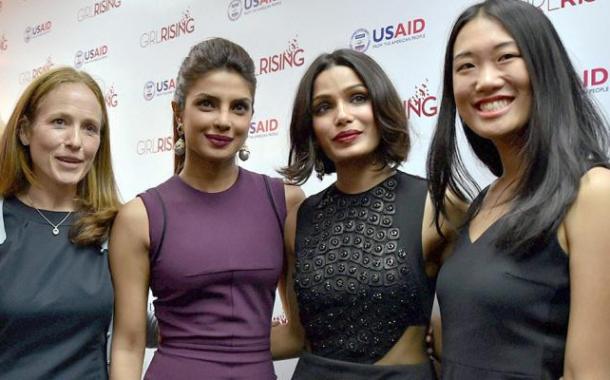
ndian actress Freida Pinto, who rose to fame with Oscar-winner ‘Slumdog Millionaire’, says the feminism advocates gender equality but is largely misconstrued as an anti-male concept. The 30-year-old actress says feminism is the need of the hour as gender bias is a sad reality today. “Feminism to me is equality. There is no man over woman and vice versa. Feminism is a very misconstrued and misunderstood topic.
“As soon as we say feminism, it does not mean all men should become subordinate and women should be the ones who rule the world. The only way we can have a progressive and successful country or world is when men and women treat each other as equals,” Freida told PTI. The young star says though men and women have different roles to play, they should complement each other rather than outdoing one another.
“There are certain roles that men play and others that women play. Our reproductive organs are different and clearly there is a reason why women carry the baby but that does not mean the man cannot help out with the caring of the child. “Father is as much a nurturer as the mother. I grew up with that equality so I can say people who understand feminism understand that men and women are equal but have different roles to play,” she said.
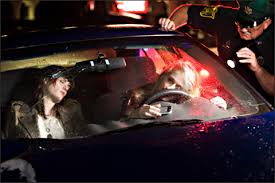
Voicing concern over increasing incidents of drunk driving, a Delhi court has said that this “menace” has been plaguing the national capital and the problem should be dealt with “sternly”.
“The menace of drunk driving has been plaguing the city for quite a long time. Despite every possible steps being taken by the state government as well as traffic regulating authorities, there are no signs of decrease in the incidents of drunk driving. This problem has to be dealt with sternly,” Additional Sessions Judge Sanjay Bansal said.
The court’s observations came while deciding the appeals of four persons, who were convicted and sentenced to varying jail terms of five and 10 days by a magistrate for driving their vehicles in a drunken state.
The court, however, reduced the jail terms of Tasleem Khan, Muntiaz Ahmed, Dinesh Singh and Arvind Kumar Verma to imprisonment till the rising of the court.
ASJ Bansal took the lenient view and reduced their jail term considering that they were first time offenders and they had already deposited the fine amount.
Tasleem and Muntiaz were sentenced to 10 days in jail by a magisterial court while Dinesh and Arvind were awarded five days imprisonment each.
The four men had pleaded guilty before the trial court. They were convicted for driving their vehicles under influence of liquor and the alcohol content found in their blood was more than the permissible limits.
The trial court had also imposed a fine of Rs 5,200, Rs 2,000, Rs 2,000 and Rs 500 on Tasleem, Muntiaz, Dinesh and Arvind respectively. It had also suspended Dinesh and Arvind’s driving licence for six months.
They had sought setting aside of the sentence given by the trial court on the ground that they had to support their families and it was their first conviction.
















)


Recent Comments