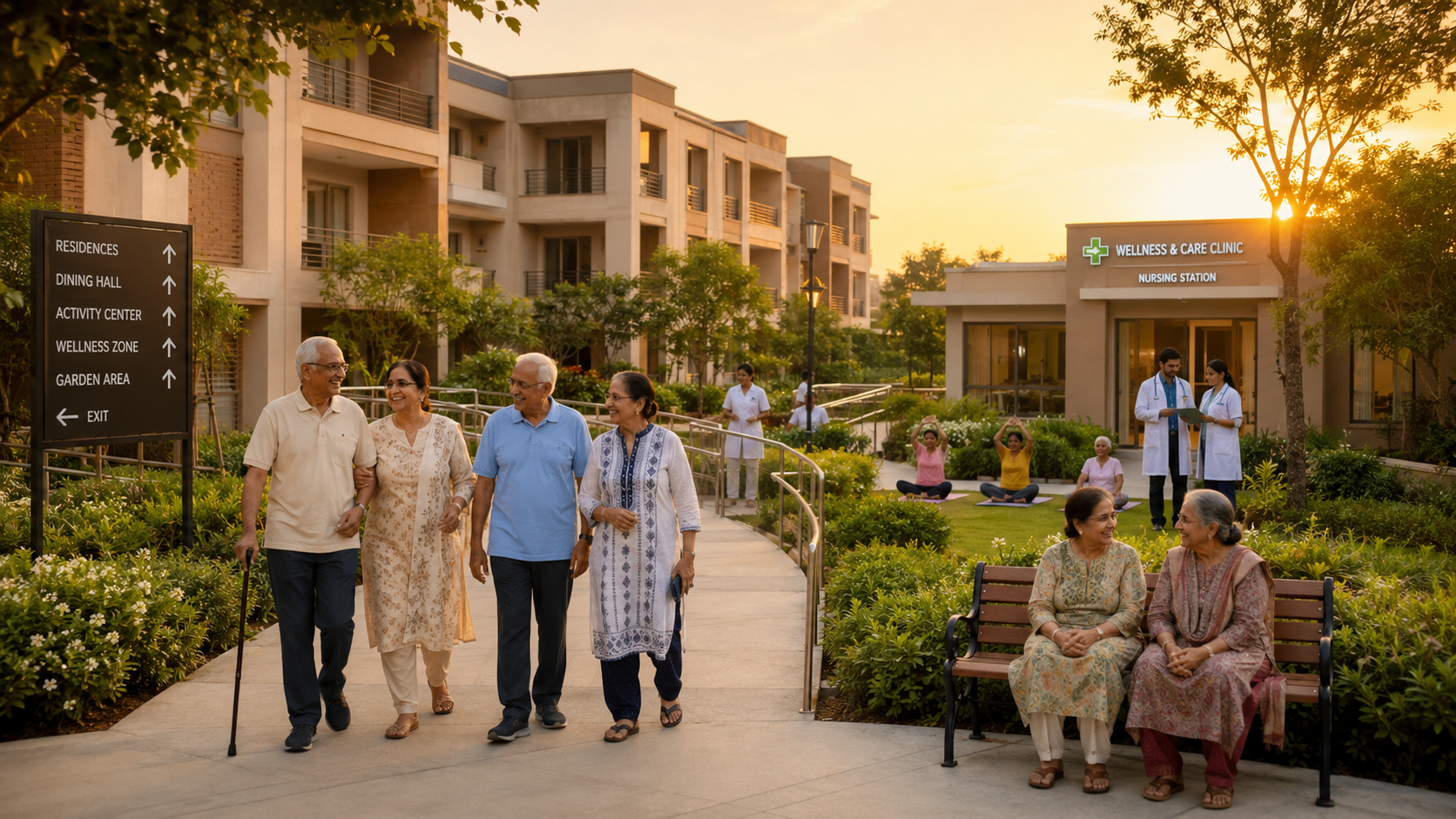
With MahaRERA’s landmark retirement-home regulations, a new state housing policy, and developers committing thousands of crores, senior living is emerging as Indian real estate’s fastest-growing — and most under-served — segment
Introduction
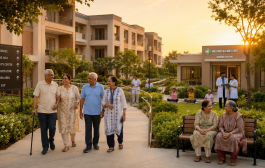
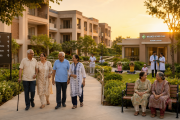
For decades, India’s real estate industry has been built almost entirely around the young family buyer — the first-time homeowner, the upgrading nuclear family, the investor chasing rental yield near a metro corridor. Almost unnoticed until recently, a parallel demand has been building at the other end of the age spectrum. India is ageing faster than its housing stock is adapting to that reality, and 2026 is shaping up as the year the real estate industry, regulators and policymakers finally began treating “senior living” as a distinct, investable asset class rather than a niche afterthought. Nowhere is this shift more visible than in Maharashtra, where MahaRERA, the state’s cooperative housing framework, and a wave of developer capital are converging around the needs of the elderly.
Background
India’s demographic arithmetic is stark. The population aged 60 and above stood at roughly 153 million in 2020 and is projected to more than double to about 347 million by 2050, lifting the elderly share of the population from around 11 percent to nearly 21 percent. Industry estimates suggest India will add close to 30 million people to the 60-plus cohort between 2025 and 2030 alone. Yet the organised senior living sector — purpose-built communities with healthcare access, safety design and community programming — remains minuscule. Industry research puts the organised senior housing stock at only around 22,157 units nationally against a base of more than 162 million seniors, meaning penetration is well under one percent of the addressable population. That gap between demographic need and built supply is precisely what is now drawing regulatory attention and developer capital.
Current Developments
Maharashtra has moved first and furthest among Indian states on this front. In May 2024, the Maharashtra Real Estate Regulatory Authority (MahaRERA) became the first real estate regulator in the country to notify dedicated guidelines for retirement housing, through an order formalising “Regulations for Retirement Homes in the State of Maharashtra.” The order lays down minimum physical specifications that any project must meet before it can be marketed or advertised as a “retirement home” — a significant consumer-protection step in a segment that had previously been loosely defined and inconsistently delivered.
The MahaRERA specifications are granular and safety-first. Buildings with more than one floor must have lifts sized for wheelchairs and mobility aids, fitted with audio and visual signalling; door openings must be at least 900 mm wide; staircases require handrails on both sides with senior-appropriate tread and riser dimensions, illuminated with fluorescent or radium strips; corridors must avoid level changes, using ramps instead of steps wherever unavoidable; kitchens must have gas-leak detection systems; bathrooms must have anti-skid tiles, outward-opening doors and grab rails near wash basins; every apartment must have power backup, particularly for kitchens and bathrooms; and emergency alarms are mandated at entry doors, bathrooms, bedrooms and common areas. The guidelines also encourage maximum use of non-polluting, renewable energy sources to reduce seniors’ exposure to combustion fumes.
This regulatory groundwork has been reinforced at the policy level. The Maharashtra State Housing Policy, 2025, approved by the state government in May 2025 following an extended draft and stakeholder consultation process that began in 2024, formally establishes “Senior Citizen Housing” as a distinct building category within the state’s Unified Development Control and Promotion Regulations (UDCPR) framework. The policy package includes lower stamp duty for elderly buyers and specific incentives for developers building senior-living communities, alongside requirements around recreational areas, round-the-clock ambulance access, and on-site nursing stations.
Detailed Analysis
The regulatory push is arriving in tandem with a wall of developer capital. Industry market-sizing from research firms places India’s senior living real estate market at approximately USD 4.47 billion in 2026, projected to expand to roughly USD 14.14 billion by 2031 — a compound annual growth rate of nearly 26 percent, comfortably outpacing most mainstream residential segments. Separately, industry estimates peg the addressable opportunity at around 2.3 million units of demand by 2030, translating into an estimated ₹64,500 crore market opportunity, against an organised sector currently valued at only about ₹25,000 crore.
Listed and established players are moving to capture this gap. Ashiana Housing, one of the pioneers of India’s senior-living format, reported record senior-living sales of ₹570.2 crore in FY26 and has committed roughly ₹425 crore toward expanding this portfolio, with a further ₹800 crore earmarked for land acquisition in FY27. The company is targeting ₹2,000 crore in senior-living revenue with a pipeline of five to six new projects, aiming to roughly triple sales in this segment within four years. Columbia Pacific’s Serene Communities has announced plans to commit close to ₹3,000 crore toward senior housing projects across Bengaluru, Chennai, Hyderabad, Pune and Kochi, with unit pricing typically ranging between ₹70 lakh and ₹1.5 crore. Groups including Max Estates and Brigade have also signalled dedicated capital and land-bank commitments to the category.
The Mumbai-Pune corridor is emerging as a particular hotspot, benefiting from proximity to metropolitan healthcare infrastructure combined with the calmer, greener settings seniors typically prefer. Projects such as Nyati Senior Living within Pune’s Nyati County township (dedicating roughly 3.64 lakh square feet exclusively to senior living), Ashiana Utsav around 64 km from Pune, and hillside communities near Talegaon in the Sahyadri foothills illustrate a format that blends accessibility to the city with a quieter living environment. Industry data suggests occupancy rates in Mumbai’s senior housing segment are running at a striking 80 to 90 percent, among the strongest demand signals in any residential sub-category currently tracked in the region.
Benefits
For the elderly population, the shift toward regulated, purpose-built senior housing promises tangible safety and dignity dividends: fall-prevention design, on-call medical response, community engagement that addresses isolation, and legal clarity on what a “retirement home” actually guarantees a buyer. For developers, the segment offers diversification away from cyclical mainstream housing demand, premium realisations, and — under Maharashtra’s new policy — fiscal incentives including stamp duty relief that improve project economics. For the state, formalising the category ahead of demographic pressure allows planning authorities to shape supply before the elderly population surge of the 2030s and 2040s arrives, potentially easing pressure on public healthcare and eldercare infrastructure later.
Challenges
The gap between potential and delivery remains substantial. Sub-one-percent penetration of the addressable elderly population indicates that supply is nowhere near matching demographic need, and much of what has been built so far is concentrated in the premium price band, leaving middle- and lower-income seniors underserved. Land costs in and around Mumbai make compliance with generous, low-rise, amenity-heavy design standards commercially difficult without policy support, which is one reason many large-format projects are gravitating toward peripheral locations like Pune, Lonavala and Talegaon rather than the island city itself. Operational complexity is another hurdle: unlike conventional residential sales, senior living requires ongoing healthcare staffing, food service, and emergency response — a services business layered on top of a real estate one, demanding capabilities many traditional developers do not yet have in-house. Finally, family and cultural attitudes toward institutional-style senior living are still evolving in India, meaning marketing and trust-building remain as important as construction quality.
Expert Opinion
Industry commentary accompanying recent market research has repeatedly framed senior living as India’s “next big real estate opportunity,” pointing to today’s seniors being more financially independent, better travelled and more open to purpose-built community formats than previous generations — a marked shift from the assumption that Indian elders will always be housed within joint or extended-family arrangements. Consultancy analysis on the segment has also noted that strong absorption and long waitlists at existing ready-to-move-in communities indicate genuine, underserved consumer demand rather than speculative developer enthusiasm, reinforcing the view that the category’s current capital commitments reflect calculated confidence rather than a passing trend.
Future Outlook
With MahaRERA’s retirement-home regulations now in force, Maharashtra’s Housing Policy 2025 formally recognising the category, and national demographic trends only intensifying through the 2030s, senior citizen housing looks set to move from a niche experiment to a mainstream real estate vertical over the next five years. Expect more state RERAs to follow Maharashtra’s lead with their own retirement-home standards, continued capital deployment from listed housing companies, and gradual expansion of the format beyond the premium segment as construction costs and operating models mature. The Mumbai Metropolitan Region, given its healthcare density and ageing urban population, is likely to remain at the centre of this growth story.
Practical Takeaways
Families evaluating a retirement-home purchase in Maharashtra should verify that a project explicitly complies with MahaRERA’s retirement-home order rather than assuming that generic marketing language equates to regulatory compliance. Buyers should ask specifically about lift accessibility, ramp versus step design, emergency alarm placement, and the presence of on-site nursing or medical response arrangements before committing. Developers entering the segment should treat healthcare service delivery as a core operating competency, not an outsourced afterthought, and should evaluate peripheral MMR and Pune-belt locations where land economics support the low-rise, amenity-rich design the category demands. Policymakers and municipal planners would do well to extend targeted incentives, of the kind now available under the state housing policy, to a wider range of income bands so that senior housing does not remain the preserve of the affluent alone.
Conclusion
India’s senior citizen housing segment sits at a rare intersection of demographic certainty, regulatory momentum and rising developer capital — a combination that has historically preceded rapid growth in other Indian real estate sub-sectors. Maharashtra’s early regulatory action through MahaRERA and its 2025 housing policy gives the state a head start in a race that will only become more urgent as the country’s elderly population swells over the coming decades. For an industry accustomed to building for the young family, learning to build for the ageing one may prove to be one of the more consequential shifts of this decade.
8. Key Takeaways
MahaRERA became India’s first regulator to notify dedicated retirement-home standards in May 2024, covering accessibility, safety and emergency-response design. Maharashtra’s State Housing Policy, 2025, formally recognises “Senior Citizen Housing” as a distinct UDCPR category with stamp duty and incentive support. India’s senior living real estate market is estimated near USD 4.47 billion in 2026, projected to reach USD 14.14 billion by 2031 at a near-26 percent CAGR. Organised senior housing supply covers well under one percent of India’s 162-million-plus elderly population, leaving a large demand-supply gap. Developers including Ashiana Housing and Columbia Pacific’s Serene Communities have committed hundreds to thousands of crores toward new senior-living projects, with the Mumbai-Pune corridor emerging as a key growth belt.
9. Conclusion
Senior citizen housing is transitioning from a peripheral real estate niche to a regulated, capital-backed growth segment, with Maharashtra’s MahaRERA framework and 2025 housing policy positioning the state as an early mover ahead of India’s accelerating demographic shift toward an older population.