
y AI Powered PMC Akbar Jiwani, Special Correspondent — Real Estate, for Realnewsofindia.com
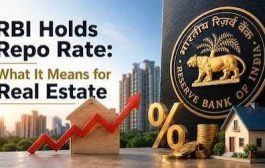
The Reserve Bank of India’s Monetary Policy Committee (MPC) has kept the repo rate unchanged at 5.25 percent for the fourth consecutive review, a decision announced by RBI Governor Sanjay Malhotra following the Committee’s three-day meeting held August 3–5, 2026. The central bank retained its “neutral” policy stance, signalling that it will continue to watch domestic inflation trends and global economic developments before making any further move on interest rates.
For India’s real estate sector, which has increasingly come to treat monetary policy announcements as a bellwether for demand, the decision lands as welcome, if unspectacular, news: stability rather than stimulus, but stability that developers and homebuyers alike say they can plan around.
What the Rate Hold Means for Homebuyers
Because the bulk of floating-rate home loans in India are now linked to the repo rate through external benchmark lending rates (EBLR), an unchanged repo rate translates directly into unchanged home loan EMIs. Borrowers with existing floating-rate loans will see no immediate change in their monthly outgo, while prospective buyers gain a rare commodity in today’s market: predictability.
That predictability matters. With India’s GDP growth for the year projected at around 6.7 percent, real estate advisors say the combination of steady borrowing costs and continued economic momentum should keep housing demand resilient across major micro-markets, particularly in the mid-income and premium segments.
Industry Reaction: Cautious Optimism
Reaction from developers and industry bodies has been consistently positive, framing the pause as a stabiliser for a sector that depends heavily on buyer confidence and financing certainty.
Kamlesh Thakur, President of NAREDCO Maharashtra, called the decision “a prudent approach amid global uncertainties,” adding that he expects housing demand to stay strong in both the mid-income and premium categories through the rest of the fiscal year.
Kaushal Agarwal, Chairman of The Guardians Real Estate Advisory, said the continuity in policy rates gives buyers “greater predictability,” and that with GDP growth holding near 6.7 percent, demand should remain robust across the country’s major cities.
Bhavesh Kothari, Founder and CEO of Property First Realty, echoed that sentiment: “A stable interest rate environment gives greater confidence to both buyers and developers, while supporting the housing sector’s long-term growth.”
Manan Joshi, Founder of Sarvam Properties, said a steady policy environment “helps maintain affordability and reinforces buyer confidence, particularly in emerging residential markets,” while Jash Panchamia, Executive Director of Jaypee Infratech Limited, noted that stable rates combined with healthy financing options should “sustain demand, particularly in mid-income housing.”
Not every voice was unreserved. Shraddha Kedia-Agarwal, Director at Transcon Developers, acknowledged that a rate cut would have offered a more direct affordability boost, but said the unchanged rate still “reassures consumers during economic uncertainty” and supports continued momentum in the premium and luxury segments. Shilpin Tater, Managing Director of Superb Realty, described the decision as balanced — giving developers room to plan with certainty while shielding homebuyers from any immediate uptick in lending rates.
Reading the Wider Policy Signal
The RBI’s fourth consecutive pause comes against a backdrop of broader regulatory activity in the housing sector this year. Real estate market trackers note that 2026 has been marked by tighter RERA compliance enforcement and a sharper focus on grievance redress mechanisms, reflecting a wider government push toward stronger developer accountability and buyer protection — themes that regulators and industry bodies alike have flagged as central to sustaining trust in the sector.
Taken together, a steady interest rate regime and continued regulatory tightening point to a real estate market that policymakers are trying to grow on a foundation of predictability rather than short-term stimulus. For a sector that has weathered volatile rate cycles in the past, that combination — even without a rate cut — is being read by most industry watchers as a net positive for sustained, healthier growth through the remainder of FY27.