
Written by Ai Powered PMC Akbar Jiwani :Special correspondent for realestate www.akbarjiwanipmc.com
## Introduction
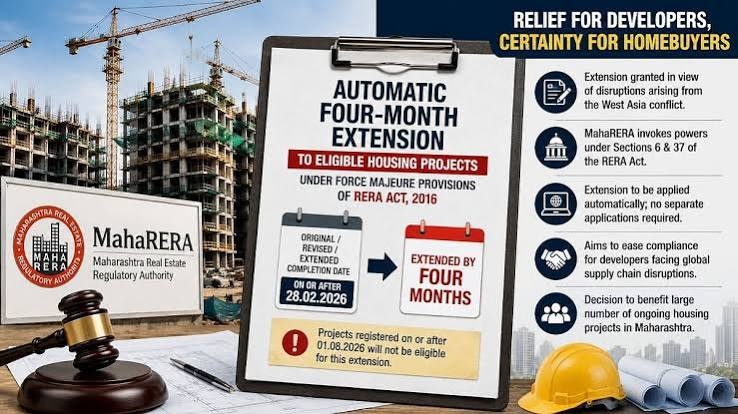
On 7 August 2026, the Maharashtra Real Estate Regulatory Authority did something it has done only sparingly in its nine-year history: it moved the finish line for thousands of housing projects at once. Invoking the force majeure provisions of the Real Estate (Regulation and Development) Act, 2016, MahaRERA extended the completion timelines of eligible registered real estate projects across the state by four months, citing the disruption to global supply chains caused by the ongoing conflict in West Asia.
The relief is automatic. Promoters do not have to file individual applications, and MahaRERA’s Registration and IT Cell has been tasked with updating project records and the public web portal to reflect the revised dates. For a state that accounts for the single largest concentration of RERA-registered housing supply in India, this is not a procedural footnote. It is a structural adjustment to how the market will read delivery promises for the rest of the year.
## Background: How a Distant Conflict Reached Maharashtra’s Construction Sites
The chain of causation is unusually well documented. The Department of Expenditure in the Union Ministry of Finance issued an office memorandum on 29 April 2026 treating the prevailing situation in West Asia as ‘war’ for the purposes of invoking the force majeure clause — a classification that carries weight across government contracting. That classification became the legal anchor for what followed.
On 31 July 2026, the Union Ministry of Housing and Urban Affairs issued an advisory asking all State Real Estate Regulatory Authorities to grant a four-month extension in the registration and completion timelines of eligible registered projects affected by the resulting disruption. Significantly, the Ministry recommended that state authorities issue a common order rather than process thousands of individual applications — a deliberate attempt to avoid the administrative bottleneck and litigation that piecemeal relief tends to produce. MahaRERA’s order a week later is the direct implementation of that advisory, and it sits alongside similar action by other state authorities, including Telangana’s TGRERA.
The mechanism itself is not new. Section 6 of the RERA Act permits extension of registration where completion is prevented by force majeure, and the sector has been here before. During the COVID-19 disruption, MahaRERA granted an automatic six-month extension with provision for a further discretionary three months, and treated the force majeure window as a moratorium for the purpose of computing delay. That precedent is instructive — and, as we shall see, contested.
## Current Developments: What the Order Actually Says
The eligibility test is a date test. Projects whose original completion date, revised completion date or previously extended completion date falls on or after 28 February 2026 receive the additional four months. Projects registered on or after 1 August 2026 are excluded — a sensible carve-out, since a developer registering after the disruption was already well known cannot claim to have been blindsided by it.
The scale is considerable. MahaRERA’s registry runs to tens of thousands of projects, and the Authority approved 10,379 real estate projects in FY2025-26 alone, a figure that covers new registrations, developer-requested timeline extensions and correction approvals. Nearly half of those approvals were concentrated in the Mumbai Metropolitan Region. Any blanket order in Maharashtra is therefore, disproportionately, an MMR order.
Industry bodies responded quickly and favourably. CREDAI president Shekhar Patel described the Centre’s advisory as a positive step in line with the sector’s ask, pointing to strained material and labour supply chains, and welcomed the common-order approach for ensuring uniform implementation across states. NAREDCO president Parveen Jain called it a balanced and much-needed step, urging states to implement it in letter and spirit to avoid unnecessary litigation. That last phrase is doing a lot of work, and deserves attention.
## Detailed Analysis: The Cost Curve Behind the Order
Force majeure relief is easier to justify when the underlying cost pressure is visible in the numbers, and here it partly is — though not uniformly. Material costs typically account for roughly 55 to 65 per cent of total construction cost in India, so shocks in that basket transmit quickly to project viability. Yet the picture through 2025 was mixed rather than uniformly inflationary: cement and steel prices were broadly soft, while aluminium and copper rose sharply on global demand. JLL has projected that construction costs across Indian asset classes will rise by three to five per cent in 2026.
The more persistent pressure is labour. Wage costs are expected to rise between five and twelve per cent following India’s new labour codes, which took effect in November 2025 and mandate improved social security, healthcare benefits and standardised wage structures. Read together, the picture is of a sector absorbing a slow, compounding squeeze on margins rather than a single dramatic price shock — with the West Asia disruption layered on top as an availability problem for specific imported inputs and logistics.
Financing conditions, by contrast, have been stable. The Reserve Bank’s Monetary Policy Committee, meeting on 5 August 2026 under Governor Sanjay Malhotra, held the repo rate unchanged at 5.25 per cent — the fourth consecutive pause, with elevated crude prices and global uncertainty cited among the reasons for caution. For developers, that means the cost of debt has not worsened; for buyers with repo-linked home loans, EMIs are broadly unchanged. Time, not money, is the variable that just moved.
## Benefits: Why the Order Makes Practical Sense
The strongest argument for the extension is that it substitutes an orderly, uniform administrative decision for a chaotic, case-by-case one. Without a common order, MahaRERA would have faced a wave of individual applications, each requiring scrutiny and each generating an appealable decision — consuming bandwidth that belongs to enforcement.
For developers, the relief removes the immediate threat of penalty and delay-interest exposure on projects whose slippage was genuinely attributable to supply disruption. That matters most for small and mid-sized promoters, who lack the balance-sheet depth to absorb both cost inflation and statutory interest simultaneously. Preventing distress at that end of the market is, indirectly, a homebuyer protection measure — a stalled project serves no one.
For the market as a whole, the order restores the credibility of published completion dates. A portal listing a date everyone privately knows is unachievable corrodes trust in the register itself. Resetting the dates transparently and on the record is preferable to letting a silent gap open between the register and reality.
## Challenges: The Homebuyer’s Legitimate Question
The obvious objection is that the buyer, who has done nothing wrong, absorbs the cost of a disruption she did not cause. Homebuyer groups have raised precisely this, demanding a waiver of interest on housing loans for the duration of projects granted force majeure extensions. The asymmetry is real: the developer’s clock stops, but the borrower’s EMI does not, and the rent-plus-EMI burden continues for four additional months.
There is also a real risk of over-claiming. A blanket date-based test cannot distinguish between a project genuinely dependent on disrupted imported inputs and one that was already years behind for reasons entirely unrelated to West Asia. The COVID-era experience is the cautionary precedent. Adjudicating authorities subsequently examined force majeure claims closely — in one widely discussed UP-RERA matter, the officer allowed roughly 476 days of justified delay after a detailed analysis of the actual restrictions, and then held the promoter accountable for the delay beyond it. Force majeure has been read as a shield for the period of genuine disruption, not as a general amnesty.
The legal architecture also remains intact beneath the order. Section 18 of the RERA Act continues to give an allottee the right to withdraw and claim refund with interest and compensation where possession is not handed over, or to claim monthly interest for delay if she chooses to stay in the project. The Supreme Court has also held that homebuyers may seek relief under both RERA and the Consumer Protection Act. An administrative extension recalibrates the reference date; it does not extinguish statutory rights, and NAREDCO’s warning about implementation ‘in letter and spirit’ is, read carefully, an acknowledgement that sloppy application will end up in tribunals.
## Expert Opinion
The considered view among practitioners is that the order should be read narrowly and applied honestly. The Centre’s own framing is instructive: the relief is directed at projects ‘affected by disruptions arising from’ the West Asia situation, and the date-based test is an administrative proxy for that condition, not a replacement for it. A promoter who invokes the extension while unable to demonstrate any actual supply-side impact is inviting scrutiny later, when an aggrieved allottee tests the claim before the Authority or an appellate forum.
The second observation is that documentation is now the developer’s cheapest insurance. Purchase orders, supplier correspondence on lead times, import invoices, evidence of material substitution and site-level progress records are what will distinguish a defensible force majeure position from an opportunistic one if the matter is litigated. Cooperative housing societies engaged in redevelopment — a large and growing share of MMR supply — should be asking their developers for exactly this evidence now, while it is easy to produce, rather than in three years, when it is not.
## Future Outlook
The demand side of the market gives little sign of flinching. Mumbai recorded 13,617 property registrations in July 2026, an 8.3 per cent increase year-on-year and the highest July figure in fourteen years, according to data from the Maharashtra Department of Registrations and Stamps analysed by Knight Frank India. Registrations rose from 13,413 in June, while stamp duty collections climbed from ₹1,086 crore in June to ₹1,223 crore in July — an 8.9 per cent rise over July 2025 and a 13 per cent sequential increase. Revenue growing faster than volume points to a continuing shift towards higher-value homes.
That combination — resilient demand, stable policy rates and a four-month cushion on delivery — suggests the extension will be absorbed by the market rather than disrupt it. The more interesting question is what happens at the end of the window. If supply chains normalise, the reset dates should hold and the episode will read as competent, pre-emptive administration. If disruption persists into 2027, the sector will return with a second request, and the Authority will face a harder decision: repeated extensions begin to erode the deterrent value of the deadline itself, which is the single most important thing RERA gave homebuyers.
## Practical Takeaways
For homebuyers, the first step is factual, not emotional: check the project’s MahaRERA page over the coming weeks and record the revised completion date the Authority publishes. Preserve the allotment letter and agreement for sale, which contain the contractual possession date, and note that the statutory right to interest for delay survives beyond the extended date. Where the delay predates February 2026, the extension does not retrospectively cure it.
For developers and promoters, the practical instruction is to treat the extension as a reprieve requiring evidence rather than a free pass. Update quarterly project progress reports accurately, communicate revised timelines to allottees in writing rather than letting them discover the change on the portal, and build a contemporaneous file on the specific supply disruptions the project experienced.
For managing committees of cooperative housing societies in redevelopment, this is the moment to convene the developer and reconcile three documents: the development agreement’s timeline, the MahaRERA-revised date, and the transit rent obligation. Extensions to the completion date do not automatically extend a developer’s liability for transit accommodation unless the agreement says so — and that gap is where society redevelopment disputes most often begin.
## Conclusion
MahaRERA’s four-month extension is, on balance, sound regulatory practice: a transparent, uniform, publicly recorded adjustment in response to a documented external shock, delivered through a single order rather than thousands of contested applications. It keeps the public register honest and prevents an avoidable wave of technical defaults.
Its legitimacy, however, will be determined entirely by how it is used. Applied to projects genuinely constrained by disrupted supply chains, it is proportionate relief. Applied as cover for delays that have nothing to do with West Asia, it becomes exactly the kind of dilution of accountability that RERA was enacted to end. Maharashtra’s homebuyers have every reason to accept the extension — and every reason to hold the industry to the promise implicit in it.