
Written by Ai Powered PMC Akbar Jiwani :Special correspondent for realestate www.pmcakbarjiwani.com
Introduction
For four decades, redevelopment in Mumbai followed a familiar script. An ageing cooperative housing society, tired of leaking slabs and rusted reinforcement, would invite developers. A builder would arrive with a glossy presentation, a promise of extra carpet area and a corpus cheque. The society would sign. And then — in an uncomfortably large number of cases — the members would wait. Sometimes for three years. Sometimes for fifteen.
In 2026, that script is being rewritten, and the pen is increasingly in the hands of the residents themselves. Maharashtra’s self-redevelopment framework — long discussed, frequently announced, rarely operational — has finally acquired the three things it always lacked: an institution, a balance sheet and a clock. A dedicated state Authority now exists. A ₹2,000 crore corpus sits behind it. And a single-window mechanism commits the government to clearing proposals within three months.
The result is a pipeline that no one in the industry can now dismiss as a niche experiment.
Background: Why Self-Redevelopment Exists at All
The arithmetic behind self-redevelopment is simple, and it has been obvious to society members for years. When a builder redevelops a plot, the developer captures the entire value of the incremental Floor Space Index — the additional construction potential unlocked by DCPR 2034 provisions, TDR loading and fungible FSI — and returns a slice of it to members as extra area and corpus. In self-redevelopment, the society itself is the developer. It borrows against its own land, appoints a project management consultant and a contractor on fee-based terms, sells the surplus flats, and retains the developer’s margin for its members.
The scale of the opportunity is not marginal. Across Mumbai and the wider Mumbai Metropolitan Region, more than 25,000 buildings are estimated to be eligible for redevelopment, representing a pipeline valued at over ₹30,000 crore. A substantial share of Mumbai’s building stock is now five to six decades old, much of it structurally distressed and increasingly expensive to merely maintain. Around 10,000 cooperative societies across Mumbai, Thane and Pune have signalled interest in redeveloping themselves rather than waiting for a developer whose interest may never arrive.
The policy scaffolding began with a Government Resolution in September 2019, which introduced a single-window scheme for self-redevelopment of registered cooperative housing societies. It was revived and reinforced subsequently, but for most of that period the framework remained more announcement than apparatus. Societies discovered that the binding constraint was never enthusiasm. It was money, and the absence of any single office accountable for saying yes.
Current Developments: The Authority, the Corpus and the Clock
The turning point came with Maharashtra’s new state housing policy, Majhe Ghar, Majha Adhikar — the state’s first comprehensive housing reform in roughly eighteen years, framed around a target of 35 lakh affordable homes by 2030. Within it, self-redevelopment was given a line item rather than a paragraph: a ₹2,000 crore allocation, and a mandate to create a dedicated self-redevelopment cell inside the housing department.
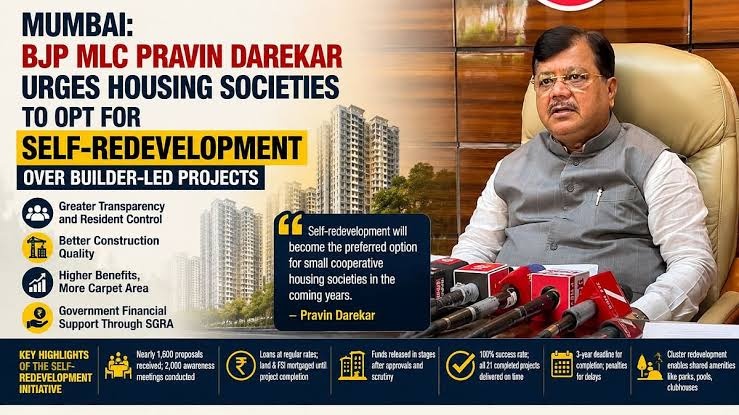
That cell has since matured into a full state Authority, chaired by BJP MLC Pravin Darekar, offering societies end-to-end guidance across project planning, financial structuring, contractor selection and execution. Darekar has publicly urged societies to choose the government-backed self-redevelopment route over conventional builder-led projects, arguing that the model delivers greater transparency, better construction quality and materially higher benefits to middle-class members.
Several operational changes have widened the gate:
The minimum plot area threshold has been reduced from 4,000 square metres to 2,000 square metres, bringing thousands of mid-sized standalone societies into eligibility for the first time. The consent threshold remains at 51% of members, aligned with the broader redevelopment norm for buildings aged 30 years or more. The Maharashtra State Cooperative Bank has been designated the nodal financing agency, operating through District Central Cooperative Banks. Under the revised rules, societies can access loans of up to ten times the assessed value of their land, based on a government-approved valuer’s report. Stamp duty on allotment of reconstructed flats to existing members is capped at a nominal ₹100 — a meaningful saving in a city where stamp duty is a serious line item. Interest on premiums payable to planning authorities was waived for such projects up to March 2026.
Uptake has followed. Roughly 1,600 society proposals are now active within the framework. Around 46 have secured sanctioned loans, and 21 projects have reached completion — a milestone marked earlier by Union Minister Piyush Goyal and Chief Minister Devendra Fadnavis at a key-distribution ceremony for fifteen self-redeveloped societies in north Mumbai.
Detailed Analysis: Reading the Numbers Honestly
The gap between 1,600 proposals and 46 sanctioned loans is the most important number in this story, and it deserves to be read carefully rather than spun.
It is not evidence that the model does not work. Twenty-one completed projects, with keys physically handed over, establish proof of concept beyond argument. It is evidence of a funnel that narrows sharply at the financing stage — and that narrowing has identifiable causes. Reserve Bank of India prudential norms restrict cooperative banks from deploying more than a defined proportion of their advances to this category of lending, which structurally limits how quickly the nodal channel can scale. Standalone self-redevelopment projects typically require ₹50 crore to ₹150 crore; cluster-scale schemes under DCPR 33(9) can exceed ₹1,000 crore. Those are institutional-finance ticket sizes being routed through a cooperative banking system with finite headroom.
The second constraint is pre-financing. Before a society can approach a lender, it must fund feasibility studies, structural audits, architectural proposals, legal title verification and premium payments. This early-stage expenditure — often ₹25 lakh to ₹1 crore — falls on members before a single rupee of debt is available. Many societies stall precisely here.
The third is governance. The 51% statutory consent threshold is necessary but rarely sufficient in practice. Experienced practitioners consistently observe that projects running below roughly 70% genuine member alignment during construction encounter disputes that damage both timeline and quality. Consent on paper is not the same as cohesion under stress.
Meanwhile, the demand backdrop is unusually supportive. Mumbai city under BMC jurisdiction recorded 80,221 property registrations in the first half of 2026, a 6% year-on-year increase and the strongest first-half performance since 2013, generating ₹6,968 crore in stamp duty. For a self-redeveloping society, that matters directly: the surplus flats it must sell to service its debt are entering a liquid market with broad-based demand rather than a thin one.
Benefits
The advantages compound. Members typically secure significantly larger additional carpet area than a builder-led deal would offer, because the developer’s profit margin is retained within the society. Control over specifications, contractor performance and timelines rests with an elected committee accountable to residents rather than with an external balance sheet. Transparency improves because the society’s own accounts, audited under cooperative law, record every rupee. The nominal ₹100 stamp duty and premium waivers reduce hard costs. And critically, the society retains ownership of unsold inventory and any residual development potential — an asset that in a builder-led transaction is signed away at the outset.
There is a civic benefit too. Self-redevelopment converts distressed, unsafe building stock into compliant, code-current housing without requiring the state to fund construction directly. In a city where structural collapse during monsoon is a recurring tragedy, that is a public-safety outcome as much as a property one.
Challenges
None of this makes self-redevelopment easy. The society assumes every risk a developer would otherwise carry: cost escalation, contractor default, construction delay, regulatory change, and the market risk on unsold flats. Managing committees composed of retired professionals and salaried members are being asked to supervise projects of a scale most have never encountered. Transit accommodation for two to three years imposes real financial and personal strain, particularly on senior citizens. Litigation from dissenting members, unresolved title defects, encroachments and tenancy complications can freeze a project indefinitely. And political ownership of the framework — while it has clearly accelerated momentum — introduces the risk that administrative energy fluctuates with the electoral cycle rather than with project pipelines.
Expert Opinion
The consensus emerging among practitioners in the MMR redevelopment ecosystem is that 2025–26 represents the most consequential structural shift in redevelopment dynamics in recent memory — not because self-redevelopment is a new idea, but because it has, for the first time, been given institutional plumbing.
The working view among consultants advising societies is that success correlates far more strongly with process discipline than with plot size or location. Societies that commission an independent feasibility and structural audit before appointing anyone, that engage a project management consultant on a fixed professional fee rather than a revenue share, that separate the roles of PMC and contractor, and that build consent well above the statutory minimum before signing anything, complete their projects. Those that reverse this order — selecting a contractor first and validating the numbers later — are the ones that appear in cautionary case studies.
The financing bottleneck, most observers agree, will need to be addressed through instruments beyond the cooperative banking channel: participation by housing finance companies, structured debt, and eventually a secondary market for society-level construction finance.
Future Outlook
Three developments are worth watching over the next twelve to eighteen months. First, whether the single-window commitment to clear proposals within three months holds under volume — the credibility of the entire framework rests on that promise being kept when applications run into the thousands rather than the hundreds. Second, whether the financing architecture is broadened beyond cooperative banks, which is the single highest-leverage reform available. Third, whether standardised, society-friendly documentation — model tender formats, model PMC agreements, model contractor contracts — is published by the Authority, since bespoke legal drafting is both a cost and a risk multiplier for lay committees.
If those three move, the pipeline of 25,000 eligible buildings converts from a statistic into a construction cycle. If they do not, self-redevelopment remains an excellent option for well-organised societies and an aspiration for everyone else.
Practical Takeaways
Societies considering the route should sequence their work deliberately. Begin with a structural audit and an independent techno-financial feasibility study before approaching any consultant with a commercial interest in the outcome. Verify title, conveyance and deemed conveyance status early, since financing cannot proceed without clean title. Confirm eligibility against the revised 2,000 square metre threshold and the 30-year building age criterion. Engage a project management consultant on a professional fee basis, and keep that appointment structurally separate from the contractor. Build member consent well beyond 51% before committing, and document dissent transparently. Approach the Maharashtra State Cooperative Bank channel through the relevant District Central Cooperative Bank, with the valuer’s report in hand. And budget honestly for pre-financing costs and transit accommodation — these are the two line items that most frequently surprise committees.
Conclusion
Self-redevelopment in Maharashtra has crossed the threshold from advocacy to administration. An Authority exists, money has been committed, thresholds have been relaxed, and twenty-one societies have keys in hand to prove it works. The framework is not yet frictionless — the distance between 1,600 proposals and 46 sanctioned loans is a candid measure of how much plumbing remains to be laid. But for the first time, a middle-class cooperative housing society in the MMR can look at its ageing building and see a route that does not begin with surrendering its land to someone else’s balance sheet. In a city built on the leverage of land, that is not a small thing. It is a redistribution of who gets to capture the value of Mumbai’s own regeneration — and it is happening now.
8. Key Takeaways
Maharashtra’s self-redevelopment framework now has institutional form: a dedicated state Authority chaired by MLC Pravin Darekar, a ₹2,000 crore corpus under the Majhe Ghar, Majha Adhikar housing policy, and a single-window commitment to clear proposals within three months.
Eligibility has widened sharply — the minimum plot threshold has been cut from 4,000 sq m to 2,000 sq m, with a 51% member consent requirement for buildings 30 years and older.
Financing has been restructured: the Maharashtra State Cooperative Bank is the nodal agency through District Central Cooperative Banks, and societies can borrow up to ten times their assessed land value on a government-approved valuer’s report.
Around 1,600 society proposals are active, with 46 loans sanctioned and 21 projects completed — proof of concept established, but a visible bottleneck at the financing stage.
More than 25,000 buildings across the MMR are estimated eligible, representing a pipeline exceeding ₹30,000 crore; roughly 10,000 societies in Mumbai, Thane and Pune have signalled interest.
The binding constraints are pre-financing costs, RBI limits on cooperative bank exposure to this asset class, and member cohesion — 51% consent is statutory, but practitioners consider 70%+ alignment necessary in practice.
Market conditions are supportive: Mumbai recorded 80,221 property registrations in H1 2026, up 6% year-on-year and the strongest first half since 2013, with ₹6,968 crore in stamp duty collections.
Societies should sequence carefully — structural audit and independent feasibility first, title and conveyance verification second, a fee-based PMC kept separate from the contractor, and consent built well above the statutory minimum before signing anything.
9. Conclusion
Self-redevelopment in Maharashtra has crossed the threshold from advocacy to administration. An Authority exists, money has been committed, thresholds have been relaxed, and twenty-one societies have keys in hand to prove it works. The framework is not yet frictionless — the distance between 1,600 proposals and 46 sanctioned loans is a candid measure of how much plumbing remains to be laid. But for the first time, a middle-class cooperative housing society in the MMR can look at its ageing building and see a route that does not begin with surrendering its land to someone else’s balance sheet. In a city built on the leverage of land, that is not a small thing. It is a redistribution of who gets to capture the value of Mumbai’s o