








Kathmandu- The distribution of relief materials sent by different countries to the earthquake victims are not reaching the people is despair and need. The local residents are appealing through their Facebook accounts to donor agencies to donate directly to the people. According to one such post it says the Government was expecting money in terms of help but when relief materials started pouring in the were least intrested in distribution an has been lying in Government stores.
A video shows some ministers being stoned and throwing water bottles b the local people. It shows their anger and anguish. Another posts has photgraphs of top 6 politicians who after the earthquake are not be seen anywhere. Speculation is rife that they must have fled to foriegn countries not wanting to take the burden on their shoulders.

KATHMANDU: A 15-year-old boy was rescued alive after spending 120 hours buried under debris of a collapsed building in Gongabu, giving search and rescue workers a renewed hope today that there are still chances of saving more people.
Pemba Lama Tamang, 15, of Nuwakot was among many people who were either killed or trapped under the wreckage of a seven-storey building that housed four guest houses. The teenager used to be a dishwasher in Hilton Guest House. “I was resting near a counter of the guest house after the morning’s work. All of a sudden the building started shaking and guests, staff and I ran down. But it was too late to escape. The building crumbled and I was trapped in a crater formed by the debris,” he recounted.
Tamang said he spent six days praying and hoping for a new lease of life. “I was lucky that two cans of ghee were lying nearby and I fed on ghee. I found a piece of cloth soaked with rain and squeezed a few drops of water to drink,” he told mediapersons from Israeli Field Hospital set up on the premises of Shree Birendra Hospital, Chhauni.
A special search and rescue team of Armed Police Force backed by the US experts had pulled Tamang out of the debris at around 11.55am after hours of arduous efforts. The rescue workers, led by Inspector Laxman Bahadur Basnet, sensed a peculiar sound from under the debris while using a sniffer dog before they confirmed someone alive there and pulled him out alive.
This triggered a celebration among the APF personnel and onlookers. The APF teams have managed to rescue as many as 330 persons, including 245 in the Kathmandu Valley so far, said DSP Ajaya Chhatkuli.
The jubilant search and rescue workers gave Tamang water and rushed him to the hospital for treatment. An Israeli doctor attending Tamang said none of his family members showed up in the hospital to visit the boy.
Ohad Horsandi, a senior official from the Ministry of Foreign Affairs, Israel, who is coordinating the hospital management, told THT, “The boy was dehydrated and exhausted but is in high spirits now. He does not have any bodily injuries. It shows that chances of pulling trapped persons alive from debris are still there even after ‘Golden Window’ period, the first 72 hours after the earthquake, is over. I love to call him a Super Hero.” Tamang’s mother works in Kuwait and the boy does not know anything about his father. He came to Kathmandu three years back and worked as a tempo and microbus helper before joining the guest house last month.
– See more at: http://thehimalayantimes.com/fullNews.php?headline=Teenager+pulled+out+alive++five+days+after+earthquake&NewsID=453374#sthash.gTSaUglK.dpuf

KATHMANDU: The death toll from the April 25 earthquake has crossed 5,858 as search and rescue teams continue their efforts to pull people dead or alive from the debris of collapsed structures. According to National Emergency Operation Centre under the Ministry of Home Affairs, another 13,827 people treated with injuries they suffered after being crushed under the rubble. At least 34 districts were affected by the earthquake.
Relief has not reached even within 5-7kms of Kathmandu Valley.Four villages south of Swyombhu are still awaiting relief where most of the houses were destroyed on Saturday’s deadly tremor. According to local residents not a single government employee or any reporter have entered their village.
A Facebook post posted by a local resident of Kuelshwar requests all foreign countries eager to help Nepal in terms of materials and food not to directly give it to the Government. They want it to be channelized through local NGOs or local residents. The Facebook posts says due to the corrupt Government the needy people will not receive these supplies for whom it actually meant for.
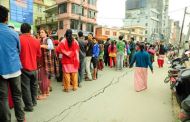
The number of tents required is far more then what is available for the survivor”s of the earthquake in Nepal. People have simply not been able to gather their courage to live in their houses due to fear of another likely tremor. According to estimates half a million more tents are required.
Relief materials are underway but more is required and the distribution system has not been efficient according to local residents. In Kuleshwore according to Shree Krishna Shahi nine houses have been affected but relief materials have not reached so far.
The local newspapers of Nepal are filled with criticism of the way things are handled aftermath of the earthquake. The number of homeless people is not accounted for so far but the government has so far provided 4,700 tents and 22,000 tarpaulins. Help has been pouring in from India, Thailand and Pakistan.

New Delhi, Apr 30 (PTI) Extending its winning run for the third straight day, gold prices were up by another Rs 55 to trade at over three-month high of Rs 27,475 per ten grammes at the bullion market today on sustained buying by jewellers to meet wedding season demand amid firming trend overseas.
Silver, however, met with resistance and traded lower by Rs 200 to Rs 37,400 per kg.
Traders said continued buying by jewellers, driven by ongoing marriage season and a firming global trend mainly boosted the sentiment here.
Gold in London, which normally sets price trend on the domestic front, rose by 0.17 per cent to USD 1,206.60 an ounce and silver by 0.57 per cent to USD 16.63 an ounce.
Besides, deprecating rupee against the dollar that made the imports costlier and shifting of funds from weakening equity also supported the uptrend, they added.
In the national capital, gold of 99.9 and 99.5 per cent purity gained Rs 55 each to Rs 27,475 and Rs 27,325 per ten gramme, respectively. It had gained Rs 370 in the previous two sessions.

New Delhi, Apr 30 (PTI) The Lok Sabha saw protests by the Congress and Aam Aadmi Party over an incident in Moga area of Punjab in which a 13-year-old girl died and her mother was seriously injured after they jumped out of a moving bus to escape molestation.
Members of both the parties from Punjab stormed the well of the House denouncing the Akali Dal-BJP government in the state over the law and order situation.
Ravneet Singh Bittu and Santokh Chaudhary (Congress) Dharmveer Gandhi and Bhagwant Mann trooped into the Well after their efforts to raise it were unsuccessful.
Speaker Sumitra Mahajan said they could raise the issue during Zero Hour in the evening.
As the protests were unrelenting, the Speaker adjourned the House for five minutes.
Reports said the girl and her mother jumped off a moving bus in Punjab’s Moga district to avoid being sexually assaulted by the conductor’s assistant, after the driver refused to stop the bus and the conductor did not come to their help.

New Delhi, Apr 30 (PTI) The 24-hour transport strike began today, affecting normal life in several parts of the country including in Kerala and Karnataka, even as the Centre asked private operators and employees of state transport authorities to call off their strike.
In Kerala, public transport buses, taxis and auto- rickshaws were off the roads, although private vehicles were plying.
The strike has been called jointly by national level road transport organisations representing both public and private sector workers which are affiliated to central trade unions like AITUC, CITU, BMS, INTUC, HMS, AICCTU, LPF and state-level outfits in protest against the proposed Road Transport and Safety Bill, 2015.
Road Transport and Highways Minister Nitin Gadkari appealed for calling off the strike, terming their concerns as ‘premature’. He said that wide consultations would be held with all stakeholders on the bill.
Commuters in Thiruvananthapuram, who depend on Kerala State Transport Corporation buses, had tough time reaching their work places as the buses did not operate.
No untoward incident has been reported from any part of the state since the strike began at midnight last night.
Examinations being conducted by various universities in the state have been postponed due to the strike.
Services of public transport buses and auto rickshaws were also affected in different parts of Karnataka.
Incidents of stone pelting on public transport buses were reported from different parts of the state including Bengaluru, Hubballi, Bellary and Raichur, Mysuru.
Transport department officials said they are plying buses based on the requirement as the number of passengers coming to bus stands is scarce, adding that they are also trying to convince the employees to attend to duty and not to cause hindrance to public. .

Washington, Apr 29 (PTI) The threat of landslides and mudslides remains high in the earthquake-hit Nepal in the coming weeks, and the risk is likely to increase when the monsoon rains arrive this summer, scientists have warned.
The region at highest risk for landslides and mudslides is the mountainous area along the Nepal-Tibet border, north of Kathmandu and west of Mount Everest, directly above the fault rupture, according to researchers at the University of Michigan (U-M).
U-M geomorphologist Marin Clark and two colleagues have assessed the landslide hazard in Nepal following Saturday’s magnitude-7.9 earthquake.
They looked for locations where landslides likely occurred during the earthquake, as well as places that are at high risk in the coming weeks and months.
The analysis found tens of thousands of locations at high risk, Clark said.
“The majority of them, we expect, have already happened and came down all at once with the shaking on Saturday,” she said.
“But there will still be slopes that have not yet failed but were weakened. So there will be a continued risk during aftershocks and with the recent rainfall, and again when the monsoon rains arrive this summer,” said Clark.
Information from the U-M-led study is being used to help prioritise both satellite observations and the analysis of data from those satellites, said Clark, an associate professor in the U-M Department of Earth and Environmental Sciences.
“The satellites looked first at places where lots of people live, including Kathmandu and the foothills areas to the south,” Clark said.
“Those areas do not look significantly impacted by landsliding, but we’re worried about the high country,” she said.
The highest-risk zone is at elevations above 8,200 feet in a region that covers 17,550 square miles.
Cloud cover has blocked observation of much of that region since Saturday’s earthquake, said Clark.
But news stories and social media reports of landslides in Nepal’s Gorka District and Langtang Valley are consistent with the team’s assessment, which showed that those areas are at high risk, she said.
Remote villages are scattered throughout the high-risk zone, which also contains the main highway that connects Kathmandu and Tibet. The area is popular with trekkers and mountaineers, as well.
The team’s assessment of the landslide risk was based on a computer analysis that looked at earthquake shaking, slope steepness and the strength of various rock types.
The death toll in Nepal’s devastating earthquake has crossed 5,000 with more than 8,000 people injured.
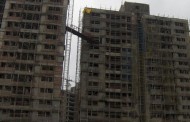
While devastating earthquake in Nepal and parts of India, right up to Delhi, has sent a stark natural reminder about following the safe and secure living structures, the growing urbanisation is leading to high growth in the high rise buildings, with Mumbai having the maximum number of buildings with 16-25 floors and upwards.
According to a joint Assocham-DTZ study on “Sky is the limit: High Rise building- safety, Security & Disaster Management”, the average number of floors in commercial high rise buildings of Delhi-NCR, Mumbai and Bengaluru are 6 to 15. In the next higher segments of 16 to 25 floors and 26 to 35 floors, Mumbai has higher number of buildings as compared to Delhi-NCR and Bengaluru.
With the growing urbanization, both commercial and residential segments have witnessed a high growth rate with respect to high rise buildings. The residential segment makes up for ? of the total high rise stock in the three major cities of the country- Delhi-NCR, Mumbai and Bengaluru, reveals the joint study.
Mushrooming growth of high rise buildings has raised new security and safety concerns, especially in the backdrop of the latest devastating tragedy in Nepal and parts of eastern India. “It is a new challenge which must be faced in a holistic manner so that as a nation, we remain alert and well -prepared to brave any natural calamity with minimum or no less,” Assocham Secretary General D S Rawat said in a statement while releasing the study.
Three metro cities of Delhi-NCR, Mumbai and Bengaluru have the highest concentration of high rise buildings and fall under seismic zone IV (high damage risk zone), III (moderate damage risk zone) and II (low damage risk zone) respectively, according the study.
As per the National Building code of India, India is divided into five seismic zones. The zone V is the highest risk zone where earthquakes of having intensity of 9 plus on the Richter scale can take place. Earthquakes of intensity 8 to 9 can be experienced in zone IV whereas earthquake can occur between 6 and 8 on the Richter scale in zone III of India.
“Mumbai has the maximum stock of high rise commercial buildings due to the severe space crunch in the city. The city has no option but to grow vertically to accommodate future urbanization because of lack of open space. The residential high rise buildings have also displayed a similar growth trend to commercial high rises,” adds the study.
Similar to commercial segment, the average number of floors in residential high rise building is 6 to 15 floors. However, residential is also seeing appetite for scaling more heights. Mumbai contributes 75% of total stock of residential buildings with 16 to 25 floors and 91% of total stock of residential buildings with 26 to 35 floors in Delhi-NCR, Mumbai and Bengaluru.
The paper points out that no development is complete without ensuring its safety. What is the point of creating a world class infrastructure without safety and security? Safety of people is of paramount importance as these vertical heights are being achieved and created by them and for them.
Rawat further said, to be better prepared and to mitigate we need a large pool of human resources both in the Government and non-government sectors and there is a great need for effective training and capacity building activities. Besides international best practices, there are several good practices in the country and variety of measures that needs to be shared. Additionally, issues of up-scaling will have to be addressed.
“Not only tier-I but tier II and III cities such as Bhubaneshwar, Chandigarh, Lucknow, Gwalior, jaipur, Nagpur, Meerut, Kochi, Indore, Patna, Gaya, Ranchi and Udaipur are also going vertical especially in the residential space. A large number of IT/ ITES companies are moving to Tier II and III cities in search of cheaper real estate and manpower. This will drive the demand for commercial as well as residential real estate. Most of the builders have launched high rise residential projects in these cities on the back of growing demand,” highlighted the study.
As per the National Building Code of India all high rise buildings should have the following attributes to be earthquake-resistant:
Good Structural Configuration: Its size, shape and structural system carrying loads are such that they ensure a direct and smooth flow of inertia forces to the ground.
Lateral Strength: The maximum lateral (horizontal) force that it can resist is such that the damage induced in it does not result in collapse.
Adequate Stiffness:Its lateral load resisting system is such that the earthquake-induced deformations in it do not damage its contents under low-to-moderate shaking.
Good Ductility: Its capacity to undergo large deformations under severe earthquake shaking even after yielding, is improved by favourable design and detailing strategies.
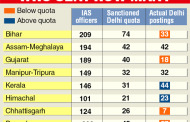
New Delhi, Apr 29 (PTI) The Centre has offered to send its officers on deputation to north eastern states to help them overcome manpower shortage and execution of policy decisions.
“I understand that you have acute shortage of officers at middle level due to low intake of officers in civil services from 1992 to 2006.
“The state governments may like to utilise the experience of the Central Secretariat Service (CSS) officers at appropriate level on deputation basis,” Department of Personnel and Training (DoPT) Secretary Sanjay Kothari said in a letter to chief secretaries of Tripura, Nagaland, Mizoram, Meghalaya, Manipur, Assam, Arunachal Pradesh and Sikkim.
The CSS is one of the earliest organised services in the country and is an important constituent of the central government machinery.
Officers of the service provide a strong and permanent set up of middle level functionaries to the central government and contribute in policy formulation and its execution.
“The arrangement will enrich the officers with the required field experience at ground level in the execution of various schemes and policies and make them understand issues in a better way which will in turn improve their capacities,” Kothari said.
He has asked the state governments willing to take CSS officers on deputation to identify vacancy and tenure of posting and convey the same to the DoPT.
“This department will circulate the vacancies among CSS officers and nominate a panel of selected officers for deputation to state government and you can choose the suitable officer from the panel,” the letter said.
There are about 2,200 Group A CSS officers.





Recent Comments