







Saudi authorities have been blamed for the stampede during the Hajj pilgrimage which killed at least 717 people, in the worst tragedy to strike the annual Muslim pilgrimage in a quarter-century.
The disaster, which also injured several hundred people, was the second deadly accident to hit worshippers this month, after a crane collapse in Mecca killed more than 100.
The stampede broke out in Mina, about five kilometres from Mecca, during the symbolic “stoning of the devil” ritual.
Hajj deaths by nationality
Algeria: 4
Benin: deaths confirmed but number unspecified
Burundi: 1
Cameroon: 20
Chad: 11
Egypt: 14
Iran: 131
India: 14
Indonesia: 3
Kenya: 3
Morocco: 87 (according to state media)
Netherlands: 1
Niger: 19
Nigeria: 3
Pakistan: 7
Senegal: 5
Somalia: 8 (according to local media)
Tanzania: 4
Saudi authorities have yet to provide an official breakdown, but several foreign countries and their media have announced the deaths of nationals. Source: AFP
Saudi Arabia categorically denied reports the crush happened after roads were closed to let a convoy of dignitaries through.
The Saudi Interior Ministry said the claim was malicious and untrue and Iranian state media appeared to have started the rumour.
Iran, which said 131 of its nationals were among the victims, accused regional rival Saudi Arabia of safety errors and organised an anti-Saudi demonstration over what it said were flawed safety measures that led to the tragedy.
“Saudi Arabia is incapable of organising the pilgrimage,” said Ayatollah Mohammad Emami Kashani, leading the main weekly Muslim prayers in Tehran.
“The running of the Hajj must be handed over to Islamic states.”
Saudi Arabia’s King Salman earlier ordered “a revision” of how the Hajj is organised, state news agency SPA said, so that pilgrims could “carry out their rituals in complete safety”.
A formal inquiry is underway.
Iran’s first vice president Eshaq Jahangiri said other nations should have a role in the investigation.
“Countries such as Iran, which have suffered so much, should be represented in the inquiry to determine the causes of the catastrophe and to gain assurances that it will not be repeated in the future,” he said.
After the prayers in Tehran, worshippers held a protest against the “mischievous and incompetent regime” in Riyadh, said the Islamic Propagation Coordination Council which organises state-sponsored demonstrations in Iran.
Shiite Iran and Sunni Saudi Arabia are bitter rivals whose relations are already strained by regional conflicts from Syria to Yemen.
The custodianship of the Muslim holy places forms a key plank in the Saudi monarchy’s claims to legitimacy.
Pilgrims at the scene in Mina faulted Saudi authorities and some said they were afraid to carry on with the Hajj rituals.
However, they said security had improved and the crowd was smaller.
Special emergency forces were heavily deployed across Mina with dozens of troops at every level of the five-storey bridge used for the stoning ritual in which pebbles are thrown at pillars.
How does a stampede happen?
The deaths of hundreds in a stampede during the annual Hajj pilgrimage raises the question: how does a stampede happen, especially during a peaceful religious gathering?
A Kenyan survivor who returned to the pillars on Friday said his group lost three people.
“I can blame the Saudi government because they did not control [the situation]. I was there. I survived,” Isaac Saleh said.
Aminu Abubakar, an AFP correspondent who was among the pilgrims when the stampede occurred, said there was no room to manoeuvre. He escaped the crush of bodies because he was at the head of a procession.
Fellow pilgrims told him of children dying despite parents’ efforts to save them near the sprawling tent city where they are lodged.
“They threw them on rooftops, mostly tent-tops … Most of them couldn’t make it,” Abubakar said.
Saudi Arabia ‘capable of managing Hajj’, health minister says
During weekly prayers at Mecca’s Grand Mosque, Sheikh Saleh al-Taleb defended the kingdom which, he said, “is capable of managing Hajj affairs” without outsiders suggesting they can do better.
“It is unacceptable to ignore all the efforts” the kingdom has made to improve infrastructure at the holy sites, he said.
Saudi health minister Khaled al-Falih, whose country has spent billion of dollars on safety measures at the Hajj, blamed worshippers themselves for the tragedy.
He told El-Ekhbariya television that if “the pilgrims had followed instructions, this type of accident could have been avoided”.
Pilgrims, however, blamed the closure of roads and poor management of the flow of hundreds of thousands of pilgrims in searing temperatures.
“People were stumbling, falling, trying to get up. They were dehydrated, getting disorientated, they were dying in front of our eyes,” witness Zaid Bayat said.
“They were suffocating. We tried to help revive them, but for every person you were helping there were 13, 14 others just falling down.”
Foreign Affairs Minister Julie Bishop extended the Australia’s condolences to the families of those killed in the Hajj pilgrimage stampede.
In a statement Ms Bishop said she was deeply saddened to hear of the tragedy and terrible loss of life.
Saudi authorities said they did not know of any Australians who had been affected.
Gallery: Muslims travel to Mecca for the Hajj pilgrimage

Co-founders of Flipkart, Sachin Bansal and Binny Bansal are the newest entrants in the Forbes list of richest Indian billionaires. With a net worth of $1.3 billion the Bansals debuted at the 86th position in the list, according to Forbes.
Binny Bansal is the youngest in the list at 32 years of age.
Here is a timeline of the Bansal Brothers’ journey:
2007: Alumni of Indian Institute of Technology, Delhi, Binny Bansal and Sachin Bansal founded Flipkart in October 2007. Initially, the e-tailer sold only books. Before starting the company the duo worked in Amazon.com.
2008: The portal went online and started selling books online. Now, Flipkart is India’s largest online bookstore selling more than five lakh books since its inception, according to media reports. Bansal said, “We sell a book a minute.”
2009: Flipkart raised funds worth $1 million from venture capital funds Accel India.
2010-2011: The e-tailer raised funds worth $10 million and $20 million from Tiger Global in the year 2010 and 2011 respectively.
2011: Flipkart launched pre-paid wallet to store money online. This feature allows shoppers to shop online and store money on the site and use it to purchase items without using their credit or debit cards for transactions.
It was an initiative to make online payments easier and more secure for customers.
2012: The portal raised around $150 million which was its fourth round of funding from MIH which is a part of Naspers Group and ICONIQ Capital.
2012: The company launched Flyte, an online digital music store. Flyte was a one-stop shop for all kinds of music in all languages. Music was available at a price ranging from Rs 6 to Rs 15 per song on the platform.
2013: The company raised around $200 million on July 2013 from its existing investors which includes Tiger Global, Naspers, Accel Partners and ICONIQ capital.
2013: Flipkart launched seller marketplace which is essentially a virtual mall where shoppers get access to all the brands at one place. Reports say that customers even got to compare sellers and get the best prices for various products.
2013: Flipkart shuts Flyte– This move raised a lot of questions to which Flipkart said that the company shut Flyte because it was running at a loss and when music was available for free, people didn’t want to pay for it.
2013: Launched PayZippy, an online payment solution for its Indian merchants. With PayZippy, online and mobile payments became easy and handy without entering card details, name or billing address every time.
2013: Flipkart raised $360 million from its existing investors.
2013: Flipkart launched an Android app for its customers which offered them with an ability to browse and purchase products from their smartphones. It allowed them to navigate through different products and departments from books, entertainment, accessories and more.
2014: Flipkart hits $1 billion in annual Gross Merchandise Value (GMV). The company reportedly reached this goal which was supposed to be achieved by 2015.
2014: In its strategic investment, Flipkart shuts PayZippy and invests in Ngpay.
2014: Flipkart acquires Myntra in an estimated $300 million deal. This deal was marked as its biggest consolidation in the e-commerce space.
2014: Big Billion Sale– Flipkart started Big Billion sale for its customers where mobile phones and tablets were sold at its lowest prices available. Although there were some glitches reported with the website, the company managed to sell products worth Rs 650 crore in 10 hours.
2014: Flipkart raised a total of $1.91 billion funding form its investors.
2015: The company claimed 150% sale growth on August 10. The company said that it has sold 150 million products till date.
2015: Flipkart launched Ping on August 15, which lets people chat with their friends using the app. It even lets people share photos, wishlists and products in the cart with friends.
2015: E-commerce major Flipkart’s co-founders Sachin Bansal and Binny Bansal, along with some others investors, invested $3,50,000 in real estate start-up ‘Plabro Networks’.
2015: On September 22, Flipkart appoints Dan Rawson from Amazon, Ravi Byakod from Google and Anand Lakshminarayanan from Microsoft.
2015: Binny Bansal and Sachin Bansal made it to the Forbes list of top Indian billionaires.
The company has set the target to reach a GVM of $8 billion, add 100,000 sellers on its platform and sell 25 million products per month by the end of 2015.The company is also said to have set a target of selling 1 billion goods in a year by the end of 2017.
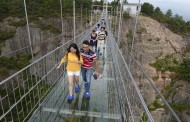
New glass-bottomed suspension bridge has opened today at Shiniuzhai Geopark in Hunan, central China
It’s the world’s longest glass-bottomed walkway at 984 foot long and is 590 foot above the canyon below
11 engineers were involved in transforming bridge from a normal wooden one into the new construction.
A group of brave tourists learnt the meaning of vertigo the hard way as they became the first visitors to cross a new 590 foot high glass-bottomed suspension bridge in China.
This spectacular structure, the first of its kind in the world, is situated in the province of Hunan, reported People’s Daily Online.
Images have emerged online showing the visitors gripped with fear and frozen in awe while standing on the see-through walkway. One female tourist is seen clutching to the handrail tightly and had to be dragged along by her friend.
The bridge had previously been a wooden overpass that linked two peaks of Stone Buddha Mountain in Shiniuzhai Geopark but is now a 984 foot long glass walkway.
Part of the bridge had already been replaced with a glass cutout in 2014, attracting hordes of fearless tourists.
However, 11 engineers have been working on the bridge over the last few months to replace all the wooden planks with glass panes, transforming the bridge into the world’s first glass-bottomed suspension bridge.
According to reports, several visitors were so terrified that they could barely move.
Some were seen holding on to each other as well as to the railings as they made the crossing.
Many people were gripped by fear as they tried not to look down to the steep drop below.
The bridge was said to wobble slightly when people walked across it, adding to the fear-factor of the frightening ordeal.
However, as part of the scenic site, it also offered incredible views over the geopark and the landscape below.
The amazing construction has already been dubbed ‘hero bridge’ because of the amount of courage required to cross it.
Those worried about the safety of the bridge can rest easy.
The glass panes forming the footpath are said to be 25 times stronger than regular window glass. They’re also created to stay in shape and withstand impact although special footwear has been issued to visitors.
n recent years, glass-bottomed walkways have become incredibly popular for Chinese thrill-seekers.
More and more tourism sites are constructing viewing platforms over steep vertical drops to attract visitors.
Most recently, a glass elevator opened at a scenic site in Hubei, central China, to allow visitors to reach the peak of the mountain quicker.
The elevator was situated next to a cliff-face and was a staggering 3,543 feet above sea level.
When visitors reach the top, they could walk along a glass-bottomed walk way along the cliff to further admire the views.
Earlier this year, a viewing platform in Chongqing, south-western China, became the world’s longest cantilever walkway with a glass bottom.
It’s a breath-taking 2,356 feet drop to the ground below.
Another bridge is currently under construction in Zhangjiajie, Hunan. It will be an astounding 984 feet above the canyon it’s built over.
The 1,247 foot long bridge will be able to accommodate 800 people at any one time when complete.
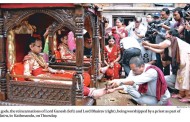
KATHMANDU: Indra Jatra, one of the biggest street festivals celebrated in the Kathmandu Valley, has started from Friday.
The festival begins after a long wooden pole was erected in front of Hanuman Dhoka in Basantapur Durbar Square.
The festival lasts for eight days with singing, mask dancing and rejoicing along with other rituals.
Indra Jatra festival falls on the fourth day of the waxing moon in the month of Bhadra as per the lunar calendar.
The festival is celebrated in the three districts of the Kathmandu Valley and in Kavre and Dolakha also.
Indra, the god of rain, is worshiped in this festival, and chariots of the living goddess Kumari and living gods Ganesha and Bhairava are pulled.
The festival is primarily celebrated by the Newar communities following both Hinduism and Buddhism.
Legends said that the Indra Jatra festival is observed to celebrate the victory of the gods over the demons to release Jayanta, the son of Lord Indra.
The government has announced public holiday in the Valley on Sunday to celebrate the festival.

May Allah bless you & Your dear ones for happy & prosperous life on Eid UL Azha & always from Real News of India Team
This year, it is starting from the evening of September 22 and will continue till September 23 evening. The festive day marks the end / finish / completion of the annual pilgrimage from Hajj to Mecca. It is the second of the two most celebrated festival and holidays by the Muslim community worldwide. It is observed on the 10th day of Dhul-Hijjah which is considered to be the last month of the Islamic calendar.
This is also known as the feast or festival of sacrifice as Eid ul-Adha is derived from the Arabic language in which Eid means festival and Adha means sacrifice. This day is observed to remember the sacrfice done by Prophet Abraham (Ibrahim).
The prophecy and mythology tells that God spared his son but replaced him with a sheep. Muslims usually sacrifice sheep, lambs, goats, rams, and other such animals since then. After sacrificing, the meat is usually divided into three parts. Family retains one, while one part is distributed among friends, relatives, neighbours and the third part is distributed among the poor and needy people.

A very big and organized syndicate is involved in stealing petrol and diesel from parked vehicles. This mod us operandi was unfolded by our Real News of India Editor in Chief S.M Fanus today.
The area where it happens on a daily basis is Government Colony, Y Building by a nearby garage, Rahul Auto Works.
The whole Operation
Private and Government vehicles bearing Maharashtra number plates come to this location. The driver parks the car and opens the bonnet. He then lingers around pretending not to know anything. Now a group of hoodlums of Rahul Auto Works comes around extracts the petrol from the petrol tank.
The driver of each vehicle gets Rs 40- Rs 50 per liter. Rahul Auto Works sells it for Rs 60 per liter. The whole operation can be viewed in you tube realnewsofindia .
Our Editor in Chief while clicking this operation was confronted by these hoodlums of Rahul Auto garage. S.M.Fanus called 100 Police help line. Babar a police constable from Khedwadi Police Station came to the site and started abusing and hitting our Editor in Chief.S.M. Fanus again called 100 to report that Babar was mishandling him. A police van came and arrested these hoodlums. The FIR was not filed for stealing petrol but for a fight that had occurred. The police is involved in this crime for more than two years. The stolen petrol is sold right in front of the cops.
While watching this video you can policemen wondering around the area. The police are paid for their involvement for acting naïve and protection.
So next time you see an open area for free parking do not get excited. Your petrol or diesel might disappear.

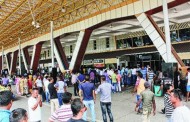
The Airports Authority of India has decided to build a boarding facility for passengers in transit at the Bagdogra airport by spending around Rs 12 crore.
The AAI officials posted at the airport today said they were waiting for the final approval for the project.
“We have decided to build a ‘transit accommodation centre’ for passengers at the airport. It will be a three-storied building and will have facilities like restaurants and rooms where people in transit can stay,” said Rakesh Sahay, the airport director of Bagdogra.
According to Sahay, the centre will have rooms which can accommodate around 20 people. “There will be restaurants, cafeterias, conference hall and space for airline companies. Anybody arriving at Bagdogra can use the facility and stay overnight in the rooms,” Sahay said.
“The project has been accepted by our superiors and has been sent to our headquarters for final approval. Once we receive the approval, we will go ahead with the project,” he added.
The centre, AAI sources said, will come up next to the office of the airport director, located a few metres away from the terminal building.
The decision to build the centre has been hailed by the residents, particularly the stakeholders of tourism industry.
“It would be an ideal facility for tourists, especially during strikes and natural calamities. There were several instances where we needed to reschedule itineraries of tourists. In such cases, it became troublesome for us to ferry tourists to the airport and vice versa,” said Samrat Sanyal, the executive president of the Eastern Himalaya Travel and Tour Operators’ Association.
Saugata Roy, a manager working in a private finance company, said the conference hall could be of immense help for corporates.
“Senior officials of different companies often pay brief visits to Siliguri. Meetings are held here and at many times, it has been found that a company official has to travel over 20km to Siliguri to hold a meeting before he takes a return flight from Bagdogra,” Roy said.
“Once the centre becomes operational, such meetings can be held at the conference hall planned at the airport. The dining and accommodation facilities would be added advantages.”
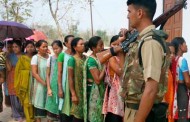
As agitations continue to spread in Assam against a recent central notification allowing non-Muslim (read Hindu) migrants from Bangladesh to settle even without any valid documents, the Centre, taking cue from the European countries, is considering dispersing them across several states instead of keeping them just in Assam. Highly placed sources in the government said the Centre is evolving a plan to distribute the non-Muslim Bangladeshi population to several states as Assam alone cannot bear such an enormous load of population. The plan seems to have also stemmed because of ruling BJP dispensation’s fear of political backlash in Assam against it for forcing native population to share finite land resources with “illegal migrants” that can have a bearing on the next year’s state assembly elections.
The Union home ministry notification of September 7 that allows persons belonging to minority communities in Bangladesh and Pakistan who entered into India on or before the 31st December, 2014 to stay on without any valid documents immediately sparked off agitations by over a dozen organisations in Assam, including All Assam Students Union (AASU) and Asom Jatiyatabadi Yuva Chhatra Parishad (AJYCP). They claim the notification is an abrogation of Assam Accord of 1985 that states that foreigners who came to Assam on or after 25 March, 1971 will be expelled. The Accord was arrived at on 15 August 1985 after a prolonged anti-Foreigners agitation in Assam.
“We are working out on the modalities and procedures of the distribution and will soon be talking to states about it to bring them on board. Hopefully, the states will see the reason and accommodate them,” said a senior official.
The Bangladeshi Hindu migrant population living in Assam alone is expected to be in several lakhs and has to distributed among close to a dozen states so that it does not become a troubling issue.
“We have a sterling example of European countries that have worked out a solution for accommodating thousands of refugees from Syria, Lebanon and other Asian and African countries. Why can’t it be done within a country,” said the official. However, the decision to issue a notification seems to have been taken in a rush without working out modalities of distributing the migrants across the country as the Centre is has not made any guidelines, procedures or methods of detecting people from minority communities in the neighbouring countries. “We are asking all such people to report to the Foreigners Regional Registration Officers (FRROs) but we do not have an estimate of the numbers yet,” an official said.
Moreover, the government is yet to decide the status of these people as they are neither refugees nor citizens but have been simply allowed to stay on.

At 468ft in length, with ship masts nearing 300ft high, ‘Sailing Yacht A’ is the world’s biggest sailing ship
The yacht has been built for Russian billionaire Andrey Igorevich Melnichenko out of a German shipyard
Cruise speed is 18mph, with a top speed of 24mph. The hull is made of steel, with a teak-finish deck
Superyacht expert tells MailOnline that it will be ‘very significant ship’ once the interior work is completed
Mr Melnichenko, whose net worth is estimated at £6billion ($9billion), founded the fertilizer producer EuroChem
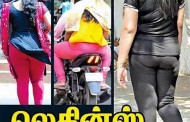
A controversy erupted on social media recently when an alleged list of no-nos for girls in Sri Sai Ram Engineering College was circulated on the Internet. The college refuted the allegation calling the circular fake. The list included leggings.
Now, a popular Tamil magazine, Kumudam Reporter, has done a cover story on leggings. The cover shows the backs of three women with the headline reading, “Are leggings obscene? Young women cross the line.” In no time, social media tweeted its outrage regarding the magazine and this story.
The article in the magazine stated that some women wore leggings in a manner that was obscene (e.g. too tight or did not cover them well). As a result, the article adds that it makes some men gawk, ogle and stare.
The magazine used photos of women wearing long kurtas with their leggings on its cover and along with the article. All the photos seem to have been taken when their kurtas were lifted in the air thanks to the wind.
Some of the tweets:
Aparna Jain @aparna_jain
Every woman should wear leggings, pull up shirt,stick out butt & send photograph to Kumudam saying “Decency is a state of mind”
9:11 AM – 23 Sep 2015
Shiva Jayashankar @adyarite
Horribly sexist, regressive & completely inappropriate – photos shot without the women’s knowledge. #kumudam #shame
9:00 AM – 23 Sep 2015
Razim Mohammad @Rasamsadham
What a sexist, violating post created by Kumudham. Disgrace! @Kumudam_Com



















Recent Comments