





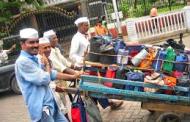
A wave of joy spread among the dabbawallahs in Mumbai, as Prime Minister Narendra Modi on Thursday nominated the world-famous lot among nine people and organisations to take forward the Swachh Bharat Abhiyaan.
As soon as the news broke on television and word spread, the 5,000-odd dabbawallas, who deliver around 2,00,000 dabbas across Mumbai daily, began to celebrate. “By nominating us, the Prime Minister has gone beyond celebrities and business tycoons and encouraged hard-working ‘kaamgar’ (workers) like us. We are very thankful to him. It is a special moment for us,” said Subhash Gangaram Talekar, spokesperson of the Mumbai Dabey Wahatuk Mandal.
At around 11.15am, the time when these ever-busy men who ferry thousands of tiffin boxes across the city take a few minutes’ break, the dabbawallas celebrated their nomination by distributing laddoos. “It is a matter of pride for us. We are also aware of the fact that we now have a great responsibility towards the nation,” said Talekar.
Well known for their efficient and nearly error-free business model for 124 years, the dabbawallas said they won’t waste a moment and will carry out the drive as early as Friday. Again at 11.15am, hundreds of them will wield brooms and clean up the area around Lower Parel station.
“Our brooms and garbage bags will be ready at the station when we reach. We plan to complete our task in 20 minutes, as we cannot delay in supplying the dabbas,” said Bhasaheb Karvande, the association’s chairman.
Talekar said their contribution to the national cleanliness movement, launched by Modi on October 2, won’t end with the drive. “We will carry the message to all our clients every day. We all live in chawls and small houses, and have always seen our areas full of filth. We know that cleaning up the country is no mean task; it is a long and slow process,” he said.
![Online [Free Watch] Full Movie Bobbi Jene (2017)](http://www.realnewsofindia.com/wp-content/uploads/2014/12/Gujarat-cop-shakes-a-leg-190x122.jpg)

Bobbi Jene (2017)
| Release | : | 2017-09-22 |
| Country | : | United States of America,Denmark,Sweden,Israel |
| Language | : | English |
| Runtime | : | 95 |
| Genre | : | Documentary |

Synopsis
Watch Bobbi Jene Full Movie Online Free. Movie ‘Bobbi Jene’ was released in 2017-09-22 in genre Documentary.
A love story, portraying the dilemmas and inevitable consequences of ambition. It is a film about a woman’s fight for independence, a woman trying to succeed with her own art in the extremely competitive world of dance.
Streaming Movie Bobbi Jene
(2017) Online
Incoming search term :
Watch Bobbi Jene Full Movie Online Free Streaming In HD Quality, watch full Bobbi Jene movie, Watch Bobbi Jene 2017
Online Free Viooz, Watch Bobbi Jene 2017 Online Free, Watch Bobbi Jene 2017 Online Putlocker, film Bobbi Jene
online, Streaming Bobbi Jene 2017 For Free Online, streaming movie Bobbi Jene 2017, Bobbi Jene film trailer,
Bobbi Jene movie trailer, live streaming film Bobbi Jene 2017, Streaming Bobbi Jene 2017 Online Free Megashare,
movie Bobbi Jene streaming, Watch Bobbi Jene 2017 For Free online, film Bobbi Jene 2017 online streaming,
download Bobbi Jene 2017 movie now, movie Bobbi Jene 2017 download, watch full movie Bobbi Jene 2017, trailer
film Bobbi Jene 2017, Watch Bobbi Jene 2017 Online 123movies, Watch Bobbi Jene 2017 Online Free 123movie, Watch
Bobbi Jene 2017 Online Free Putlocker, movie Bobbi Jene 2017 trailer, Watch Bobbi Jene 2017 Online Free
netflix, watch Bobbi Jene film online now, Bobbi Jene 2017 movie streaming, Bobbi Jene 2017 Watch Online, Watch
Bobbi Jene 2017 Online 123movie, download movie Bobbi Jene, Watch Bobbi Jene 2017 Online Free megashare, watch
Bobbi Jene movie now, Watch Bobbi Jene 2017 Online Free hulu, Watch Bobbi Jene 2017 Online Viooz, live streaming
movie Bobbi Jene 2017, Bobbi Jene live streaming film online, movie Bobbi Jene 2017, Watch Bobbi Jene 2017 Online
Megashare.
This is the time of the year when millions across the globe pray for peace on earth. And no, this is not being said ironically. Surely, as the year winds down to a close, humanity can get together to celebrate the idea of peace, of hope, of compassion, no matter what one’s religious affiliations might be?
But this seems to be a futile wish.
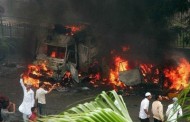
Even as people prepare to celebrate, in various ways, the end of the year, a bloodbath once more engulfs this land. In Sonitpur and Kokrajhar districts of Assam, suspected National Democratic Front of Boroland(S) killed innocent villagers, mostly Adivasis, when they opened fire on Tuesday.
Among the dead were women and young children.
And then the terror, and inevitably, the retaliation. The newspapers have pictures of people fleeing their homes, their possessions in little bundles on their heads. There is grief in their eyes, and horror. Frail men, young and old, arm themselves with nothing more lethal than fragile, primitive bows and arrows, against the modern guns used against them.
The death toll is 72 and rising, and retaliatory attacks are taking place, as expected. In these, and in police firing, seven more have been killed, bringing the total so far to 79.
And so it goes, endlessly. Horror piled on horror.
Around the year, across the globe, there have been numerous deaths at the hands of terrorists. These come to us via the media. Some get worldwide coverage, as well they should. Earlier this month, sending chills up the spines of all were the pictures of the attack on schoolchildren in Peshawar, Pakistan. That was perhaps a new nadir in human depravity, though who knows, even that point might soon be breached.
But some others terror attacks, such as the ones in Kokrajhar and Sonitpur, have hardly been noticed by mainstream media. Even though these assaults are equally horrifying, and deserving of condemnation in the strongest terms. It is not that media coverage will alleviate the sufferings of the survivors. But there is the hope that perhaps, if the rest of the world comes to know of it, there will be awareness of what is going on. And through awareness, perhaps, there will come condemnation, and ultimately, a refusal to tolerate this kind of terrorist attack by the larger communities of the world, in future.
And yes, it is a sorry thing when we weigh “gravity” and “importance” of the horrors around us, to allocate space in our papers and our electronic media. A violent death by a terrorist attack brings trauma and untold grief and misery in its wake, crippling the survivors and scarring them for life. But there is, today, a kind of “terror fatigue” which ensures that only the most gut-wrenching acts of terrorisms make it to the consciousness of the world. The other, numerous deaths by terrorist acts remain in the local media. There seems to be a hierarchy in this matter. This is a very sad, but very true fact of life.
This is a wretched commentary indeed on the state of the world today. Has civilisation reached such a low point that horrific acts must now jostle with each other for media space, each one more terrifying than the last?
We see that body counts matter, even in the space allocated to the news of deaths by terror attacks.
We see that location matters. A large number of deaths in a remote area, considered peripheral by the “mainstream”, merits less space than fewer numbers in a place deemed to be more “central”, therefore more “important”.
We see also that economic status matters. The rich, and the middle class get more media space if they become the victims of these attacks. As for the poor – well, even as pictures of lines of them fleeing their burning homes stream into our drawing rooms, one face merges into the next, one scream of terror begins to sound very much like another.
And that, too, is another aspect of the horrors of the times that we live in.

When last seen in public some 25 years ago, Dawood Ibrahim was a chubby man with oversized sunglasses and a droopy mustache. His fondness for betting on cricket matches and keeping company with Indian movie stars has attracted police investigations and tabloid headlines.
Ibrahim is also one of India’s most-wanted terrorists. He’s linked to bombings that killed hundreds of innocent men and women in his native country. India and the U.S. accuse him of financing Pakistani militants who killed hundreds more, as well as brokering a deal with al-Qaeda to allow the group access to his smuggling routes.
And all available evidence culled from accounts on the ground in India and Pakistan, buttressed by reports from the U.S. and United Nations, point to one conclusion: Ibrahim is living in Pakistan.
Just as Osama bin Laden’s death at a house down the road from the Pakistan Military Academy set off fierce debate about the nation’s commitment to fighting terrorism, Ibrahim has become a symbol of why Pakistan’s neighbors often don’t take its public statements about uprooting militants seriously.
The cost of that reluctance was underlined in blood last week when Pakistani Taliban militants murdered 152 people, including 134 children, in the nation’s northwest city of Peshawar. In the aftermath of that slaughter, Prime Minister Nawaz Sharif vowed to wipe out every last terrorist from Pakistani soil.
A traffic police officer stands and directs traffic through the streets of Karachi, Pakistan.
There are no indications that Ibrahim, thought by police to be 58 years old, had anything to do with the carnage in Peshawar. In fact, officials in Islamabad insist, as they did with bin Laden, that he isn’t in their country at all.
‘No Information’
“Pakistan has no information about his whereabouts,” Tasnim Aslam Khan, a foreign ministry spokeswoman in the capital, said by phone on Dec. 20. Switching between Urdu and the lightly-accented, crisp English of her country’s elite, she continued: “He’s an Indian national. Sometimes we hear he’s in Bangkok, and sometimes elsewhere.” Maj. General Asim Bajwa, chief spokesman for Pakistan’s military, didn’t respond to text messages or an e-mail seeking comment.
Ibrahim’s story personifies the violent and, often, shadowy nature of relations between India and Pakistan, which together hold about a fifth of the world’s people. The two nations were cleaved from one another by physical partition when British colonial rule ended in 1947, leaving hundreds of thousands dead just eight years before Ibrahim’s birth. The region now contains a tempest of corrupt officials, religious zealots and competing business interests that can be unpredictable — men who pull triggers for you today can turn their guns back on you tomorrow.
Pedestrians cross a road in the Dharavi slum area of Mumbai, India.
Simply ‘Dawood’
The son of a Mumbai police constable, Ibrahim worked his way up from smalltime street thug to the city’s most powerful gang leader. Police in Mumbai say that he ran a protection and smuggling racket before moving to Dubai in the 1980s. He is known to readers of Indian newspapers simply as “Dawood,” a main inspiration for the Mafioso archetype in Bollywood films.
A former aide of Ibrahim, wearing a fat diamond and ruby ring on his finger, said his old boss had a taste for expensive cigarettes, nice cars and Italian suits. These days, he said, Ibrahim can’t travel as far as he used to.
Photographs of Ibrahim, whose full name is Dawood Ibrahim Kaskar, are easily accessible on the Internet. Despite facing criminal charges from India, standing accused by the U.S. and the UN of terrorist activities, and being listed by Interpol, Ibrahim remains free — and thought to be not far from his hometown.
Karachi Homes
The alleged mass murderer has long done business in Karachi, a Pakistani megacity that like Mumbai sits on the Arabian Sea. The twin metropolises are some 540 miles from one another on the same coastline, roughly the distance of a quick flight from New York to Charlotte, North Carolina. Ibrahim’s presence there, complete with stories of large homes and lavish parties, was confirmed by Bloomberg News in conversations this year with a half dozen past associates and witnesses in Karachi and Mumbai, as well as Indian officials. Many asked not to be identified due to fears about their personal safety.
For Indians, the suggestion that they’re still in touch with a man seen by law enforcement as something of a Judas figure — the son of a cop who betrayed his own country — could bring trouble. The same is true in Pakistan, where confirming his presence contradicts the official line and might cause an unwelcome visit from intelligence agencies. And then there’s always the risk of offending the man himself.
U.S. Sanctions
As India and the U.S. made political overtures this past year to mend a relationship that had drifted, part of the rapprochement included renewed efforts to squeeze Ibrahim.
Indian Prime Minister Narendra Modi and U.S. President Barack Obama, the leaders of the world’s two largest democracies, issued a statement after a September summit in Washington, D.C. that listed Ibrahim’s organization, known as D Company, among those for which they would seek to jointly “disrupt all financial and tactical support.”
D Company was named a “significant foreign narcotics trafficker” in 2006 under a U.S. anti-narcotics kingpin law. A 2010 Congressional Research Service report said that D Company’s business model includes smuggling humans and money, and selling drugs — pointing to it as “an example of the criminal-terrorism ‘fusion’ model.”
Indian officials accuse Ibrahim of helping mastermind a dozen bombings and grenade attacks that ripped through Mumbai in March 1993, killing 257 people and wounding 713 in one of the deadliest terrorist attacks in the nation’s history.
Pakistani Passports
After that onslaught, according to U.S. Treasury and UN reports, Ibrahim doled out cash to Lashkar-e-Taiba. The outlawed militant organization is based in Pakistan and opposes India’s presence in Kashmir, a region divided between India and Pakistan and claimed by both. A senior Lashkar-e-Taiba member used money from Ibrahim to “facilitate the July 2006 train bombing in Mumbai,” the UN said in a 2009 report. Those seven blasts left 187 dead and 829 injured. The group also stands accused of carrying out a 2008 commando-style assault on Mumbai that killed 174 people.
The U.S. Treasury has published passport numbers for Ibrahim, including two issued by Pakistan’s government. The U.S. and UN listed addresses in Pakistan that correspond to a series of villas in Karachi and Islamabad obscured by high walls. A street near one was blocked by guards earlier this year. Two trucks of gunmen sat close to another. Business cards left on outer gates didn’t result in calls back.
Policeman’s Son
Retired Lt. General Hamid Gul, who headed Pakistan’s Inter-Services Intelligence agency for a period in the 1980s and said that he became “very popular with the jihadis,” claimed Ibrahim was “probably not involved” in the 1993 Mumbai bombings. He said there was no connection between the agency, known as ISI, and Ibrahim.
As for Ibrahim’s whereabouts, Gul, dressed in a blue cardigan sweater and gray blazer, shrugged. “I don’t know about him,” he said in a February meeting in Islamabad. “They say that he’s in Karachi.”
At Ibrahim’s old south Mumbai neighborhood of Dongri, cramped restaurants sell bone marrow soup and mosques sit among shops selling Korans and bedazzled iPhone covers. One of his brothers, Iqbal Kaskar, still lives up a dim flight of stairs nearby, a location confirmed by a family lawyer. He didn’t respond to requests for comment.
As Ibrahim’s gang rose first in Muslim quarters and then across the city, it maintained cordial ties with the police, said Shamim Hava, a mining businessman involved in regional politics who grew up in the area. “Because his father was a policeman,” he said, “they always had a soft spot for him.”
Spy Agency
Shamsher Khan Pathan, a cop who worked Ibrahim’s neighborhood in the 1980s and retired as assistant commissioner of police for Mumbai in 2012, gave a different reason for why men in uniform left Ibrahim and his men alone: “Money.”
Ibrahim first established a relationship with Pakistan’s ISI spy agency while building his smuggling operations for consumer goods, then gold and finally drugs, according to Indian security officials.
ISI operates as an empire unto itself in Pakistan, beyond the control of any civilian authority. It smoothed the way for Ibrahim to make illegal shipments in the region, said Gopal K. Pillai, who helped oversee security and intelligence agencies as India’s home secretary from 2009 to 2011.
That bond grew tighter as Ibrahim spent time in Dubai, where criminals, businessmen and spies from across the region had space to mix in a murky underworld, Pillai said in a meeting in Delhi late last year.
“Everybody plays one way, two ways, three ways — and at the end you don’t know what really is the truth,” Pillai said. “But it’s a game which everybody plays. So, he got into that.”
Mumbai Bombings
In December of 1992, a crowd of Hindu nationalists tore down a mosque in northern India. Riots followed between rampaging mobs of Hindus and Muslims that month and the next. Hundreds of people were killed in Mumbai, the majority of them Muslim. Ibrahim was watching.
“He was angry and he was frustrated and he wanted to do something,” said Rakesh Maria, Mumbai’s police commissioner, who has worked in counter-terrorism and made taking down Ibrahim a life’s ambition. “This is where these people, ISI, came into the picture.”
No one interviewed about Ibrahim described him as being a religious ideologue. They attributed his role in the 1993 bombings in varying degrees to a desire for revenge after the bloodshed in Mumbai and the ISI sensing an opportunity to exploit him to strike an old foe. Current and former Indian officials presented Ibrahim’s relationship with the ISI as one of mutual convenience: The spy agency gave safe haven for him personally as well as his broader criminal network, with Ibrahim in return offering financial backing and logistical support to ISI-backed militant groups.
Guns, Grenades
Confessions showed that those picked up after the attacks were tutored in bomb-making and “handling of sophisticated automatic weapons like AK-56 Rifles and handling of hand grenades in Pakistan,” the Supreme Court of India wrote in a 2013 judgment reviewing death sentences for men involved in the bombings. The training circuit, the court said, was “organized and methodically carried out by Dawood Ibrahim” and others.
U.S. officials have kept tabs on Ibrahim over the years, according to diplomatic cables published by WikiLeaks in 2010. One document details a 2004 meeting with an anti-money laundering official in the United Arab Emirates to discuss Ibrahim; another notes allegations that same year of his links with an Islamist group in Indonesia; and a 2009 cable mentions his alleged links to drug trafficking in Mozambique.
‘Global Terrorist’
When answering questions about Ibrahim, U.S. officials are cautious. The U.S. gave Pakistan about $26 billion in overt aid and military reimbursements between 2001 and 2013 even as American drones killed suspected terrorists in the country.
Although the U.S. Treasury named Ibrahim a “Specially Designated Global Terrorist” in 2003 and listed known addresses for him in Karachi, American officials never publicly demanded that Pakistan hand him over.
Asked about Ibrahim earlier this year, the U.S. embassy in Islamabad sent a statement grouping him with Hafiz Saeed, a Pakistan resident who helped create Lashkar-e-Taiba, the militant outfit that Ibrahim allegedly funded. “We encourage the Government of Pakistan to enforce the sanctions against these individuals,” said the statement. The embassy said in October it had nothing to add.
Legitimate Businessman
Last month, Indian Home Minister Rajnath Singh told a conference in New Delhi that Ibrahim had been moved to Pakistan’s border region with Afghanistan after increased diplomatic pressure to have him extradited.
While Ibrahim’s exact address in Pakistan isn’t known, his past wheeling-and-dealing in Karachi left a trail.
Some around the world consider Ibrahim a terrorist, but in Pakistan he’s a legitimate businessman, said a top real estate broker in Karachi, between sips of tea in the lobby of the city’s Marriott.
Ibrahim invests in residential projects and undeveloped plots of land, said the broker, who wore sunglasses indoors and added that he’s advised Ibrahim on past ventures. The money is routed through proxies and the transactions are perfectly legal, he said, adding that Ibrahim hasn’t done anything wrong in Pakistan.
In 2005, Ibrahim’s daughter married the son of famous retired Pakistani cricket player Javed Miandad. News of a ceremony held by Ibrahim’s family in Dubai was splashed across headlines in India. The patriarch apparently didn’t show up.
Seaside Wedding
Miandad’s family later held a quieter function at a hotel in Karachi with a guest list that included Imran Khan, a former captain of Pakistan’s national cricket team and now a top opposition politician.
“Believe me, I never saw Dawood Ibrahim there,” Khan said in an interview. Miandad declined to discuss Ibrahim.
As recently as 2011, Ibrahim hosted a wedding event in Karachi for his son, according to one of the city’s wealthiest businessmen, who attended. The proud father and accused terrorist greeted guests at the wedding hall, decorated by billowing white tent roofs near the Arabian Sea. The site the businessmen named isn’t far from a McDonald’s and a beach-side shopping mall in Pakistan’s financial capital.
Although Ibrahim couldn’t arrange the family event in his hometown of Mumbai, there, under the skies of Karachi, he was safe. For Pakistan’s neighbors, that’s the problem.
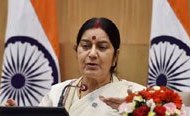
External Affairs Minister Sushma Swaraj on Thursday said that religious conversions in the country will continue till a central law against the practice comes into force.
Such a law can come into existence if all political parties agree to it, the Union Cabinet minister said. She was responding to a question on whether events like Ghar Vapasi (reconversion ceremonies organized by right-win g organizations across the country) were proving a hurdle in the Narendra Modi government’s development and good governance agenda.
Defending anti-conversion laws in BJP-ruled Gujarat and Madhya Pradesh, the Lok Sabha member from Vidisha insisted that they did not ban voluntary conversions.
Mumbai: A civil suit has been filed in a Pune court against Akhil Bhartiya Hindu Mahasabha seeking a ban on its forthcoming film ‘Desh Bhakt Nathuram Godse’, slated for release on January 30.
The suit filed by activist Hemant Patil alleges that Mahasabha general secretary Munna Kumar Sharma had said in a section of media that “the film would show that Nathuram Godse, the assassin of Mahatma Gandhi, was a patriot while Gandhi was anti-Hindu”.
Civil Judge S S Nair has placed the suit for hearing tomorrow, said advocate Wajid Khan, the petitioner’s lawyer.
According to the suit, the film was being released on the same day when Godse had gunned down Mahatma Gandhi in 1948. “As the film has the potential to incite people on communal lines”, the petition has prayed for a ban on its release.
The suit’s main prayer is to stop the release of the film until the producer satisfies the court that it would not in any way flare up communal issues or cause disharmony among people.

A founder of the low-cost Indian airline SpiceJet has asked the government for more time to financially resuscitate the struggling airline. SpiceJet, India’s fourth-largest carrier, has been in a severe financial mess for most of the year. Earlier this month, thousands of SpiceJet passengers were stranded when unpaid suppliers refused to provide fuel, forcing it to cancel over 1,500 flights in the span of a week. Flights resumed only after the airline started the fuel in cash.
Ajai Singh who owns nearly 5% in the troubled airline is attempting a rescue and is reportedly in discussions with a few U.S.-based private equity funds. SpiceJet’s majority owner is media billionaire Kalanithi Maran (#38 on Forbes’ list of Indian rich) of the Sun Group who belongs to a prominent political family in southern India. Maran has refused to extend a helping hand but new reports indicate that Singh is inclined to buy his stake.
Meanwhile, amid falling fuel prices and a generally upbeat economic scenario, the Tata Group- Singapore Airlines joint venture, a premium full-service airline called Vistara, is set to launch on January 9. In ads, the airline promised personalized touches and seamless service.
Inventively, the airline is offering over half-a-dozen seat categories including business flexi, premium economy and supersaver economy.
But SpiceJet owes hundreds of millions of dollars in fuel dues, airport fees, taxes and salaries and it seemed imminent to become the second Indian carrier, after Kingfisher Airlines, to crash land within the span of two years.
No domestic investor or global airline has shown interest in bailing out SpiceJet. But the national carrier Air India is staying airborne thanks to government largesse in the form of billions of taxpayer dollars.
All but one Indian carrier, Indigo, are making losses as high airline fuel costs, steep operating costs and frequent fare wars have kept them in the red in an extremely competitive market. If SpiceJet is unable to revive, it will mean a setback for India’s airline industry. It will make the market a virtual monopoly of Indigo as competitors are too new or too small.

San Francisco: Google and Microsoft have joined forces with Sony, using their online might to release “The Interview” film to online audiences despite threats from hackers.
“Of course it was tempting to hope that something else would happen to ensure this movie saw the light of day,” Google chief legal officer David Drummond said in a blog post yesterday.
“But after discussing all the issues, Sony and Google agreed that we could not sit on the sidelines and allow a handful of people to determine the limits of free speech in another country — however silly the content might be.”
The Japanese entertainment giant began contacting Google and other companies a week ago to pursue potential for “The Interview” to be made available for streaming to viewers on the Internet, according to Drummond.
“A cyber-attack on anyone’s rights is a cyber-attack on everyone’s rights, and together we need to defend against it,” Microsoft general counsel Brad Smith said in a blog post. “After substantial thought, we decided to stand up with Sony and work with others to ensure that freedom of expression triumphs over cyber-terrorism.”
Using their platforms as online stages for the film is expected to make Google and Microsoft targets for hackers who hit Sony’s film unit with a devastating cyber attack.
Late yesterday morning in California, “The Interview” became available for rent in high-definition streaming at Google Play, YouTube Movies, Microsoft’s Xbox Video service and at a dedicated seetheinterview.com website for a price of USD 5.99.
Digital copies of the film could be purchased for USD14. “It was essential for our studio to release this movie, especially given the assault upon our business and our employees by those who wanted to stop free speech,” Sony Entertainment chief executive Michael Lynton said in a release.
“I want to thank Google and Microsoft for helping make this a reality.”
“The Interview” outraged North Korea by lampooning dictator Kim Jong-Un.
The madcap comedy became available for rent in the United States from 1800 GMT on several platforms, one day before its December 25 limited theatrical release. The future of the film had been in doubt after Sony said last week that it was cancelling the release following a hacking attack on its corporate network and threats against moviegoers.
The US government blamed the attack on North Korea, reportedly angry at the film’s cartoonish portrayal of Kim’s communist regime, and President Barack Obama threatened reprisals.

e several Bodo houses have been set ablaze.
The toll rose to 78 on Thursday in attacks by NDFB(S) and retaliatory violence in lower Assam with miscreants among Adivasis setting afire houses of Bodos as the backlash to the Tuesday massacre continued for the second day.
In worst-affected Sonitpur district, six more bodies were recovered on Thursday morning from Maitalu Basti under Zinzia police station bordering Arunachal Pradesh taking the toll in attacks by NDFB(S) to 43 in the district and overall toll to 71, a police spokesman told PTI.
Three Adivasis were killed in police firing during protests against the carnage on Wednesday.
In Kokrajhar, the other severely-affected district, retaliatory violence by miscreants among Adivasis claimed the lives of four Bodos at Manikpur and Dimapur areas.
Twenty five people were killed by militants in Kokrajhar and three in Chirang district.
Fresh incidents of violence have been reported on Thursday morning from Gossaigaon area in Kokrajhar where several houses of Bodos have been set ablaze despite the indefinite curfew clamped in the entire district, he said.
Curfew has been also imposed in the affected areas of Sonitpur and Chirang districts along with parts of Dhubri and Baksa districts as precautionary measure, he added.
Union Minister of Home Rajnath Singh accompanied by his deputy Kiren Rijiju on Thursday visited Bishwanath Chariali in Sonitpur district to review the prevailing situation and also held talks with different political and social organisations.
They had reached Guwahati on Wednesday night and held meeting with Chief Minister Tarun Gogoi.

Alibaba ramped up its efforts to remove counterfeit goods before its initial public offering in September, the company said during a press conference today. Chief risk officer Polo Shao states that Alibaba took down 90 million suspicious listings from its marketplaces.
The Chinese e-commerce giant also works with law enforcement as well as brand owners to identify and remove counterfeit goods on its sites. The open nature of its marketplaces, especially Taobao, China’s largest C2C platform, however, often make it difficult to enforce intellectual property laws.
But as Alibaba prepared for its record-setting $25 billion IPO, it invested heavily in removing knock-offs from its sites.
In a company report (PDF link) that was also published today, Alibaba says that from the beginning of 2013 to the end of November 2014, it spent over one billion RMB ($160.7 million) to identify and remove counterfeit goods from its platforms. It also cooperated with law enforcement agencies in over 1,000 counterfeiting cases this year, which resulted in the arrests of 400 suspects from 18 counterfeiting rings, and the closure of 200 brick-and-mortar stores, factories, and warehouses.
According to the company’s research, 90 percent of all counterfeit goods in China were distributed from 10 regions, with the top three being the Pearl River Delta region, Yangtze River Delta region, and Southeast China.
“By using transaction data and mapping technology Alibaba Group found that more than 60 percent of counterfeit watches and jewelry originate from Southern China, while 60 percent of counterfeit outdoor sporting goods are from Southeast China region and 50 percent of counterfeit apparel originates from Eastern China,” it said.
“This year we increased our information sharing initiatives with various Chinese government agencies and continued to work with brands to bring about effective enforcement against counterfeiters who operate offline. Additionally, we continue to refine and harness technological tools at our disposal to track and trace counterfeiters who sell on our platforms, in order to assist enforcement authorities in tackling the problem at its source,” said Alibaba in its report.
These tools include data mining technology that lets Alibaba analyze and track transactions involving counterfeit goods and find where they originate; an online complaint platform for brand owners to report knock-offs; and random third-party checks to look for fake goods on its platforms.
These efforts have gradually paid off. In 2012, for example, Taobao was removed from the U.S. government’s “notorious markets” list.
At the same time, the company acknowledged that the problem will be difficult to completely eradicate.
“A report issued by China’s State Administration for Industry and Commerce showed that counterfeiting is still rampant offline, constituting the majority of trademark-infringing and counterfeit cases investigated. According to the report, of the 83,000 counterfeit and trademark-infringing cases investigated by the SAIC last year, online counterfeit cases constituted about 300 cases.”


Recent Comments