







New Delhi: The voters in Sadar Bazar constituency of Delhi are in a dilemma on who to support in the Delhi Elections. While the Bharatiya Janata Party is yet to declare its candidate, the Congress has nominated the party election committee chief Ajay Maken and Aam Aadmi Party has named former MLA Som Dutt.
With not much hullabaloo till now over the one-day poll on February 7 for the 70-seat Assembly, the election fever has not yet caught up in this constituency. Only a few banners and flags of the political parties are seen in the main market and parties are yet to take up extensive campaigning.
On one hand the Congress is projecting Ajay Maken for his clean image while the BJP is banking on former IPS officer Kiran Bedi who is the party’s chief ministerial candidate. But the AAP it seems is at a loss from this seat as people are not very happy with Som Dutt.
“I have always voted for the BJP and will vote for it this time as well. No other party will form government here,” says s Sadar Bazar voter.
But there are many who do not exercise their franchise and celebrate the voting day as a holiday.
“I do not vote, but I enjoy the day as a holiday and spend time with my family,” says Nitesh Gupta of Gupta and sons.
As there has been no extensive campaigning, it has hit the business of those dealing with election campaigning material.
“There has been no demand of any election campaigning material as of now,” says Harpreet Singh of GV Traders.
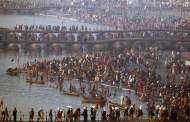
Allahabad, Jan 19 (IANS) More than 80 lakh people are likely to take a holy dip at Sangam, the confluence of three rivers – Ganga, Yamuna and the mythical Saraswati in Uttar Pradesh – on the occasion of Mauni Amavasya Tuesday, an official said Monday.
Mauni Amavasya is one of the most crucial days for taking a holy dip during the 44-day Magh Mela here.
The district administration has tightened security around the area where people will take the dip, a district official told IANS.
The North Central Railways has deployed security personnel on foot overbridges and platforms.
Additional District Magistrate (city) S.K. Sharma Monday inspected the ghats and reviewed the preparations to receive millions of people Tuesday for Mauni Amavasya.

A 20-year-old man, identified as Iftikhar, out on bail in a case of alleged vandalism at a temple in Unnao three weeks ago, has once again been arrested by the Uttar Pradesh police for ransacking the furniture and burning religious books and prayer mats at a mosque in Azamgarh on Sunday.
The youth, during interrogation, told the police that he does such things “because he feels like doing it”. The police, though further probing the case, said Iftikhar appeared to be mentally unsound.
According to the police, when people went to offer early morning prayers at the mosque in Khapda village under Saraimeer police station area on Sunday, they found the furniture ransacked and religious books and prayer mats burnt. They also found a young man sleeping inside. They caught him and handed over to the police.
Police officials said some people gathered at the spot and tried to create trouble by blocking the road. However, the blockade was lifted soon after it came to light that the man was apparently mentally unsound. Additional police force was deployed as a matter of precaution.
“The situation turned normal once people realised that it was the handiwork of a youngster, identified as Iftikhar (20), a resident of Safiganj Kot, Unnao, who was not able to explain his behaviour. Investigations revealed that he had earlier indulged in a similar offence in a temple in Unnao district. He was arrested there and later released on bail. He has not even been able to explain as to how he reached Azamgarh. When asked why he is doing such things, he said he does it because he feels like doing it,” said Station Officer (Saraimeer), Tej Bahadur Singh.
Singh added that Iftikhar even claimed to have come under the spell of djinns. “We got in touch with his family. They confirmed his identity, but said they have nothing to do with him,” the SO added.
Circle Officer (Phoolpur), Satyendra Kumar Singh, said the youth has not been able to explain anything coherently about his background. “We have got his antecedents checked from Unnao police. There too, he had carried a similar act and then could not explain his act. As far as we are concerned, he is mentally unsound. Further investigations are on”.
The police have registered a case against Iftikhar under Sections 295 (Injuring or defiling place of worship with intent to insult the religion of any class) and 427 (mischief causing damage) of the IPC.

New Delhi, Jan. 17 (ANI): Twenty four children, including eight girls, will be given National Bravery Awards for the year 2014.
Four of these awards will be given posthumously.
The Bharat Award has been conferred on sixteen-and-a-half-year-old Resham Fatma of Uttar Pradesh, an acid attack victim, who displayed outstanding courage while fighting off her tormentor.
The Geeta Chopra award has been conferred on thirteen-and-a-half-year-old Gunjan Sharma of Assam who displayed valour in saving her friends from the clutches of an abductor.
The children will receive their awards from Prime Minister Narendra Modi on January 24, and will also participate in the Republic Day parade.The awardees will receive a medal, certificate and cash.
The National Bravery Award Scheme was initiated by the Indian Council for Child Welfare to give due recognition to the children who perform outstanding deeds of bravery.
Since the inception of the scheme in 1957, the ICCW has given awards to 895 children. (ANI with inputs)
The Supreme Court on Friday stayed for three weeks the trial in a sexual assault case against Tehelka founder editor Tarun Tejpal as he opposed proceeding in the case without providing him the necessary documents.
A bench led by Chief Justice H L Dattu asked the trial judge to make sure that prosecution supplies all the relevant documents to Tejpal within three weeks. It also asked Tejpal to refrain from delaying the trial on any ground in future.
The petition, filed by advocate Sandeep Kapur, had contended that the session court while passing the December 23, 2014, order was conscious of the “recklessness” shown by the prosecution to uphold statutory requirements that are obligatory to provide all necessary documents.
It also claimed that the prosecution had deviated from procedure and failed to appreciate that speedy trial was barely a facet of fair trial. The petition alleged that the court has not reprimanded the prosecution for its “deliberate non-compliance, for deviating from the statutory mandates” to the detriment of the petitioner and his right to fair trial.
“That the petitioner has established a good prima facie case on merits and the balance of convenience tilts overwhelmingly in favour of the petitioner. The impugned orders have been passed by the trial court without consideration of the cardinal principle of law. Therefore, it is just, proper and expedient that the interim relief as prayed for may kindly be granted in favour of the petitioner. Grave and irreparable harm and injury would be caused to the petitioner, in case interim orders as prayed for, are not granted,” the plea said.
The Tehelka chief has sought stay of the operation of the December 23 order of last year passed by Additional Sessions Judge, Mapusa, Goa who will go ahead with arguments on framing of charges. Tejpal has been chargesheeted for allegedly raping, sexually harassing and outraging the modesty of a junior colleague during an event at a Goa hotel in November last year.
He was arrested on November 30, 2013 and is presently out on interim bail. He has been accused of sexually assaulting the victim on November 7 and repeating the offence the next day. Before being released on interim bail, he was lodged at Sada sub-jail in Goa’s Vasco town.

A secret US cybersecurity report warned that government and private computers were being left vulnerable to online attacks from Russia, China and criminal gangs because encryption technologies were not being implemented fast enough.
The advice, in a newly uncovered five-year forecast written in 2009, contrasts with the pledge made by David Cameron this week to crack down on encryption use by technology companies.
In the wake of the Paris terror attacks, the prime minister said there should be no “safe spaces for terrorists to communicate” or that British authorites could not access.
Cameron, who landed in the US on Thursday night, is expected to urge Barack Obama to apply more pressure to tech giants, such as Apple, Google and Facebook, which have been expanding encrypted messaging for their millions of users since the revelations of mass NSA surveillance by the whistleblower Edward Snowden.
Cameron said the companies “need to work with us. They need also to demonstrate, which they do, that they have a social responsibility to fight the battle against terrorism. We shouldn’t allow safe spaces for terrorists to communicate. That’s a huge challenge but that’s certainly the right principle”.
But the document from the US National Intelligence Council, which reports directly to the US director of national intelligence, made clear that encryption was the “best defence” for computer users to protect private data.
Part of the cache given to the Guardian by Snowden was published in 2009 and gives a five-year forecast on the “global cyber threat to the US information infrastructure”. It covers communications, commercial and financial networks, and government and critical infrastructure systems. It was shared with GCHQ and made available to the agency’s staff through its intranet.
One of the biggest issues in protecting businesses and citizens from espionage, sabotage and crime – hacking attacks are estimated to cost the global economy up to $400bn a year – was a clear imbalance between the development of offensive versus defensive capabilities, “due to the slower than expected adoption … of encryption and other technologies”, it said.
An unclassified table accompanying the report states that encryption is the “[b]est defense to protect data”, especially if made particularly strong through “multi-factor authentication” – similar to two-step verification used by Google and others for email – or biometrics. These measures remain all but impossible to crack, even for GCHQ and the NSA.
The proposal for auctioning for phase III of FM channels was given a go ahead by the government today, a process that could add an estimated revenue of over Rs 550 crore to the exchequer.
The Union Cabinet, chaired by Prime Minister Narendra Modi also approved migration (renewal) of private FM Radio licenses from Phase-II to Phase-III in 69 existing cities for 135 channels on payment of migration fee according to TRAI recommendations.
As of now, with the implementation of two phases of private FM Radio — Phase I (1999-2000) and Phase II (2005-06) — there are 243 private FM channels in operation in 86 cities of the country, spanning 26 states and three Union Territories.
“The auction process will add an estimated revenue of over Rs 550 crore to the national exchequer on successful auctions of all proposed channels,” an official statement said here.
Besides, it will beget the amount realised through the migration process which is dependent on the TRAI recommended formula, where migration fee is linked with the discovery of market prices through the FM Radio Phase III auction.
The roll out of the first batch of FM Radio Phase III auction will provide more channels to listeners with richer content in 69 existing cities, the statement said.
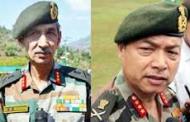
Nagrota (J&K), January 15
Army on Thursday said there were inputs about possibility of attacks by Pakistan-based terror outfits on “soft targets” such as schools, religious places, military convoys and civilian areas in Jammu and Kashmir ahead of US President Barack Obama’s India visit later this month.
General Officer Commanding (GOC), 16 Corps, Lt Gen K H Singh said that 200 heavily-armed militants were waiting in 36 launching pads across the Line of Control (LoC) on the other side of Pir Panjal range and there is every possibility that Pakistan might try to divert the fringe elements of the home grown terrorist outfits on this side of the border.
“There are general inputs that terrorists might try to attack soft targets, including schools, religions places, army convoys and other civilian areas,” he told reporters here.
Singh said the army was fully prepared to foil any such nefarious designs of the terrorist organisations.
“There are 200 terrorists waiting in 36 launching pads across the border on the other side of the Pir Panjal range to sneak into Indian side, we have so far been able to foil their attempts,” he said.
Singh said the terror infrastructure across the border is active and terrorist organisations were receiving the support of Pakistani establishment including the army and ISI.
“There are 14 to 15 terrorists training camp active on the other side of the line of control within our area of responsibility.
“The terrorist infrastructure across the border is intact and there is every possibility that Pakistan might try to divert some of its home grown terrorists towards this side of the border,” he said.
Singh said there could be a possibility that some disgruntled elements of Tehrik-e-Taliban Pakistan might surrender to the Pakistani Army, which can be used to launch attacks against India.
He said that less than two months ago the chief of banned terror group Lashkar-e-Taiba, Hafiz Sayeed, was reported to have visited the areas along the border in Pakistan to motivate his cadre to launch anti-India attacks.
On a question whether India was ready to launch a counter attack on the terror infrastructure across the border, Singh said the army is always prepared to face any eventuality.
He said that there were 37 active militants in Jammu region, but their movements are under check by the security agencies.
“There are 80 to 90 people involved in militancy in Jammu region including 37 active militants, the rest are sleeper cells, but we make sure that we continue to dominate them so they cannot launch any operation,” Singh said.
While Pakistan-based terror outfits were trying to infiltrate militants in to the Indian side, Singh said the army has been foiling their attempts.
“Several infiltration attempts were made, but we foiled all such attempts from their side,” he added.

India’s biggest book fair in terms of a single exhibitor is till Janurary 29th at Sunderbai Hall at Churchgate Mumbai. It is the delight of book readers and intellectuals.
The exhibition has more than 1 lakh Books on display. The range of books vary from Fiction, non fiction, , Art, Interior, Health, Cookery, Fashion and Craft, Travel, Spiritual and Classics. The exhibition is displayed at a large area of 5,000 sq ft.
The percentage of readership in India is at an average of 15-20%. The highest number of readers are from Bangalore, followed by Delhi, Mumbai and Kolkata. With the large number of people hooked on the internet the percentage of readers are declining.
However looking at the spirit of buying in the exhibition was very encouraging with people randomly selecting books and putting them on their cartel. This included young, old, male and females.
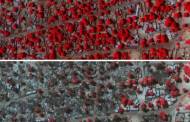
Lagos (AFP) – Leading human rights groups on Thursday released satellite images claiming to show massive destruction by Boko Haram of two Nigerian towns in what is feared to be the deadliest strike of the Islamists’ six-year insurgency
Amnesty International and Human Rights Watch published separate images of Baga and the nearby town of Doron Baga, on the shores of Lake Chad, in the far north of Borno State in northeast Nigeria.
Hundreds of people, if not more, are feared to have been killed in the attack, Amnesty said, that is thought to have targeted civilian vigilantes helping the army and that reportedly included one woman being killed while in labour.
But Nigeria’s military, which often downplays death tolls, said that 150 died and dismissed as “sensational” claims that 2,000 may have lost their lives.
HRW said the exact death toll was unknown and quoted one local resident as saying: “No one stayed back to count the bodies.
“We were all running to get out of town ahead of Boko Haram fighters who have since taken over the area.”
Satellite images from January 2 (top) and January 7, 2015 believed to show the scale of last week …
Amnesty’s images showed aerial shots of the two towns, which have been hit previously by fighting, on January 2 — the day before the attack — and January 7, after homes and businesses were razed.
The group said the images suggested “devastation of catastrophic proportions”, with more than 3,700 structures — 620 in Baga and 3,100 in Doron Baga — damaged or completely destroyed.
HRW said 11 percent of Baga and 57 percent of Doron Baga was destroyed, most likely by arson, attributing the greater damage in the latter to the fact that it houses a regional military base.
The Multinational Joint Task Force of troops from Nigeria, Niger and Chad has been involved in counter-insurgency operations against Boko Haram.
At least 16 settlements around Baga were burnt to the ground and at least 20,000 people fled, according to local officials.
A screengrab taken on October 2, 2014 from a video released by Boko Haram and obtained by AFP shows …
– ‘Killed in labour ‘ –
Harrowing testimony has been emerging from survivors about the scale and brutality of the assault in Baga.
Eye-witnesses spoken to by AFP described seeing decomposing bodies in the streets and one man who escaped after hiding for three days said he was “stepping on bodies” as he fled through the bush.
Amnesty said on Thursday that survivors have told them that Boko Haram fighters killed a woman as she was in labour, during indiscriminate fire that also cut down small children.
“Half of the baby boy (was) out and she died like this,” the unnamed witness was quoted as saying.
Rescue workers work to put out a fire following a bomb explosion that rocked the busiest roundabout …
A man in his fifties added: “They killed so many people. I saw maybe around 100 killed at that time in Baga. I ran to the bush. As we were running, they were shooting and killing.”
Another woman said: “I don’t know how many but there were bodies everywhere we looked.”
Medical charity Doctors Without Borders (MSF) said on Tuesday that its team in the Borno State capital, Maiduguri, was providing assistance to 5,000 survivors of the attack.
The UN refugee agency has said that more than 11,300 Nigerian refugees have fled into neighbouring Chad.
Amnesty said the eye-witnesses and images reinforced the view that the attack was Boko Haram’s “largest and most destructive” in its fight to establish a hardline Islamic state in northeast Nigeria.
“The deliberate killing of civilians and destruction of their property by Boko Haram are war crimes and crimes against humanity and must be duly investigated,” it added.
Some 300 women were said to have been rounded up and detained at a school, witnesses told Amnesty, adding that older women, mothers and children were released after four days but younger women kept.
The Baga attack came before presidential and parliamentary elections in Nigeria next month and an upsurge in violence apparently designed to undermine the legitimacy of the vote.
Nigeria’s electoral commission said voting was “unlikely” in rebel-controlled areas and arrangements were being made to allow hundreds of thousands of displaced people to cast their ballots.


Recent Comments