





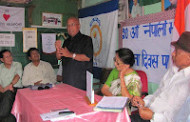
MUKESH SHARMA| Kalimpong: The Nepali Language Bhasa Manyata Diwas was today observed all across the Hills. Different school, organisation and political parties of the Hills today assembled to mark the completion of the 20years of the recognisation of the Nepali language. The Bharitya Gorkha Parisangh Kalimpong Branch under the Chairmanship of President Dr.Saroja Rai today celebrated the day where the Gorkha Dukh Niwarak Sammelan, Nepali Sahitya Adhyan Samiti, Kalimpong Sanrakshan Samiti and the representatives of the other several organisations were also present.The day stressed on the use the language in the Governmental offices which has got its constitutional recognisation long back. The language from today has to be used in every offices said that BGP President Dr Anos Das Pradhan. He also said that a clear definition of being a Gorkha and Nepali has to be sort out first. Slamming the Government, he said that the Nepali Language which got its recognisation in the Indian Constitution has not been used practically in every sphere. He also appealed that the newly formed Gorkhaland Territorial Administratio (GTA) Sabha to emphasis on the matter thereby adopting all the documentation and all forms of work in Nepali language. They have sent a memorandum to the GTA Executive Chief Bimal Gurung through the Sub Divisional Officer on the regard. Further the party has appealed the setting up of Nepali Bhasa Cell.Stressing more he also went back to the history that agitated for the recognisation of the language, which today has been enshrined in the Indian Constitution.Similarly Kalimpong Primary Government School at Chandralok also observed the day where the former Principal BR Chettri was present as the Chief Guest. Different programmes relating to the Nepali languages were staged on the day. The day was observed at different places in Kalimpong Sub-division is learnt.

An auto ride in Mumbai turned into a nightmare for 23-year-old Srishti Singh on Tuesday night when the auto driver started masturbating in front of her. The incident comes on the heels of similar one that took place in Colaba on Monday.
At about 8.20 pm, when Singh was travelling in an auto from Malad station to Rizvi Colony, after reaching the destination, the driver stopped the auto and masturbated in front of her.
“At first, when I was in the rickshaw, I saw him doing something, I thought something must be itching. But what I saw after I got down is the most torturous thing and probably every girl’s nightmare,” said Singh.
Singh had walked out of the station from a side where not a lot of share rickshaws were present. After being refused by 4-5 drivers, this man agreed to take her.
Singh claims that the auto driver purposely took her on a longer route. “He took me from the Raheja’s Govind Nagar road, which is usually dimly lit and deserted. He said he did it to avoid traffic, but after the incident I realise what he was actually trying to do,” she said .
On reaching Rizvi Colony, Singh got down and looked for money in her purse. It’s when she looked up, she saw what the driver was up to all this while. “As soon as I started yelling at him, he hurriedly turned his rickshaw, threw the money out, almost dashed into a wall and fled.” said Singh, who has managed to note down the number of the plate. In an attempt to stop him, Singh almost got run over.
In the morning when Singh tried to find the guy through a government website, it crashed. “The website showed errors. So I will go to the police station. I will not at any cost let him get away with this. I will file an FIR and make sure he gets due punishment,” Singh said.
Though Singh’s friends have raisesd concerns over taking action, she refuses to be cowed. “My friends tell me that sometimes these people take revenge by throwing acid and all. But I’m determined. I will make sure others stand against such heinous incidents, which all the girls go through but never complain about,” she said.

LOS ANGELES, CA – Playboy magazine today released its list of “America’s 25 Sexiest Cities,” as featured in its September 2015 issue.
New York took the list’s top spot, and was described by the magazine as a city where “the people are hot, the sex is prime quality and the frequency is high, averaging 138 times per year.” NYC was also recognized for having “the best and most nightlife” of the ranked cities, and for having “a touch of the forbidden.” In the magazine’s survey of the top five cities, New York respondents were the most interested in kink, with nearly two thirds open to experimentation and almost a quarter into BDSM.
The following is Playboy magazine’s complete list of “America’s 25 Sexiest Cities”:
1. New York
2. Los Angeles
3. Chicago
4. Miami
5. San Francisco
6. Boston
7. Seattle
8. Las Vegas
9. San Diego
10. Portland
11. Dallas
12. Philadelphia
13. Austin
14. Minneapolis
15. Denver
16. Tampa
17. Atlanta
18. Phoenix
19. Washington, D.C.
20. Charlotte
21. Orlando
22. Houston
23. Pittsburgh
24. New Orleans
25. Santa Barbara
Playboy’s list was determined by results from two customized polls conducted exclusively for the magazine and other metrics such as “hot locals, cool nightlife, a great setting and an undercurrent of desire.”
Survey results voted Detroit the “unsexiest city in America.”
Bollywood celebrities Shekhar Kapur, Rajat Kapoor, Hansal Mehta and Resul Pookutty criticised the arrest of five students of Film and Television Institute of India (FTII) from its campus on charges of rioting.
The arrest comes after a group of striking students had on Monday gheraoed the institute director, Prashant Pathrabe, protesting against “irrational and unjustified” assessment of the incomplete diploma projects.
Filmmaker Shekhar took to Twitter and wrote, “There was a time #FTII was considered one of the best film schools in Asia and produced some brilliant talent. What happened?.” Oscar-winning sound engineer Pookutty, who earlier expressed his displeasure over appointment of Gajendra Chauhan as FTII chairman, said, “Police arrive in the middle of the night at #FTII, arrest 40 students. So are they really anti nationals?!or are Police implementing orders.” “
Bangkok, Thailand (CNN)The chief suspect in the deadly bombing of Bangkok’s popular Erawan Shrine is “an unnamed male foreigner,” according to an arrest warrant issued Wednesday by a Thai court.
A Thai motorbike taxi driver who believes he picked up the suspect shortly after the blast also said he did not seem to be Thai.
Driver Kasem Pooksuwan, 47, told CNN that the man — who spoke an unfamiliar language on his cell phone during the short ride — didn’t speak to him at all but showed him a piece of paper with the name of a central city park written in English.
“When I dropped him, he still appeared very calm, just like (a) normal customer. He seemed not in a hurry at all,” Kasem said.
Thai police spokesman Lt. Gen. Prawut Thavornsiri earlier said police had questioned the motorcycle taxi driver but did not give details of what the man had told them.
Police believe the man suspected of carrying out the deadly bombing in the heart of the Thai capital probably had accomplices.
Examination of surveillance video footage from the Erawan Shrine indicates at least two others were helping the main suspect in the attack that killed 20 people and wounded more than 120 Monday evening, police officials said at a news conference Wednesday.
Authorities are hunting for the man seen on a surveillance video putting a backpack under a bench in the shrine and then walking away shortly before the blast went off.
Beyond the yellow T-shirt and dark-framed glasses he was wearing, little is known so far about the man who police say they are “very sure” is the bomber.
Thai Prime Minister Prayuth Chan-ocha appealed on Wednesday for the chief suspect to turn himself in to authorities. Addressing reporters, Prayuth said he feared the suspect “might be silenced by killing” and that if he wanted to be safe, he should surrender.
Here’s where things stand with the investigation into the attack, which authorities have described as a deliberate act of terror:
The chief suspect
Police say they don’t yet know the suspect’s identity but do now appear to have concluded that he’s a foreigner.
They are studying more than 10 days’ worth of closed-circuit TV footage from the scene.
The surveillance footage shows the suspect in the yellow shirt sitting down on a bench in the shrine at 6:52 p.m. Monday and hiding the backpack under the bench, said Prawut, the police spokesman. The man left without the backpack, and the blast went off minutes after he set it down.
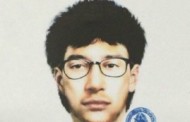
Police have released a sketch of the suspect, who is described as a dark-haired man with glasses and light facial hair.
Thai police have released a sketch of the suspect in the shrine bombing.
Thai police have released a sketch of the suspect in the shrine bombing.
Police also said the suspect had material wrapped around his forearms, which they say could indicate he had previously suffered some kind of injury.
A reward of 1 million Thai baht ($28,000) is being offered for information leading to the suspect’s arrest, he said.
Kasem told CNN he thinks the suspect “is not Thai,” although he admitted he did not look at his whole face. He said he remembers a long chin and white pale face very well, however.
“I wish I looked at his face more, but I really didn’t know what happened yet at that time. Normally I would not stare at my customer’s face,” he said.
Kasem, who has been a Bangkok taxi driver for a little more than two years, said he did not think the unfamiliar language spoken by the man was English. He dropped his passenger at Lumpini Park, by which time he was no longer on the phone, he said. It wasn’t clear whether he placed the call or received it.
The suspected accomplices
After studying surveillance footage from the shrine, police have zeroed in on two men they think could have been working with the man in the yellow shirt, said Prawut.
One was wearing a red shirt and the other a white shirt. The pair can be seen standing in front of the chief suspect as he places his backpack under a bench shortly before the explosion.
Police want to speak to both men as to whether they stood there to shield the yellow-shirted man’s actions from view.
The device
The blast was caused by a pipe bomb containing wheel bearings, according to police.
nvestigators say they think the device was assembled in Thailand because many parts, including the pipe, were made in the country, Prawut said.
CNN security and intelligence analyst Bob Baer said it was unusual for a pipe bomb to kill so many people and cause so much damage.
“It would be a very sophisticated pipe bomb,” he said.
Another blast that struck near a river pier in Bangkok on Tuesday was caused by a similar device, Prawut said. That explosion went off in the water and didn’t hurt anyone, but it was still “quite big,” he said.
Royal Thai Police Commissioner Gen. Somyot Poompanmoung said Wednesday that investigators were so far unable to establish a link between the two explosions, adding they have no leads on who might have been behind Tuesday’s blast.
The motive
There has been no claim of responsibility for the shrine bombing, and comments from Thai officials so far have been vague.
Investigators hunt for motive in Bangkok bombing
Investigators hunt for motive in Bangkok bombing 03:19
“From this incident, it is apparent that there are active individuals or groups that harbor the intention to damage Thailand, who may be pursuing political gain or other intentions by damaging the economy and tourism,” the Prime Minister said Tuesday.
Analysts have speculated about a wide range of groups — including opponents of military rule in the country or a rogue faction in the army or police — but there is so far no evidence to link the attack with any of them.
Asked if there was any information on a possible motive, police spokesman Prawut said earlier this week it was too soon to reach any conclusions.
Bangkok shrine bombing: The search for a motive
The victims
Many of those killed were from other countries.
The shrine is a popular tourist site and sits at a busy intersection near a big shopping mall.
China’s state-run news agency reported that six Chinese citizens, two from Hong Kong, were killed. Malaysia’s national news agency Bernama said that four Malaysian citizens, all from the same family, were among the dead.
Officials have said that five Thais, a Briton and a Singaporean also died.
Police had put the overall death toll at 22, but on Wednesday they revised it down to 20, saying confusion arose from the number of body parts scattered at the scene.
Bodies thrown, bikes mangled and a vibrant city on edge
The shrine
Monks in orange robes chanted and prayed for departed souls Wednesday at the shrine, which bore the scars of the powerful blast.
A golden statue of the four-headed Hindu god Brahma was missing most of one of its jaws. Fresh concrete had been poured over the crater caused by the explosion.
Tributes of flowers were piled on a table and pinned to the railings outside. “Rest in peace” read one paper sign attached to a barrier.
Some people prayed, while others took photos.
The site is popular among Buddhists as well as Hindu and Sikh members of Thailand’s Indian community.
CNN’s Kocha Olarn reported from Bangkok, while Jethro Mullen wrote from Hong Kong and Laura Smith-Spark from London. CNN’s Saima Mohsin, Pamela Boykoff and Elizabeth Joseph and journalist Kiki Dhitav contributed to this report.

When Kawasi Hidme, a young adivasi woman from Sukma, Bastar district, Chhattisgarh, was released after eight years in Dantewada jail as an undertrial on false charges, her lawyer told her that Bastar’s IG, SRP Kalluri had ordered all his men to look for any case in any thana with the name Hidme on it. Allegedly, the name was all he needed to send her back in jail, on the very day she got out.
Hidme’s story is one that encapsulates the war on adivasis that seems to be going on in parts of India, where adivasi communities are slowly being driven out of their lands and forests. And Kalluri plays a big part in that, given his alleged involvement in assaults, murders, kidnappings. Hidme was picked up when she was 15, shuttled between thanas in Sukma, Dantewada, Bhansi, beaten relentlessly, raped, and after eight years acquitted when the charges of ‘naxal activities’ against her proved false. In jail, Hidme befriended adivasi activist Soni Sori, who has also borne the brunt of state brutality, and post her acquittal has been staying with, which is how she could be in New Delhi on Tuesday, accompanied by Sori and the latter’s nephew Linga Kodopi, to tell the mainstream press just what has happened to her and countless other women at the hands of the police. A writ petition with her video testimony is also being prepared to present in the Supreme Court.
In 2008, on her way to a fair, Hidme was picked up by the police in a case involving the killing of 23 policemen. Senior lawyer, Vrinda Grover, part of the panel that spoke on Tuesday, said that the initial FIR did not have Hidme’s name in it’s long list of suspects. Her name was added five months later. Hidme says that it was given by a woman from her village was had been with the Salwa Judum. On arrest, she was taken to the local thana, then to Dantewada thana, and the next day to Bhansi thana. There, in Bhansi, she was kept tied, blindfolded, her sari and gold ornaments were taken away. She was raped by the policemen and then beaten for six days relentlessly. “It was only when they realised I was going to die, did they give me some water,” said Hidme.
She was hit on the head, her body swelled up so much so she could barely walk, and, she narrated, she was left only in her petticoat, without a sheet to cover herself with or lie down on. She was tortured by electric shocks. “Only when she was sent back to Sukma, was she given her clothes. The policemen there helped get her treated but warned her to not tell the magistrate she had been beaten if she ever wanted to go home. She was not the only one by far. Numerous other women were and are systematically abused in jails, said Hidme, who came across cases similar to hers behind bars.
For years, Hidme was transferred between the Raipur and the Jagdalpur jail, her health deteriorated rapidly, with multiple operations required to treat her. Getting each operation was a task, by her account, as often jail authorities would say they didn’t have enough guards on duty to the hospital.
Grover told the press that this excuse, of a lack of armed guards is also used to make undertrials miss their dates in courts, which is why their cases stretch on for years.
“The actual conviction rate in Chhattisgarh for undertrials is 1 per cent to 3 per cent. A majority of cases are then proved to be false,” said Grover. She added, “one the police puts the tag of a ‘naxal case’, which is not a legal term, on a person, they can carry out any sort of extraordinary treatment without anyone questioning them. Right now, Chhattisgarh’s jails are the most overcrowded according to NCRB data, 260 per cent over crowded.”
On her acquittal, Hidme was received by Sori at the Dantewada jail. However Sori was first stopped by a strange man who insisted he had been sent by Hidme’s family to collect her. By the time Sori stalled him, went inside to bring Hidme out, the man had disappeared. Neither Hidme, nor anyone in her family knows who he is.
The involvement of Salwa Judum in such cases is especially pertinent given talks of its return. This, according to all activists on the panel, has frightened villagers, who are certain they will not survive a return of those horrific years.
Activist Arundhati Roy pointed out that all this is driven by the agenda to acquire land for industrialisation, that adivasis inhabit. She was backed in her claim by activist Himanshu Kumar, driven out of Bastar by state forces, who said that Kalluri once told a lawyer that he was doing what he did to get land. “Kalluri told this lawyer that he would shoot people if he had to, but he would not stop,” related Kumar.
This loss of home is perhaps, the most heartbreaking part of Hidme’s story, as she no longer recognises her village, nor does anyone there know her. She lives with Sori for now, eight years have not only robbed her of a physical and emotional strength but her home as well.
“I need to give her strength again,” said Sori, “I want her to fight. Perhaps we can do something for all women who come out of jail but are still unhappy, to be help them get their lives back.” “Who knows,” Sori added, ” perhaps Hidme can become the strongest fighter of us all.”
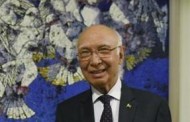
Srinagar, Aug 19 (PTI) The Pakistan High Commission has invited Kashmiri separatist leaders for consultations with Sartaj Aziz ahead of the National Security Advisor-level talks with India in New Delhi next week.
The Pakistan High Commission extended the invitation to the separatist leaders including chairmen of both factions of Hurriyat Conference yesterday.
Spokesman of the Geelani-led faction Ayaz Akbar told PTI that “Chairman Syed Ali Shah Geelani was invited for the talks with Pakistan NSA Sartaj Aziz. A decision on whether to accept the invitation will be taken at a meeting of the Hurriyat Conference.”
Akbar said the stand taken by Pakistan was welcome as “they have asserted that there will be no dialogue with India without inclusion of Kashmir issue”.
The moderate faction headed by Mirwaiz Umar Farooq has also been invited to meet Aziz during his visit to India for talks with National Security Advisor A K Doval.
“We are meeting today to take a decision on the issue,” a spokesman of the Mirwaiz-led faction said.
Sources in the Mirwaiz-led Hurriyat said the meeting today was a formality as “We believe in dialogue as a solution for the Kashmir issue”.
“We have met Pakistan officials in the past and nothing has changed in recent times to force a rethink,” the sources said.
India had last year cancelled Foreign Secretary-level talks with Pakistan after its High Commissioner invited separatist leaders for a meeting ahead of the talks.
Doval is scheduled to meet Aziz here for talks on terrorism-related issues for the first time on August 23 in New Delhi, as decided in a meeting between Prime Ministers Narendra Modi and Nawaz Sharif last month in Ufa in Russia.
India is expected to present strong evidence of terrorism emanating from Pakistan highlighted further by recent attacks in Gurdaspur in Punjab and near Udhampur in Jammu and Kashmir.
India’s case is bolstered by the capture of Mohammed Naved Yakub, a Pakistani national and a LeT operative, who carried out an attack on a BSF bus near Udhampur.
In his early twenties, Naved is from Pakistan’s Faislabad area. During the talks, India is expected to share evidence provided by Naved to prove that he is a Pakistani national and crossed-over from Pakistan to carry out terror attacks in the country.

It’s fair to say the controversial spiritual leader Radhe Maa has entered our national consciousness. She is practically everywhere and even ended up being debated on TV by Arnab Goswami which is the universal standard for importance. And now she has her own dubsmash! A guy actually dressed up like her and mouthed her iconic: “I am pure and pious (pice)!” The guy even wore make-up and performed the to the Student of the Year track Radhe On The Dance Floor.
The controversial godwoman has been in the news for a variety of reasons. Born Sukhvinder Kaur in Gurdaspur on April 4, 1965 has been accused of indecent behaviour, abetting suicide, dowry harassment and was banned from the Nashik, Mahakumbha.

Today he is reveling in the huge success of Bajrangi Bhaijaan, has praises and appreciation coming in from all corners and is regarded as a fine actor who has even left a mark on the international shores. However, for actor Nawazuddin Siddiqui, it has been a long journey from a small town called Budhana in Muzaffarnagar, UP to the big glamorous world of Bollywood. On route to his stardom, he worked as a chemist in some petrochemical company, even took up a job of a watchman before finally facing the camera and doing what he does the best – entertain. Nawaz’s success story is not only inspiring but also reflects his passion for his craft, which has brought him so far in his life.
Starting up on his own, with no godfathers in the industry, the actor faced many hurdles and setbacks before reaching where he is today. “I have struggled a lot,” says the actor without any hesitation, he adds, “I have never got things easily. During my struggling days, people around me would get offers and roles for films after a couple of attempts, but even after trying so hard, I was finding it difficult to get work. People kept saying — ‘You are a very good actor.’ But I was hearing that since my theater days — ‘What a performance!’, ‘You are fantastic’ etc, but it never got translated into work, at least initially. It took me so many years to reach where I am today. About 10 – 13 years in Bombay. And 7 years before that in Delhi.”
Elaborating further on his days of struggle, which lasted for over 15 years, Nawaz says, “Times were really bad. I had no money. I used to borrow money from people and then when the time used to come to return it back, I would borrow it from someone else and return it to the first person I had borrowed it from. This cycle of lending money went on for a very long time. I often thought I should go back home, but then felt, people back home would make fun of me. When I left my village to become an actor, many people from my village told me — ‘Kya actor banega, you don’t even look like an actor.’ ‘You need a good body, good looks… you will be wasting your time in Mumbai’, but somewhere deep down I knew this was my calling and I had to pursue it.”
Well, those who have the courage to chase their dreams and passion despite all the setbacks definitely reach their goals. “I always believed that hard work pays. Maybe a little late in life, but hard work certainly pays,” says the National Award winning actor, whose strength during those tough days was his mother.
“My mother was my strength, she once wrote a letter to me in which she mentioned this one particular quotation, which has stayed with me ever since. I remember it had been almost six years since I was struggling in Mumbai to find work, to make a mark for myself. And at that time, my mom sent me this letter, which said – ‘baara saal main kachre ke bhi din badalte hai toh befikar raho, do whatever you want to do just don’t give up.’ When I read that quotation, I was like – abhi toh sirf 6 saal hua hai. It is not 12 years yet. After 7 – 8 years, things finally started working out for me. Every time I used to feel dejected, I used to remember my mom’s quotation. Main yehi samaj raha tha ki main kachra hoon, but one-day things will change.”
And things did change eventually. In 2012, Gangs Of Wasseypur released and Nawaz’s destiny took an about turn. The film not only made people sit up and take notice of this versatile actor but also got him international acclaim. Then came the National Award for his notable performances in films like Kahaani, Gangs Of Wasseypur, Talaash and Dekh Indian Circus. Not only off-beat cinema, but Nawaz is also making his mark in commercial films like Kick, Badlapur and the recently released Bajrangi Bhaijaan. Today Nawaz is at the peak of his career and has set and inspiring example for one and all – that no matter how tiring the road is, once you start on your journey don’t look back till you reach your destination.
Wanna know who can be the new age Gabbar, Thakur and Basanti? Read on to find out the cast of Sholay 2015!
Before I even begin to reveal the casting of modern day Sholay, there are three things I need to admit. One, I am big fan of Ramesh Sippy’s Sholay. Two, I am aware of the fate of Ram Gopal Varma Ki Aag at box office. Three, I do agree that Sholay is one such cult classic which can never be remade successfully.
But on the occasion of 40 years of Sholay, I have a strong urge to revisit this cult classic with new age stars. Even though I know that Amitabh Bachchan, Dharmendra, Hema Malini, Amjad khan and Sanjeev Kumar’s performances can’t be matched, but the fanboy in me wonders how Sholay would have turned out if iconic characters of Jai, Veeru and Gabbar were not played by those in RGV Ki Aag. So without any delay, I reveal my choice of actors for Sholay 2015:
















Recent Comments