

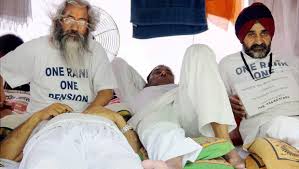
NEW DELHI: A retired army havildar who was on a relay hunger strike as part of agitation by veterans for early implementation of ‘One Rank One Pension’ was on Saturday rushed to the Army hospital after his health deteriorated.
“Havildar Abhilash Singh has been taken to hospital. He was on relay hunger strike,” an official from the United Front of Ex-Servicemen, the umbrella organisation of veterans carrying out the protest, said.
Besides Singh, four others who were on fast-unto-death have been admitted to hospital after their health deteriorated.
The deadlock over OROP continues even as the protest entered its 76th day on Saturday.
Yesterday the government had sought “some more time” to roll out OROP.
Close to 22 lakh retired servicemen and over six lakh war widows stand to be the immediate beneficiaries of the scheme, which envisages a uniform pension for the defence personnel who retire in the same rank with the same length of service, irrespective of their date of retirement.
Currently, the pension for retired personnel is based on the Pay Commission recommendations of the time when he or she retired. So, a Major General who retired in 1996 draws less pension than a Lt Colonel who retired after 1996.

Just like senior Kareena Kapoor, junior Kareena Kapoor aka Alia Bhatt is obsessed with fashion. She loves experimenting with her style and we must say her experiments do pay off really well! Even when she sported Stuart Weitzman knee high, shinning metal gladiator sandals teamed with Khakhi shorts and olive shirt, she made many heads turn. She was just being casual but her gladiators deserved a second look. She even flashed these gladiators at a promotional event of Humty Sharma Ki Dulhania paired with a short dress. She looked stunning in both the attires,
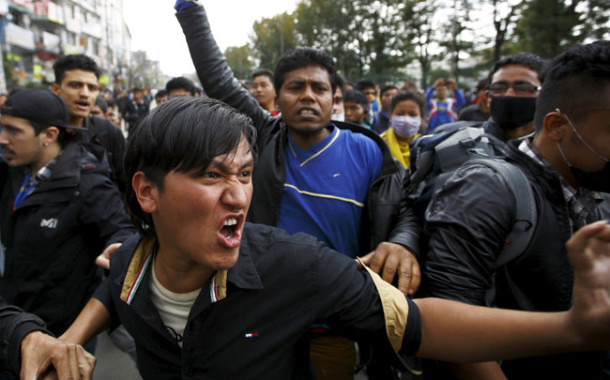
KATHMANDU/SINDHUPALCHOWK, Nepal (Reuters) – Nepali villagers blocked trucks carrying supplies for earthquake victims on Wednesday, demanding the government do more to help after last week’s disaster left more than 5,200 people dead and tens of thousands homeless and short of food and water.
In the capital Kathmandu, about 200 people protested outside parliament, asking for more buses to go to their homes in remote parts of the Himalayan nation and to hasten the distribution of aid that has flooded into the country but been slow to reach those in need.
In Sangachowk village in one of the worst-hit districts, about three hours by road from the capital, scores of angry villagers blocked the road with tires.
They stopped two trucks headed for the district capital with rice, noodles and biscuits. Later they blocked a convoy of three army trucks with relief supplies, leading to a tense standoff with armed soldiers.
“We have been given no food by the government,” said Udhav Giri, 34. “Trucks carrying rice go past and don’t stop. The district headquarters is getting all the food.”
The government was struggling to fully assess the devastation wrought by Saturday’s 7.8 magnitude quake.
“This is a disaster on an unprecedented scale. There have been some weaknesses in managing the relief operation,” Nepal’s Communication Minister Minendra Rijal said late on Tuesday.
An official from Nepal’s home ministry said the number of confirmed deaths had risen to 5,238 by Wednesday night. Almost 10,350 were injured in Nepal, and more than 80 were also killed in India and Tibet.
Prime Minister Sushil Koirala has told Reuters the death toll could reach 10,000, with information on casualties and damage from far-flung villages and towns yet to come in.
That would surpass the 8,500 who died in a 1934 earthquake, the last disaster on this scale to hit the Himalayan nation of 28 million people located between India and China.
However, there were signs on Wednesday that Kathmandu was slowly returning to normal. Some people prepared to head home to sleep after spending the last four nights in the open out of fear their damaged homes may not be able to withstand aftershocks.
Some street vendors started selling fruit in the city, but others said they were too scared to open shops because buildings had been so badly damaged.
“I want to start selling, I have children at home, but how can I open a shop where it is risky for me to sit inside?” said Arjun Rai, a 54-year-old who runs a general store.
In some mountainous areas, the government has struggled to deliver aid. Rescue helicopters have had problems landing at some sites.
Shambhu Khatri, a technician on board one of the helicopters, said entire hillsides had collapsed in parts of the Gorkha district, burying settlements, and access was almost impossible.
FEAR OF DISEASE
In Kathmandu and other cities, hospitals quickly overflowed with injured soon after the quake, with many being treated out in the open or not at all.
Guna Raj, who works for a Kathmandu-based NGO specialising in providing sanitation, said there have been outbreaks of diarrhoea in relief camps because of a shortage of toilets and clean water.
“In the next few days or weeks I am sure there will be an outbreak of epidemics,” said Raj, who is involved in the relief effort.
Foreign Secretary Shanker Das Bairagi appealed for specialist doctors from overseas, as well as for search-and-rescue teams despite earlier suggestions from officials that Nepal did not need more such assistance.
“Our top priority is for relief and rescue teams. We need neurologists, orthopaedic surgeons and trauma surgeons,” Bairagi said. Experts from a Polish NGO that has an 87-strong team in Nepal have said the chances of finding people alive in the ruins five days after the quake were “next to zero”.
Nevertheless, a Nepali-French rescue team pulled a 28-year-old man, Rishi Khanal, from a collapsed apartment block in Kathmandu on Tuesday after he had spent around 80 hours trapped in a room with three dead bodies.
Doctors amputated one of his legs on Wednesday because of damage from prolonged internal bleeding.
Tensions between foreigners and Nepalis desperate for relief surfaced, rescuers said, as fresh avalanches were reported in several areas.
Members of Israeli search-and-rescue group Magnus said hundreds of tourists, including about 100 Israelis, were being airlifted out of Langtang in Rasuwa district, a popular trekking area north of Kathmandu hit by a fresh avalanche on Tuesday.
Fights had broken out there because of food shortages, Magnus team member Amit Rubin said. One of the trekkers said there had also been scuffles over places on the rescue helicopters.
The quake also triggered an avalanche on Mount Everest that killed at least 18 climbers and guides, including four foreigners, the worst disaster on the world’s highest peak.
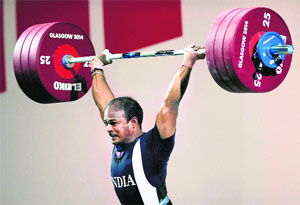
New Delhi, Aug 26 (PTI) Glasgow Commonwealth Games gold medallists Sivalingam Sathish Kumar and Khumukcham Sanjita Chanu will spearhead the Indian attack at the IWF Senior World Weightlifting Championships at Houston, USA, which will also double up as the qualification tournament for next year’s Rio Olympics.
A 14-member team will vie for top honours besides Olympic berths for the country at the World Championships to be held from November 10 to 29.
Besides 14 weightlifters (seven male and seven women), the contingent will also comprise four coaches, one masseuse and one physiotherapist.
Before the World Championships, the entire team will undergo a short-term foreign training camp to prepare for the prestigious event.
The squad:
Men: Sukhen Dey (56kg), Jamjang Deru (56kg), Apurba Chetia (62kg), Deepak Lather (62kg), Papul Changmai (69kg), Sivalingam Sathish Kumar (77kg) and Kojum Taba (77kg).
Women: Khumukcham Sanjita Chanu (48kg), Saikhom Mirabai Chanu (48kg), Matsa Santoshi (53kg), Bangaru Usha (53kg), Pramila Krisani (58kg), Minati Sethi (58kg) and Punam Yadav (63kg).
Coaches: Vijay Sharma, Kunjarani Devi, Sandip Kumar and Balwinder Singh Mehdwan.
Physiotherapist: Aakrant Saxena and Masseuse: Nepram Renubala Chanu
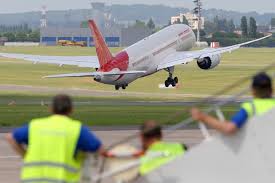
New Delhi, Aug 26 (PTI) National carrier Air India is likely to seek more time from Boeing for taking a final call on the firm’s proposal offering it 11 single-aisle aircraft in lieu of three wide-body B777s, which were a part of a 68-aircraft order placed in January, 2006.
The airline has constituted a three-member panel to go into the pros and cons of the proposal, which has been pending for nearly four years, Air India sources said today.
Boeing had asked the airline to take a final decision on the long-pending proposal by this month.
Air India had initially planned to cancel the order for the three B777s following the downturn in aviation sector worldover in 2008 but had to deferred the deliveries as there was no “cancellation clause”, the sources said.
Later, the US aircraft maker offered Air India to convert this order into an order for 11 Boeing 737 MAX aircraft.
“Air India has sought an extension in the deadline as it wants the new chairman and managing director (CMD) to take a call on such an important issue,” one of the sources said.
Air India CMD Rohit Nandan has set up a committee of three functional directors to go into the proposal and submit the report in this regard, they said.
As part of its fleet expansion plan, the national carrier had in 2006 placed orders with Boeing for 68 aircraft: 27 Dreamliners, 15 B777-300ERs, eight B777-200LRs and 18 B-737- 800s. Of these, eight B777-200LRs, 21 Dreamliners and 18 B-737-800s have already been delivered.
Single-aisle aircraft Boeing 737 MAX has a maximum seating capacity of 180 passengers while Boeing 777-300ER has a seating capacity of 230 plus, the sources said.
In 2013, Air India sold its five Boeing 777-200LRs to Etihad for around USD 350 million.
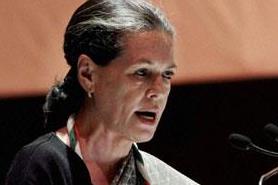
New York, Aug 26 (PTI) An appeals court here has affirmed a district judge’s order to dismiss a human rights violation lawsuit?filed?against Congress president Sonia Gandhi by a Sikh group in connection with the 1984 anti-Sikh riots case, ruling that the petition lacked merit.
The three-judge panel of the US Court of Appeals for the Second Circuit ruled that it found the arguments presented by Sikhs for Justice (SFJ) in its case against Gandhi “without merit”.
The bench of Circuit Judges Jose Cabranes, Renna Raggi and Richard Wesley affirmed the district court’s order of June 9, 2014 in which the judge had dismissed the human rights violation lawsuit?filed by SFJ?against Gandhi.
US District Judge Brian Cogan had granted Gandhi’s motion to dismiss the complaint due to “lack of subject matter jurisdiction” and failure to state a claim.
“Upon due consideration…, it is hereby ordered, adjudged, and decreed that the judgement of the District Court is affirmed,” the three-judge bench said in its order issued here yesterday.
Gandhi’s lawyer eminent Indian-American attorney Ravi Batra termed the appeals court ruling as “historic” and said the judges have upheld a nation’s sovereignty by declared Gandhi free of any fault – despite SFJ’s “reprehensible defamatory efforts”.
Batra told PTI in a statement that SFJ should “publically apologise” to Gandhi and to every leader it has sued without just cause or any legal right or standing to do so, and state that it will no longer hurt genuine victims of 1984 by selling false hope that only re-victimises them.
“SFJ making false, reprehensible and defamatory allegations against India’s leaders is the wrong recipe,” he added.
SFJ legal advisor Gurpatwant Singh Pannun said the group will file a petition for a “rehearing en banc” with the appeals court challenge the order?within 14 days of the order.
SFJ had filed a lawsuit in 2013 against Gandhi accusing her of allegedly shielding and protecting Congress party leaders in the anti-Sikh riots that had erupted following the assassination of former Prime Minister and her mother-in-law Indira Gandhi.
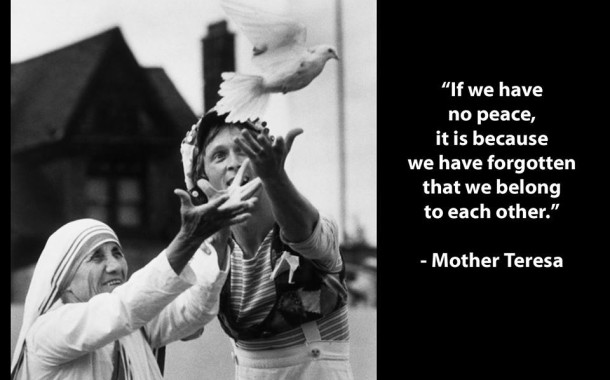
HAPPY BIRTHDAY BELOVED MOTHER…WHEREVER YOU ARE!
26 August 1910 – Mother Teresa, Macedonian-Indian nun and missionary, Nobel Prize laureate (d. 1997) was born.
Blessed Teresa of Calcutta, MC,commonly known as Mother Teresa (26 August 1910 – 5 September 1997), was a Roman Catholic religious sister and missionary who lived most of her life in India. She was born in what is today Macedonia, with her family being of Albanian descent originating in Kosovo.
Mother Teresa founded the Missionaries of Charity, a Roman Catholic religious congregation, which in 2012 consisted of over 4,500 sisters and is active in 133 countries.
Mother Teresa was the recipient of numerous honours including the 1979 Nobel Peace Prize. In 2003, she was beatified as “Blessed Teresa of Calcutta”.
By Suraj Mani Pradhan
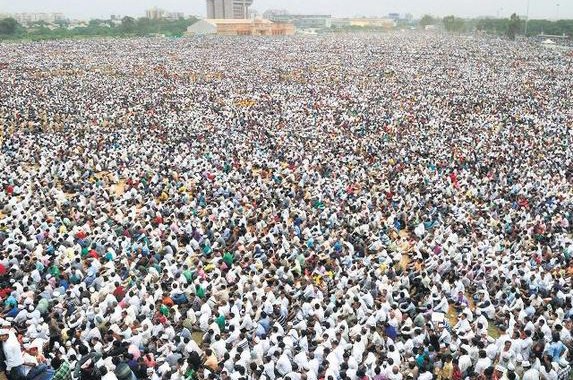
After a mammoth rally organised by Gujarat’s economically and politically powerful Patel community demanding reservation in government jobs and education, the police cracked down on the organisers, briefly detaining 22-year-old Hardik Patel, the spearhead of the agitation, while severely beating up his supporters and media persons.
In a late-night operation, the police swooped down on the agitators led by Mr. Patel who were sitting on an indefinite fast after the rally, which had already turned violent with several incidents of group clashes and stone-throwing across the city.
“He has been arrested because the organisers had not taken permission to hold the fast. The police permission was only for the rally and the gathering during the day,” a senior police official told The Hindu.
The arrest sparked violence in the city, with Patel community members clashing with police and six buses being torched.
During the day, the police resorted to baton-charge and tear-gas as clashes broke out between members of the Patel community and local residents in several parts of the city.
Earlier, over half a million Patels thronged the Gujarat University ground for the rally, bringing the entire city to a standstill. “The lotus will not bloom in 2017 if the demand [for quota] is not heeded,” Mr. Patel warned the BJP government, which depends on support from the community.
Watch: Hardik Patel goes on hunger strike post ‘lathi charge’
Rally galvanises Patel community
Launched at a rally in Visnagar town of North Gujarat on July 6, the agitation of the Patels for OBC status has become a mass movement as thousands of people in Surat, Vadodara, Mehsana and in Ahmedabad filled the streets pressing the demand for quotas.
The movement appears as much against the government as against the established leaders of the community who are dominating the show in the ruling BJP. The Chief Minister, top seven Ministers, State party chief, half a dozen MPs and more than three dozen MLAs of the party belong to the Patel community, considered as affluent and influential in Gujarat.
After the rally, government spokesperson Nitin Patel said that except for a few untoward incidents, the entire rally was peaceful. However, the government did not say whether Chief Minister Anandiben Patel would go to meet Mr. Hardik Patel as demanded by his outfit, the Patel Andolan Anamat Samiti (PAAS).
In Gujarat, 146 castes including over a dozen castes from the minority community, are identified as socially and educationally backward castes, also known as OBCs, and enjoy 27% quota in the government jobs and education.
Rift comes to the fore
PTI reports:
A rift between the two major groups of the Patel community seeking reservation came out into open on Tuesday with the Sardar Patel Group (SPG), led by Lalji Patel, distancing itself from the decision to go on a hunger strike by Mr. Hardik Patel, who is spearheading the agitation.
The SPG is the biggest Patel community social group in the State which had earlier supported Hardik’s Patidar Anamat Andolan Samiti for organising Tuesday’s mega rally in support of their demand for inclusion of the community in the OBC category for reservation.
Mr. Hardik Patel had earlier on Tuesday said that he would sit on a hunger strike after the rally at the venue till Chief Minister Anandiben Patel came to accept a memorandum from them.
“Hardik’s decision of sitting on a hunger strike until the Chief Minister comes and takes memorandum from him is his individual decision, which is not supported by others,” Mr. Lalji Patel said.
When asked if his group was ready for talks with the government, he said, “We are always ready for it and we will go if the government invites us.”
Mr. Hardik Patel had earlier said that Patels would not hold any talks with the government.
Tuesday’s rally was marked by the young leader’s speech whereas Mr. Lalji Patel did not address the gathering.
Asked why he was not allowed to speak at the rally, Mr. Lalji Patel said, “The programme was planned by Hardik and his team and I don’t want to make any comment on this.”
Another leader of the SPG, Vinod Patel, termed Mr. Hardik Patel’s decision to sit on a hunger strike as “kiddish” and said his remarks against Prime Minister Narendra Modi and the Chief Minister were “improper”.
Mr. Vinod Patel said they would make a representation to the State OBC Commission over the issue while Mr. Hardik Patel in the rally had said the decision of hunger strike was taken unanimously by the community and that he would stick to it.
Meanwhile, Mr. Hardik Patel said that he had the support of the people who want him to go ahead with the hunger strike.
“Some people (referring to Mr. Lalji Patel), who are separately addressing press conferences, must know that lakhs of people here (at GMDC ground) told us to sit on a hunger strike until our demand is fulfilled and until the Chief Minister comes and takes our memorandum of demands,” he said
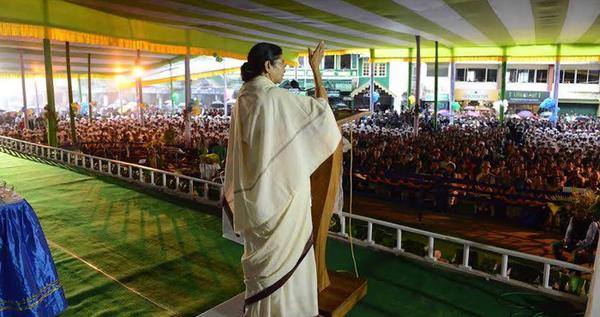
Mamata Announces Bhutia Development Board – “No More Boards” She Says
After the formation of separate development boards for the Lepcha, Sherpa and Tamang communities, chief minister Mamata Banerjee on Tuesday announced the formation of a separate development board for the Bhutia community as well.
She further announced during the Clean and Green Darjeeling programme held at Chowrastha today that Rs.5 crore will be provided for the Bhutia Development Board.
“Initially I had formed development boards for the Lepcha, Sherpa and Tamang communities, now I have formed a development board for the Bhutia community as well,” Banerjee said, adding, “They have been living here since a long time. With regard to the other communities, we have incorporated them in the Tamang board. Everyone will work united. After all everyone lives in the hills.”
It may be mentioned that during her last visit to Darjeeling, the Mangar community of the hills had also submitted a memorandum demanding the creation of a separate development board for the Mangar community. All India Bhutia Association (AIBA) had been demanding the formation of a separate development board for the Bhutia community for the past three years. “Denzongpa, Drukpa, Singsapa, Toto, Khampa, Yolmo and Tibetan ethnic groups fall under the Bhutia community. We are very happy and we welcome the decision of the chief minister,” said Palden Bhutia, president of AIBA.
However, when asked GTA executive member and Gorkha Jana Mukti Morcha (GJMM) general secretary Roshan Giri regarding the formation of the new development board, he preferred not to answer.
Meanwhile, Banerjee announced that the state government will sanction a sum of Rs.500 crore for the ‘Clean and Green Darjeeling’ project. She added that every development board will have to construct 5000 toilets.
The chief minister said that Nadia district has been number one in implementing the Nirmal Bangla Abhiyan. “I have chosen Darjeeling, and I want Darjeeling to be number one. My dream is sky high for the people of Darjeeling.”
GTA and GJMM chief Bimal Gurung also attended the programme.
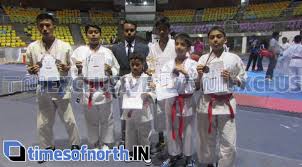
25th August, 2015: Five selected children of Darjeeling Karate-do-association bagged five laurels in the 11th All India Independence Cup Karate Championship held on August 22nd and 23rd in Talkatora Indoor Stadium, Delhi. Arnav Thapa from St Augustine School and Chogyal Bhutia from Kumudini Homes bagged gold medals, Anisha Lepcha from Pranami balika Vidhya Mandir bagged silver medal, Subham Prasad from St Augustine School and Rigzin Dorjee from SUMI won bronze medals. Sharing their experience Arnav Thapa,gold medalist said that it was wonderful to participate in national level competition, ‘I was little nervous as it was my first participation in a national level competition but later I gained the necessary confidence’. These were the same students who were felicitated on 17th August by Darjeeling Karate-do-association to encourage them who indeed didn’t let go of the expectations from their chief coach Sushan Thapa. Meanwhile, Thapa who is also a secretary of Darjeeling Karate-do-association expressed his happiness, ‘It would not be possible without children’s dedication towards this art, they are very passionate about Karate’ said Thapa. P.R Pradhan, the advisor of the association and the former principal of SUMI also spoke to the correspondent regarding the achievement of the young students, ‘we have to encourage them to go and play in national level competitions so that they get an opportunity to face contestants from other states’ said Pradhan. However the town is more enthusiastic on other sport activities like cricket and football which ruefully shadows such martial arts and artists, feels P.R Pradhan.













Recent Comments