
Written by Ai Powered PMC Akbar Jiwani :Special correspondent for realestate www.pmcakbarjiwani.com
Two numbers, published five working days apart, capture the paradox of Indian real estate in August 2026. On 31 July, Knight Frank India reported that Mumbai had recorded 13,617 property registrations in July — an 8.3 per cent rise year-on-year and the highest July figure in fourteen years, generating Rs 1,223 crore in stamp duty for the state exchequer. On 7 August, the Maharashtra Real Estate Regulatory Authority (MahaRERA) told many of those same developers that they could have four more months to finish what they had promised to build.
Demand has rarely looked healthier. Delivery has rarely looked harder. MahaRERA’s blanket extension order is the regulator’s attempt to hold both truths at once — and it has reopened a consequential question in Indian housing law: when a war on the other side of the world slows a construction site in Thane, who pays for the delay?
Background: How the word ‘war’ entered a housing file
The chain of causation is unusually easy to trace. Following the military escalation in West Asia at the end of February 2026, the Department of Expenditure in the Union Ministry of Finance issued an Office Memorandum on 29 April 2026 formally classifying the prevailing West Asia situation as ‘war’ for the purpose of invoking the force majeure clause in government contracts. That memorandum permitted procuring entities to grant extensions of two to four months, case by case, to firms that were not already in default of their obligations as on 27 February 2026.
Once the Centre had made that classification for its own contracts, the logic travelled quickly to real estate. Developer bodies made representations to the Union Ministry of Housing and Urban Affairs (MoHUA) arguing that the conflict had disrupted global supply chains, tightened the availability of construction materials, and pushed out procurement and execution schedules. On 31 July 2026, MoHUA issued an advisory — with the approval of the Union Minister for Housing and Urban Affairs — asking every state Real Estate Regulatory Authority to consider extending registration and corresponding completion timelines by four months.
The statutory hooks are precise. Section 6 of the Real Estate (Regulation and Development) Act, 2016 permits extension of a project’s registration on force majeure grounds, and the Act expressly lists ‘war’ among the events that qualify. Section 7(3) empowers an Authority to allow a registration to remain in force, subject to such conditions as it deems appropriate in the interest of allottees, rather than revoking it outright. MoHUA also suggested that Authorities issue a single common order covering all eligible projects instead of requiring thousands of promoters to file individual applications — an administratively sensible instruction that has now been followed.
Current Developments: What the MahaRERA order actually does
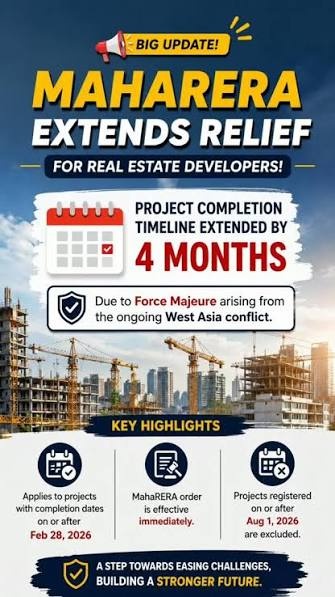
MahaRERA acted on 7 August 2026. Its order extends completion timelines by four months for registered projects in Maharashtra whose original completion date, revised completion date or previously extended completion date falls on or after 28 February 2026.
Three features of the order deserve attention. First, it is automatic. Promoters are not required to file separate applications or obtain individual extension orders; MahaRERA’s Registration and IT Cell will make the necessary changes to project records and update the MahaRERA web portal to reflect the revised timelines.
Second, it is bounded at the front end. Projects registered on or after 1 August 2026 are excluded. A developer who registered knowing the supply position could hardly claim to have been surprised by it, and the cut-off closes that door before it opens.
Third — and this is the feature most commentary has skipped past — the order is an instrument under Section 6. It changes the date by which a project must be completed. It does not, on its face, change what a promoter owes an allottee for a delay that has already occurred.
Detailed Analysis: Section 6 is not Section 18
The distinction between the registration timeline and the promoter’s contractual liability is the legal heart of this story.
Section 18 of RERA gives an allottee two remedies where a promoter fails to hand over possession by the agreed date: a refund with interest if the buyer exits the project, or monthly interest for every month of delay if the buyer chooses to stay. Nothing in the text of Section 18 makes that liability conditional upon, or subject to, the absence of a force majeure event. The Supreme Court has treated the right as robust — in Imperia Structures Ltd v. Anil Patni and in Newtech Promoters and Developers Pvt Ltd v. State of Uttar Pradesh, the Court characterised the allottee’s entitlement to interest at the prescribed rate as unqualified and indefeasible. Clause 6 of MahaRERA’s own Model Agreement for Sale likewise does not exempt a promoter from interest liability merely because the delay arose from circumstances beyond his control.
The practical consequence is that a promoter whose project was already running late as on 28 February 2026 does not receive a clean slate. The registration validity moves forward; the accrued liability does not automatically move with it. For a buyer in a project already eight months behind schedule in February, the extension changes the regulatory clock but not the arithmetic of what has gone wrong.
That said, this is a genuinely untested question rather than a settled one. Promoters will argue — not unreasonably, at first glance — that if the state has declared a force majeure event and extended the completion date, the date of possession has itself shifted, and no interest can accrue over a period that is no longer, in law, a delay. The counter-argument is that the MoHUA circular of 31 July concerns only Section 6; it neither advises Authorities to grant an ‘interest holiday’ for the four-month period from 28 February 2026, nor deprives buyers of interest payable on refunds when they exit projects because of delays already incurred.
Benefits
The order does real work. An estimated 5.4 lakh housing units across India’s top seven cities were scheduled for completion in 2026 — the largest single-year delivery commitment in a decade — and much of that pipeline was exposed to input and logistics disruption. Allowing registrations to lapse en masse would have penalised builders for a shock none of them created, and destabilised projects in which lakhs of buyers hold stakes.
A blanket order is also the right administrative instrument. Case-by-case adjudication of thousands of force majeure pleas would have consumed MahaRERA’s bench capacity for months and produced inconsistent outcomes. A uniform order delivers certainty in a single step, at near-zero compliance cost.
For lenders, the extension also removes a technical trigger: a lapsed registration complicates disbursement, escrow operation and title diligence, and keeping registrations alive keeps construction finance flowing.
Challenges
The obvious risk is moral hazard. A blanket instrument cannot distinguish between a developer genuinely stranded by a shortage of imported facade systems or electrical equipment and one whose project was floundering for reasons entirely domestic — a funding gap, an approval dispute, or plain mismanagement. Both now receive the same four months.
The second risk is expectational. Buyers who read the headline as ‘four more months of waiting’ without understanding that their Section 18 rights survive may either despair or, worse, accept a promoter’s assertion that no interest is payable. The absence of an explicit clarification from MoHUA leaves that asymmetry of information exactly where a regulator should not want it — with the better-resourced party.
Third, there is a precedent question. Force majeure relief was granted during the pandemic, and is being granted again now. Each round is defensible in isolation; cumulatively, repeated extensions risk softening the delivery discipline that was the entire purpose of enacting RERA. The credibility of a completion date depends on how rarely it is moved.
Expert Opinion
Industry has welcomed the move. Hitesh Thakkar, Vice President of NAREDCO Maharashtra and Managing Partner of the Prem Group, called the MoHUA advisory ‘a significant and much-needed relief for the real estate sector,’ thanking the Ministry of Housing and Urban Affairs and the Government of Maharashtra for ‘recognising the challenges arising from global disruptions and responding with a practical solution,’ and expressed the hope that MahaRERA would implement the advisory promptly through a common order — which it has now done.
The consumer side is more measured. Advocate Shirish V. Deshpande, chairman of the Mumbai Grahak Panchayat, has argued that force majeure may operate only as a mitigating factor where buyers seek compensation over and above statutory interest, and does not extinguish the statutory interest itself. He describes the question as a legally untested grey area and has called on the Union Housing Ministry to issue a clarificatory circular stating its position, leaving any aggrieved party free to approach the courts for a final determination. That reading is likely to become the reference position for buyer associations across the state.
Market analysts, meanwhile, are watching a demand side that remains unusually firm. Shishir Baijal of Knight Frank India attributed July’s Mumbai numbers to resilient end-user demand and the city’s strong economic fundamentals, noting that stamp duty revenue rose faster than transaction volumes — the signature of buyers trading up. Collections climbed from Rs 1,086 crore in June to Rs 1,223 crore in July 2026.
Future Outlook
Three things are worth tracking over the next two quarters. The first is whether MoHUA issues the clarificatory circular on interest liability. If it does, the grey area closes quickly. If not, the question will be settled by MahaRERA benches and appellate tribunals one order at a time, over what could easily be eighteen months of avoidable litigation.
The second is the inventory picture. Knight Frank’s H1 2026 data shows unsold stock across eight markets at 525,695 units, up 4 per cent year-on-year, with accumulation concentrated at the top of the market: inventory in the Rs 2-5 crore band rose 43 per cent to 65,671 units and the Rs 1-2 crore band rose 12 per cent, even as sub-Rs 50 lakh stock fell 7 per cent to 171,363 units. Mumbai holds the largest unsold stock at 157,410 units, ahead of NCR at 103,984 and Bengaluru at 74,299. Four extra months of runway added to a premium segment already absorbing slowly is a supply-timing question worth watching.
The third is the cost of money. The RBI’s Monetary Policy Committee held the repo rate at 5.25 per cent on 5 August 2026 — its fourth consecutive pause under Governor Sanjay Malhotra, with a neutral stance. Stable borrowing costs are a large part of why demand has held up through a supply shock, and remain the most important variable for the affordable and mid-income segments.
Practical Takeaways
For homebuyers: check your project’s revised completion date on the MahaRERA portal, because the change is automatic and you will not receive individual notice. If your project was already delayed as on 28 February 2026, do not assume your accrued interest claim has lapsed — take advice before signing any addendum, waiver or supplementary agreement a promoter offers on the strength of this order.
For promoters: the extension is relief on registration, not indemnity on contract. Document the specific supply-chain causation for your project — purchase orders, shipment delays, substitution costs, revised procurement schedules — because that evidence, and not the blanket order, is what will decide a contested Section 18 claim.
For cooperative housing societies in redevelopment: check whether your development agreement’s timeline is tied to the RERA completion date or to an independent contractual milestone. If the former, your developer’s clock has just moved four months; if the latter, it has not, and obligations on transit rent, corpus and bank guarantee continue on the original schedule.
Conclusion
MahaRERA’s order is a well-designed piece of regulatory triage: fast, uniform, cheap to administer, and bounded so that it cannot be gamed by projects registered after the disruption was already known. What it is not is a settlement of accounts between developers and buyers. Section 6 has moved. Section 18 has not been touched. Until MoHUA says otherwise, those four months belong to the construction schedule — not to the promoter’s liability ledger. Buyers who grasp that distinction will negotiate from a considerably stronger position than those who do not.