
By AI Powered PMC Akbar Jiwani, Special Correspondent: Real Estate for RealNewsofIndia.com | September 24, 2026
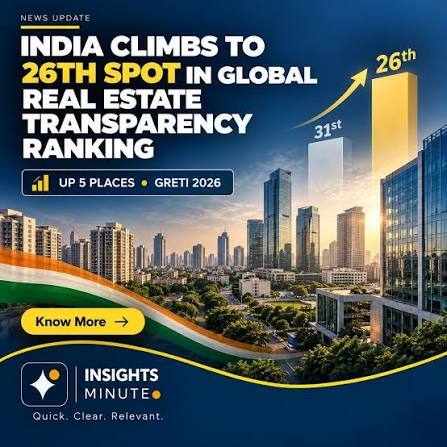
NEW DELHI — India has climbed five places to rank 26th out of 88 countries in the JLL Global Real Estate Transparency Index (GRETI) 2026, entering the “Transparent” tier for the first time and earning recognition as the best-improving real estate market in the Asia-Pacific region and among the top five most-improved markets worldwide, according to the latest edition of the biennial report released this month.
The GRETI, published by global property consultancy JLL, evaluates 146 city markets across 88 countries on 260 individual factors, scoring each on a scale of one to five. India’s jump from 31st position in the previous edition to 26th this year marks one of its strongest showings in the index’s history, with the country logging the fourth-best 10-year progress and third-best 20-year progress globally.
Government-led reforms drive the gains
The improvement has been credited largely to sustained regulatory and policy reforms undertaken by the central and state governments over the past several years. The report’s authors point to the continued maturation of the Real Estate (Regulation and Development) Act, or RERA, along with liberalisation of foreign direct investment norms and the digitisation of land records under government-backed initiatives such as the National Urban Digital Mission (NUDM), the NAKSHA property survey programme, and the Digital India Land Records Modernisation Programme (DILRMP).
India’s biggest category gain came in “Regulatory and Legal” parameters, where the country vaulted from 37th to 19th globally — and from 9th to 6th within Asia-Pacific — making it the single strongest driver of the country’s overall rise. Its “Transaction Process” score held steady at 10th globally and 3rd in the region, while “Sustainability” improved from 29th to 27th globally, aided by the Securities and Exchange Board of India’s Business Responsibility and Sustainability Report (BRSR) framework and the National Green Building Mission launched in 2025. The phased rollout of the Digital Personal Data Protection Act and investment measures under the Union Budget 2026-27 were also cited as contributing factors.
“India did not just improve this year; it set the pace for Asia Pacific. Moving from 31st to 26th globally and ranking among the top five most-improved markets worldwide reflects a market that is compounding gains, not chasing a single good year,” said Radha Dhir, CEO, India, JLL.
Capital inflows at a 20-year high
The transparency gains coincide with a surge in institutional and cross-border capital into Indian real estate. Direct investment into the sector touched a 20-year high of roughly $8.1 billion over the past 12 months, according to JLL data, while private equity real estate investment rose 17 per cent year-on-year to $10.5 billion in 2025, with momentum continuing into 2026 as H1 inflows reached $4.3 billion, up 25 per cent from a year earlier.
“The direct investment we saw this year, a 20-year high, is not the ceiling; it is the foundation we are building on. Private equity flows are already up 17 per cent year-on-year, reaching $10.5 billion in 2025,” said Lata Pillai, Senior Managing Director and Head of Capital Markets, India, JLL.
The listed real estate space has also expanded sharply, with office REIT-eligible stock growing 58 per cent, from 104 million square feet in 2024 to 164 million square feet in 2026 — now accounting for roughly half of India’s total Grade A office stock. Green-certified Grade A office space has climbed from about 39 per cent in 2020 to 66 per cent in the first half of 2026, with certified buildings commanding a 10-15 per cent rental premium over non-certified stock.
JLL also flagged data centre capacity as a coming growth frontier, projecting India’s capacity will need to nearly quadruple by 2029 to meet demand, requiring an estimated $110 billion in capital investment — a scale that analysts say will further test, and likely reward, the country’s continuing transparency and regulatory reforms.
Still room to climb
Despite the leap, India remains outside the world’s most transparent markets, which continue to be led by the United Kingdom, France, Australia, the United States and the Netherlands. Industry watchers say sustaining the pace of reform — particularly faster dispute resolution, wider RERA compliance across states, and continued digitisation of title and ownership records — will be key if India is to break into the “Highly Transparent” tier in future editions of the index.
For now, however, the 2026 GRETI findings offer a clear signal to global investors: India’s real estate market, long seen as opaque and fragmented, is being reshaped by a decade of regulatory reform into one of the world’s fastest-improving investment destinations.