
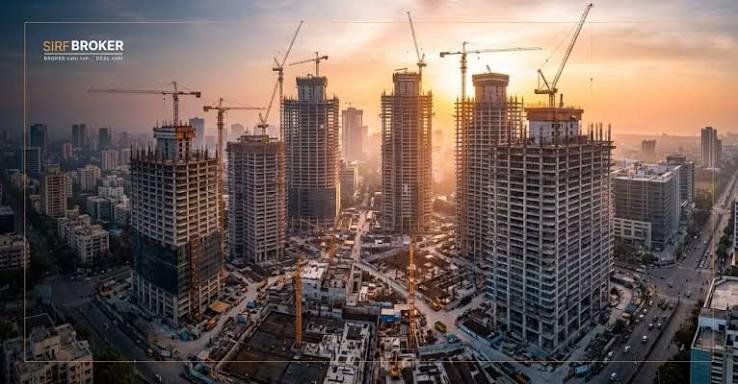
By AI Powered PMC Akbar Jiwani, Special Correspondent: Real Estate for Realnewsofindia.com
New Delhi, September 18, 2026: India’s real estate sector has entered the second half of 2026 on its strongest institutional footing in years, with fresh data confirming that the country’s property investment market not only hit a record high in the first half of the year but is also being led overwhelmingly by domestic capital — a shift analysts say marks a structural maturing of the Indian real estate story.
According to the latest half-yearly capital markets report, India’s real estate sector attracted equity capital inflows of USD 8.5 billion in H1 2026, up 32 per cent year-on-year from USD 6.4 billion in H1 2025 — the highest half-yearly figure on record for the sector. The momentum held through the second quarter as well, with Q2 2026 alone accounting for USD 3.4 billion, broadly stable compared with the same quarter last year.
What stands out most for market watchers is the composition of this capital. Domestic investors accounted for nearly 92 per cent of Q2 2026 inflows, with global investors making up the remainder — a marked departure from earlier cycles when foreign institutional capital dominated Indian real estate deal-making. Within that domestic pool, developers contributed roughly 34 per cent of capital infusion, while domestic institutional investors accounted for close to 32 per cent. Institutional investor capital inflows specifically rose 51 per cent quarter-on-quarter in Q2 2026, pointing to sharpening conviction among large domestic funds.
Land and development-site acquisitions, together with built-up office assets, made up roughly 94 per cent of total equity investment inflows in the quarter. More than 88 per cent of the capital directed toward site and land acquisitions flowed into residential and office developments, with the balance spread across data centres, mixed-use projects, and industrial and logistics assets — sectors that continue to draw steady, if smaller, allocations as India’s digital infrastructure and supply-chain buildout gathers pace.
Geographically, the growth story remains concentrated in India’s established investment hubs. Bengaluru, Delhi-NCR and Mumbai together accounted for nearly 60 per cent of total inflows during the quarter, underscoring how office demand, tech-sector expansion and residential absorption in these three markets continue to anchor investor decision-making. Separately, new investment and development platforms worth approximately USD 1.6 billion were set up during the period across the residential and office sectors, signalling that large investors are structuring long-term vehicles rather than making one-off bets.
Commenting on the trend, Anshuman Magazine, Chairman and CEO – India, South-East Asia, Middle East and Africa, CBRE, said: “This momentum reflects the underlying resilience and depth of India’s real estate capital markets. Domestic investors have continued to demonstrate strong conviction in the sector’s long-term fundamentals, even as the broader environment remains dynamic. We expect this momentum to carry into the second half of the year, with select foreign capital expected to re-engage as global conditions stabilise.”
Gaurav Kumar, Managing Director & Co-Head, Capital Markets, India, CBRE, added: “India’s real estate investment landscape continues to demonstrate sustained growth with strong institutional investments in core assets and hectic activity in land transactions. Global investors and domestic players have been unanimous in their aggressive intent in expanding their real estate portfolios across all asset classes. We expect the market to sustain this momentum going forward on account of a sophisticated capital pool that is now deeply committed to the Indian Real Estate Market.”
The record inflows have also translated into outsized market share for individual advisory firms. In a separate update dated September 17, 2026, CBRE disclosed that it captured a 55 per cent share of all tracked investment sales activity across property types in India during H1 2026 — more than half the entire market, per data from MSCI Real Assets. The firm’s dominance was even starker in specific segments: a 77 per cent share in development-site transactions and a 100 per cent share in apartment and residential asset sales. Globally, CBRE ranked as the No. 1 firm for commercial real estate investment sales with a 23 per cent share, and topped the Asia-Pacific league table with a 33 per cent share — an 1,100-basis-point lead over its nearest competitor, alongside top rankings in Australia, Hong Kong SAR, Japan, New Zealand and Thailand.
“Commanding more than half of India’s investment sales market is a strong signal of the confidence investors continue to place in CBRE,” Magazine said of the H1 league-table performance. “Our leadership reflects where and how we see the strongest capital flows in India today, and we expect that momentum to continue through the second half of 2026.”
For India’s broader property sector, the takeaway is twofold: capital availability is no longer the constraint it once was, and the investor base underpinning that capital has become distinctly more domestic and more institutional in character. With residential and office assets continuing to draw the lion’s share of money, and logistics, data centres and mixed-use developments building a steady base beneath them, industry watchers expect 2026 to close as one of the strongest years yet for Indian real estate capital markets — provided global conditions stay stable enough to draw the foreign capital that executives say is waiting on the sidelines.