
By Akbar Jiwani | MahaRERA-Registered Project Management Consultant | Special Correspondent Universal Buildtech Development | Bandra West, Mumbai
Introduction: The Invisible Cost Spiral
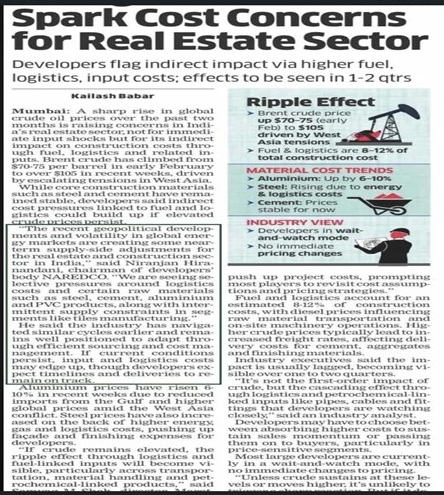
The sharp rise in Brent crude oil prices — from USD 70–75 per barrel in early February 2025 to over USD 105 per barrel in recent weeks — is sending quiet but significant tremors through India’s real estate and construction ecosystem. While the first-order impact on steel and cement appears muted for now, it is the second and third-order cascading effects that experienced Project Management Consultants (PMCs) and developers must brace for with urgency and precision.
As someone who has stewarded projects exceeding ₹38,660 crores across 3,010+ buildings in Maharashtra’s complex DCR/DCPR 2034 regulatory landscape, I write this not as an alarmist, but as a practitioner who has navigated multiple such cycles — and who firmly believes that forewarned is forearmed.
The Indirect Cost Equation: Why PMCs Must Pay Close Attention
The real estate and construction sector does not consume crude oil directly. It consumes its derivatives — diesel for machinery, petrochemical-linked inputs like pipes, cables, PVC conduits, aluminium composites, sealants, waterproofing compounds, and tile adhesives. It relies on logistics networks that are entirely crude-sensitive.
When fuel and logistics together account for 8–12% of total construction cost, a sustained 40% spike in crude prices does not merely affect transportation invoices. It ripples through:
Façade and finishing works — aluminium prices have already risen 6–10%, with cladding, window systems, and ACP panels directly exposed to Gulf import disruptions.
On-site machinery operations — tower cranes, concrete pumps, batching plants, and excavators run on diesel. A ₹5–8/litre diesel price increase on a large-scale redevelopment project adds millions to operational costs within a single project cycle.
Supply chain fragility — intermittent supply constraints in segments like tiles, PVC products, and finishing materials directly affect delivery timelines, which in turn affect MahaRERA-registered project schedules and the obligations of developers to allottees.
For societies currently evaluating redevelopment proposals — particularly under DCR 33(5), 33(7), 33(9), and 33(11) schemes in Mumbai — this is a critical moment to reassess cost assumptions embedded in feasibility reports.
The Redevelopment Context: Impact on Feasibility Models
From my current engagement across multiple active redevelopment projects — including DCR 33(9) feasibilities in Powai and Versova, and a DCR 33(11) model in Bandra West — I can confirm that construction cost estimates are the single most sensitive variable in any viable redevelopment model.
Most feasibility presentations prepared for housing societies are built on base construction costs ranging from ₹3,500 to ₹5,500 per sq.ft depending on specification grade, location, and structure type. These base costs typically embed a fuel and logistics component of 8–12%, as the NAREDCO data confirms.
A 10% escalation in this component alone — which is entirely plausible under sustained high crude — translates to:
₹28–66 per sq.ft increase in base construction cost, depending on specification.
On a 2,00,000 sq.ft construction project, this means ₹56 lakhs to ₹1.32 crores in additional cost per project — before accounting for inflation in aluminium, PVC, and finishing materials.
In projects where the break-even is already finely calibrated — as in the Jal Vayu CHSL (Powai) model where our break-even is benchmarked at ₹28,170/sq.ft — even a 3–4% construction cost escalation can erode developer margins and threaten corpus commitments.
This is not speculation. This is arithmetic that every society member, managing committee, and PMC must factor into their due diligence.
Six Risk Flags for Societies in Active Redevelopment Negotiations
Drawing on ground realities and the current crude-linked cost environment, I flag the following six risk areas that housing societies and their PMCs must proactively address:
1. Fixed-Price Construction Contracts Without Escalation Clauses Many Development Agreements (DAs) and construction contracts presented to societies contain fixed-price commitments. Developers who have not built in material escalation clauses will be under significant margin pressure. Societies must ensure that the DA protects member corpus, rental compensation, and timelines irrespective of developer cost escalation.
2. Corpus Fund Adequacy Reassessment If feasibility models were prepared 6–12 months ago and crude has since risen 30–40%, the corpus fund projections may no longer hold. Societies should request an updated sensitivity analysis from their PMC before executing any DA.
3. Timeline Extension Risk Under MahaRERA Supply chain disruptions in tiles, PVC, and finishing materials — directly linked to crude price volatility — can legitimately trigger project delays. Societies must understand MahaRERA’s force majeure provisions and ensure adequate contractual protection against arbitrary timeline extensions.
4. Aluminium-Intensive Façade Specifications Projects with high ACP cladding, aluminium window systems, or glass curtain walls are most exposed. Societies should request that their PMC conduct a material substitution analysis to identify equivalent specifications using less crude-sensitive materials.
5. Developer Financial Stress Testing A developer who has simultaneously committed to multiple projects and is now facing a cost escalation environment may deprioritise or delay individual projects. PMCs must include developer financial health assessments as a mandatory due diligence step.
6. GST and Input Tax Credit Implications Fuel and diesel used for construction machinery is specifically excluded from GST Input Tax Credit under the current framework. Rising diesel costs are therefore a direct, unrecoverable expense for developers — which further compresses margins and may create downstream contractual tensions.
The Opportunity Within the Crisis
It would be professionally incomplete to present only risk without recognising opportunity. The current environment, while challenging, offers PMCs and well-organised societies a decisive advantage.
Developers in a cost-stress environment are more amenable to negotiation. Societies that approach negotiations with rigorous, independently verified feasibility models — rather than accepting developer-prepared numbers — are in a position to extract better corpus, better specifications, and more protective contractual terms, precisely because developers value certainty of land and regulatory approvals over margin optimisation in an uncertain cost environment.
The NAREDCO chairman’s own words are instructive: the industry has navigated similar cycles before. Experienced PMCs have seen crude at USD 140 (2008), at USD 28 (2016), and at every point between. The structural demand for urban redevelopment in Mumbai — driven by aging building stock, FSI incentivisation, and the MahaRERA regulatory push — does not disappear with a crude oil spike. It recalibrates.
What changes is who gets the deal, and on what terms. Societies with professional PMC representation will get better deals. Societies that proceed without independent PMC guidance — particularly in this cost-volatile environment — will bear the residual risk.
My Recommendations: Practical Steps for Housing Societies
Request an updated feasibility sensitivity analysis from your PMC that stress-tests construction costs at current and projected crude-linked input prices.
Do not execute a Development Agreement based on feasibility numbers prepared more than six months ago without a material cost revision.
Insist on a Construction Cost Escalation Clause in the DA, with a clear formula tied to published indices (e.g., CCI — Construction Cost Index) rather than developer discretion.
Ensure corpus fund is held in an escrow account with disbursement linked to construction milestones, not developer cash flow requirements.
Appoint a MahaRERA-registered PMC as your independent technical and financial watchdog — not as a formality, but as an active governance mechanism throughout the project lifecycle.
Conclusion: Vigilance Is the Fiduciary Duty
The crude oil price surge of early 2025 is a reminder that real estate feasibility is never a static document — it is a living financial instrument that must respond to macroeconomic signals. The developers who survive and deliver are those who have built resilient cost models. The societies that secure just, timely redevelopment outcomes are those who have engaged independent, experienced PMC oversight.
As India’s urban housing renewal accelerates — driven by policy, demography, and structural necessity — the role of the PMC has never been more critical. It is not enough to facilitate a transaction. A PMC’s fiduciary duty is to protect the long-term interests of members, anticipate risk before it materialises, and ensure that every commitment made on paper can be delivered on the ground.
The crude oil cycle will turn. Societies that are professionally guided through this period will emerge with stronger projects, stronger protections, and stronger communities.
Akbar Jiwani is a MahaRERA-Registered Project Management Consultant (Reg. No. A51800001057) and Managing Director of Universal Buildtech Development, Bandra West, Mumbai. He specialises in housing society redevelopment under DCR 33(5), 33(7), 33(9), and 33(11) schemes, project finance advisory, and cooperative housing governance. He can be reached through Universal Buildtech Development, Bandra West, Mumbai.
Views expressed are the author’s own professional assessment and do not constitute legal or financial advice.
© 2025 | Universal Buildtech Development | UrbanReach360 — AI-Powered Marketing. Human-Centered Connections.

























One Comment
Michelle1288
https://shorturl.fm/23oSq