
By Akbar Jiwani | Special Correspondent | AI-Powered PMC |Published: April 1, 2026 | Urban Affairs & Infrastructure Desk
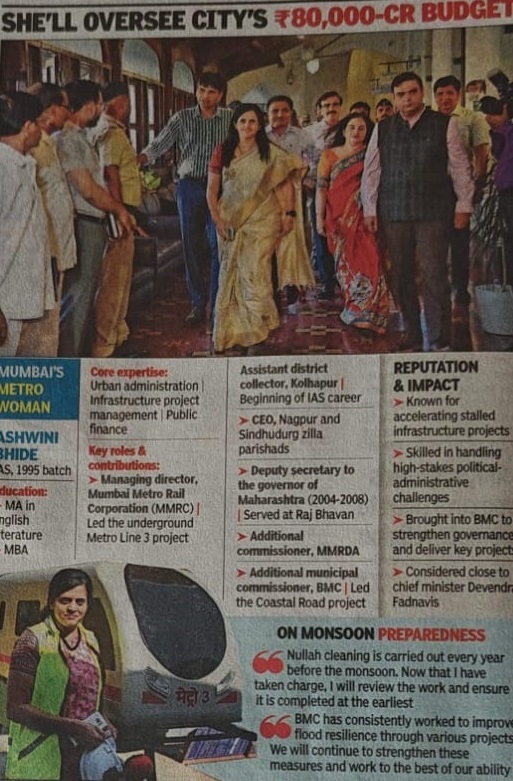
MUMBAI: In a landmark moment for India’s financial capital — and indeed for urban governance across the nation — IAS officer Ashwini Bhide has been appointed as the first woman Municipal Commissioner of the Brihanmumbai Municipal Corporation (BMC), the country’s richest civic body with an annual budget exceeding ₹80,000 crore.
As a professional deeply embedded in Mumbai’s built environment — from DCR-compliant redevelopment projects to infrastructure-linked real estate feasibilities — I write this not merely as a correspondent, but as a practitioner who understands, firsthand, the extraordinary complexity of the city this remarkable officer now helms.
A Historic Appointment, A Momentous Mandate
The appointment of Bhide, an IAS officer of the 1995 batch, follows a pre-appointment meeting between Chief Minister Devendra Fadnavis and Deputy Chief Minister Eknath Shinde, with Fadnavis understood to have actively backed her candidacy. The decision reflects not just political confidence but professional recognition of a career marked by decisive execution of stalled, complex, and politically sensitive infrastructure projects.
For the urban real estate and infrastructure ecosystem, this is not merely a symbolic milestone. It is a signal: Mumbai’s development pipeline — long bottlenecked by slow clearances, monsoon-season regulatory fatigue, and fiscal management challenges — may now find renewed administrative velocity.
From Metro Lines to the Commissioner’s Chair
Ashwini Bhide’s credentials in the urban infrastructure space are formidable. As Managing Director of the Mumbai Metro Rail Corporation (MMRC), she led the execution of the underground Metro Line 3 (Aqua Line) — one of the most technically demanding and politically fraught infrastructure projects in post-independence Mumbai. Her core expertise spans urban administration, infrastructure project management, and public finance — a trifecta of competencies that the ₹80,000-crore BMC machine urgently demands.
As Additional Municipal Commissioner, BMC, she spearheaded the Mumbai Coastal Road Project, a transformative arterial intervention reshaping Western Mumbai’s connectivity. Earlier assignments as Deputy Secretary to the Governor of Maharashtra, CEO of Nagpur and Sindhudurg Zilla Parishads, and Additional Commissioner, MMRDA have built in her a rare ability to navigate across tiers of governance — from Mantralaya corridors to on-ground civic delivery.
The Challenges Ahead: A PMC’s Reading
Speaking as a Project Management Consultant with over 25 years of experience across ₹38,660 crore worth of Mumbai’s development projects, I can assert with professional authority that Commissioner Bhide steps into a role with four defining pressure points:
1. Pre-Monsoon Readiness — The Annual Reckoning
Mumbai’s monsoon preparedness is perpetually under scrutiny. Nullah desilting, stormwater drain augmentation, and flood-resilience infrastructure must be completed before June. Bhide has already committed publicly: “I will review the work and ensure it is completed at the earliest.” In BMC governance, this is not a platitude — it is a deliverable with a hard deadline measured in weeks.
2. Capital Project Execution — Clearing the Pipeline
The BMC’s capital expenditure now accounts for nearly 60% of the total budget — an extraordinary proportion reflecting Mumbai’s ambitious infrastructure expansion. From road resurfacing and flyover construction to sewage treatment plants and coastal zone developments, the execution calendar is dense. Bhide’s known track record of accelerating stalled projects makes her appointment particularly strategic.
3. Fiscal Stewardship of ₹80,000 Crore
Managing the country’s largest municipal budget in a politically plural environment — with the BJP governing BMC in alliance with the Shinde-led Shiv Sena, and opposition represented by UBT Shiv Sena corporators — demands both financial discipline and political dexterity. Bhide has explicitly acknowledged the need for collaboration: “Even in government roles, we work closely with elected representatives.”
4. Long-Standing Civic Issues
From the perennial crises of illegal construction, OC amnesty demands, deemed conveyance disputes, and housing society redevelopment permissions — to the broader challenge of aligning BMC’s development plan approvals with the DCPR 2034 framework — the Commissioner’s office is the apex arbiter. For practitioners like myself working across DCR 33(5), 33(7), 33(9), and 33(11) schemes, the quality of BMC’s administrative leadership directly impacts thousands of redevelopment projects and lakhs of Mumbai’s residents.
A Historic Convergence: Women at Mumbai’s Civic Helm
What makes this moment doubly significant is the broader landscape in which it sits. BMC’s newly elected civic body — barely two months old at the time of Bhide’s appointment — already features women in multiple key positions:
Mayor Ritu Tawde (BJP Corporator from Ghatkopar)
Opposition Leader Kishori Pednekar (Shiv Sena UBT Corporator)
Chairpersons of the Improvement and Education Committees — Sandhya Doshi and Rajeshree Shirwadkar
The Municipal Secretary’s post is also held by a woman — Manjiri Deshpande
This is not coincidence. It is a structural shift — a consolidation of female leadership at the apex of India’s most complex civic institution. As Opposition Leader Pednekar rightly observed, this is a “matter of immense pride” for Mumbai — not merely an administrative milestone, but a city-wide affirmation of women’s empowerment.
A Voice from the Ground: What the Real Estate Ecosystem Expects
From where I stand — advising housing societies across Bandra, Versova, Powai, Cuffe Parade, and Kandivali on redevelopment, conveyance, and infrastructure compliance — the appointment of a seasoned infrastructure administrator to the Commissioner’s chair sends an unambiguous message:
Process integrity, project velocity, and professional governance will be the hallmarks of this administration.
For the thousands of housing society members navigating BMC approvals for SRA, MHADA, and self-redevelopment schemes; for developers awaiting Occupation Certificates, Commencement Certificates, and plan sanctions; for urban planners and PMCs seeking clarity on DCPR interpretations — a competent, execution-oriented Commissioner is not a luxury. It is a necessity.
Commissioner Bhide herself has framed her mandate with characteristic precision: “The role remains the same, regardless of gender.” It is this clarity — unencumbered by symbolism, anchored in delivery — that gives the real estate and infrastructure ecosystem reason to be cautiously optimistic.
Conclusion: Mumbai Deserves This Moment
Mumbai is a city of extraordinary ambitions and equally extraordinary administrative complexity. Its housing crisis, infrastructure backlog, climate vulnerability, and fiscal scale demand leadership of the highest caliber. In Ashwini Bhide, the city may well have found a Commissioner equal to the challenge.
As a MahaRERA-registered PMC, I have long advocated that Mumbai’s development pipeline succeeds or stalls not on the strength of its regulations — which are among the most detailed in the world — but on the quality of their execution and the integrity of their administration.
Today, that administration has a new face. A historic one.
Mumbai is watching. And for once, with genuine hope.
Ai Powered PMC Akbar Jiwani is a MSME Govt -certified Project Management Consultant ( Founder of Universal Buildtech Development, and Managing Principal of Apex Proptech Legal and UrbanReach360. He writes on urban governance, real estate law, housing policy, and infrastructure development. Views expressed are his own.
© 2026 | UrbanReach360 | AI-Powered Marketing. Human-Centered Connections.
Tags: #BMC Commissioner | #Ashwini Bhide | #Mumbai Infrastructure | #Urban Governance | #Real Estate | #DCPR 2034 | #Women in Leadership | Mumbai Development