




Written by Ai Powered PMC Akbar Jiwani :Special correspondent for realestate www.pmcakbarjiwani.com
For a homebuyer in Thane who has been paying rent and an EMI simultaneously for three years, four months is not an abstraction. It is roughly eighty thousand rupees of additional rent, four more EMI cycles on a home she does not yet live in, and one more phone call to a landlord asking for an extension.
That is the human arithmetic behind a decision taken in New Delhi on the last Friday of July. The Ministry of Housing and Urban Affairs (MoHUA) advised every state Real Estate Regulatory Authority to extend the registration and completion timelines of eligible registered projects by four months, invoking the force majeure provisions of the Real Estate (Regulation and Development) Act, 2016. The trigger was not a domestic slowdown or a policy failure. It was a conflict in West Asia that has disrupted shipping lanes, energy prices and the availability of construction inputs across the country.
MahaRERA has already acted on the advisory. For Maharashtra — which alone accounted for 10,379 project approvals, extensions and corrections in FY26 — the order effectively moves the delivery goalposts for a very large slice of the country’s housing pipeline. Whether that is relief or reprieve depends entirely on where you stand.
— Background: What Force Majeure Means Under RERA —
The RERA Act was drafted with an unusual degree of realism about construction. Its authors understood that projects fail for reasons ranging from the culpable to the genuinely unforeseeable, and they built a narrow escape hatch for the latter.
Section 6 of the Act permits the extension of a project’s registration where force majeure conditions — expressly including war — adversely affect the regular development of a real estate project. Section 7(3) goes further, empowering a regulatory authority to allow a project’s registration to remain in force rather than revoking it, subject to such conditions as the authority considers appropriate in the interest of allottees. Together, these provisions give regulators a calibrated instrument: they can grant time without erasing accountability.
The chain of reasoning MoHUA used is worth tracing, because it explains why this extension is legally solid rather than discretionary generosity. On 29 April 2026, the Department of Expenditure under the Ministry of Finance issued an Office Memorandum treating the prevailing situation in West Asia as a “war” for the purpose of invoking force majeure clauses in government contracts. Once the Union government had made that classification for its own procurement, extending the same characterisation to the RERA framework became a matter of consistency rather than novelty.
— Current Developments: The Advisory and the First Mover —
The MoHUA advisory, issued through the Ministry’s Housing Division on 31 July 2026, sets out a clear eligibility test. Registered projects whose original completion date, revised completion date or previously extended completion date falls on or after 28 February 2026 qualify for a four-month extension.
The Ministry also did something administratively sensible. Rather than requiring thousands of individual developers to file separate applications — a process that would have swamped regulators and generated its own delays — it suggested that RERAs issue a common order or direction covering all eligible projects at once.
MahaRERA adopted precisely that approach. Its order grants the relief automatically; promoters do not have to apply. The authority also drew a firm line to prevent opportunistic registration: projects registered on or after 1 August 2026 are excluded from the four-month extension. A developer registering a new project today cannot claim disruption that predates the project itself.
The Ministry said it acted after receiving several representations from sector stakeholders documenting the impact of the West Asia situation on construction activity, particularly the disrupted availability of key building materials.
— Detailed Analysis: The Numbers Behind the Disruption —
The case for force majeure rests on input markets, and the input data is stark.
TMT steel prices in some markets rose roughly 20 per cent between February and March 2026, moving from approximately Rs 62,000 to Rs 72,000 per tonne. Cement manufacturers raised prices by Rs 10-12 per bag in April 2026, driven by costlier petcoke, diesel and polypropylene. Shipping costs climbed from about $9.80 to $12.20 per tonne within weeks in March 2026 as conflict disrupted traffic near the Strait of Hormuz.
Critically, the pain was not confined to imports. Higher energy costs and logistics disruption pushed up production costs and slowed deliveries even for materials manufactured within India — steel, cement, PVC piping, electrical components and copper wiring alike. A developer sourcing entirely domestically still felt the shock.
The exposure is concentrated where India builds most. A record 5.4 lakh homes were scheduled for completion across the top seven cities in 2026, with nearly 70 per cent of that inventory in Mumbai, Pune and Bengaluru. In Maharashtra, roughly half of MahaRERA’s FY26 approvals were in the Mumbai Metropolitan Region, with Pune second. The state’s exposure to a materials shock is therefore disproportionate — which is why MahaRERA moving early matters more than it might appear.
— Benefits: Why This Was the Right Instrument —
The strongest argument for the extension is that it substitutes an honest, documented delay for a dishonest, litigated one.
Without relief, thousands of projects would have breached their registered completion dates for reasons no promoter could control. That breach would have triggered a cascade: interest liability under Section 18, a surge of complaints before regulatory benches already carrying substantial caseloads, potential registration revocations, and lenders reclassifying accounts. None of that would have delivered a single flat faster. It would simply have converted a supply-chain problem into a legal one.
A blanket, automatic extension also protects the honest developer from the transaction costs of proving what is publicly obvious. And by issuing a common order, MahaRERA has avoided creating a discretionary approval counter — a design choice that closes off both delay and the temptations that come with case-by-case adjudication.
For homebuyers, there is a subtler benefit. A registered, revised completion date is enforceable. An informal slippage is not. The extension keeps projects inside the RERA perimeter rather than pushing them into the grey zone of expired registrations.
— Challenges: The Buyer’s Side of the Ledger —
None of this makes the homebuyer whole.
Four months of additional delay means four more months of paying rent while servicing a home loan on an undelivered asset. For buyers who had timed a lease exit, a school admission or a relocation to a promised possession date, the cost is real and uncompensated. Homebuyer representatives have made this point sharply, and it deserves to be taken seriously rather than waved away.
There is also a legitimate worry about precedent. The RERA framework has faced criticism for tilting towards promoters in practice; in February 2026, the Supreme Court was reported to have observed that RERA was “doing nothing except facilitating defaulting builders.” Every blanket extension, however justified on its own facts, adds to a pattern that erodes buyer confidence in registered timelines.
The design guards against the worst of this. The 28 February 2026 cut-off excludes projects that were already delayed for unrelated reasons before the disruption began, and the 1 August 2026 registration bar prevents fresh projects from claiming a windfall. But enforcement will decide whether those guardrails hold. If a project that was eighteen months behind schedule in 2024 uses this order as cover, the instrument will have been abused.
— Expert Opinion —
Industry bodies welcomed the advisory without ambiguity. CREDAI President Shekhar Patel described it as a positive response to the sector’s request for regulatory support. NAREDCO President Parveen Jain noted that the geopolitical situation had increased both the cost and the scarcity of construction materials, and characterised the Ministry’s recognition of these circumstances under the force majeure provisions as a balanced and timely intervention.
It is worth noting that CREDAI had sought an extension of three to six months. The Centre settled on four — closer to the lower end of the industry’s ask, which suggests the Ministry weighed buyer interest rather than simply granting what was requested.
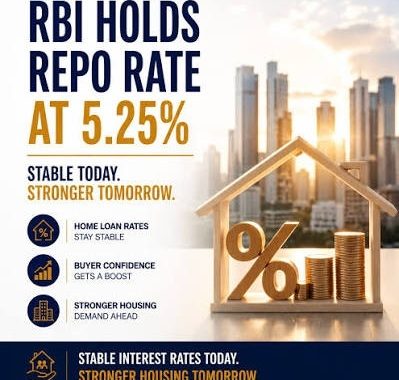
The wider financing backdrop is comparatively benign. The Reserve Bank of India held the repo rate at 5.25 per cent in its August 2026 review, its fourth consecutive pause, retaining a neutral stance. Stable rates do not solve a materials shortage, but they do mean that developers absorbing four extra months of carrying cost are not simultaneously absorbing a rate shock — and that buyers servicing an extended EMI-plus-rent period face a predictable, not rising, monthly outgo.
— Future Outlook —
The immediate question is how uniformly the advisory travels. MoHUA advised; it did not mandate. Each state RERA must issue its own order, and states will differ in speed and in how tightly they draw eligibility. Maharashtra has set a template — automatic relief, clear cut-offs, no application burden — that other authorities would do well to study.
The medium-term question is structural. This episode has demonstrated that Indian real estate delivery timelines are exposed to geopolitical events in shipping lanes thousands of kilometres away. The rational response is not another extension the next time, but procurement resilience: longer-dated material contracts, diversified sourcing, greater use of domestically manufactured substitutes, and precast or modular construction methods that compress on-site dependency on volatile inputs.
Expect, too, a sharper conversation about compensation. If force majeure protects the developer’s timeline, buyers will increasingly ask what protects their carrying cost. Some form of structured rent-offset or milestone-linked relief in future agreements for sale is a plausible next frontier.
— Practical Takeaways —
If you are a homebuyer, log in to the MahaRERA portal and check your project’s revised completion date. The extension is automatic, so your registered date may already have moved — and you are entitled to know by how much. Retain your allotment letter, agreement for sale and every payment receipt; if the eventual delay exceeds four months beyond the revised date, your remedies under Section 18 remain fully intact.
If you are a promoter, do not treat the extension as slack. Document your material-procurement disruption contemporaneously — invoices, supplier communications, shipping records. If the delay is later contested, that file is your defence, and the extension order alone will not be.
If you are a cooperative housing society considering redevelopment, factor the current input-cost environment into your project cost estimates and your developer agreement. Build a materials-escalation clause and a realistic timeline buffer into the agreement now, rather than negotiating one under pressure later.
— Conclusion —
The four-month extension is a reasonable answer to an unreasonable situation. It is legally grounded in Sections 6 and 7(3), administratively efficient in its common-order design, and bounded by cut-offs that limit misuse. MahaRERA deserves credit for moving quickly and cleanly.
But relief is not resolution. The extension buys time; it does not deliver homes. The measure of this decision will not be the elegance of the order — it will be whether, in the last week of the extended window, keys actually change hands. India’s homebuyers have been patient. They have been asked to be patient for four months more.

For nearly 5,000 families living in some of Mumbai’s oldest MHADA colonies at Bandra Reclamation and Adarsh Nagar in Worli, the summer of 2026 has turned into a legal cliffhanger. On July 29, 2026, the Supreme Court of India stepped into a dispute that had already travelled through the Bombay High Court, directing that no work order be issued for the state’s ambitious integrated cluster redevelopment of these two layouts until at least August 13, 2026. The order, passed by a bench of Justice Vikram Nath and Justice Sandeep Mehta, is a temporary pause rather than a final verdict, but it has thrust one of Mumbai’s largest live redevelopment schemes, and the legal architecture behind cluster redevelopment itself, back into the spotlight.
The case, formally titled M.I.G. Adarsh Nagar Co-operative Housing Society Ltd. v. State of Maharashtra & Ors., is being watched closely by housing societies, developers, planners and policymakers alike because it tests the limits of the state’s power to redevelop MHADA layouts without the individual consent of every housing society involved.
Background
The Adarsh Nagar and Bandra Reclamation layouts were built between the 1950s and 1960s to house middle- and lower-income families under the Maharashtra Housing and Area Development Authority’s original mandate. Decades on, the buildings have aged into structurally weak, dilapidated stock, while the land beneath them, some of the most valuable real estate in Mumbai, sits underutilised at low-rise densities. Adarsh Nagar spans about 34.33 acres in Worli and Bandra Reclamation spans about 98.27 acres, together accounting for roughly 132 acres and nearly 5,000 tenements.
Rather than allow each of the dozens of housing societies within these layouts to pursue piecemeal, building-by-building redevelopment, the Maharashtra government opted for an integrated, planned approach. This was formalised through Government Resolutions dated April 25, 2025 and December 15, 2025, which laid out the framework for cluster redevelopment of the two layouts under the state’s broader housing policy, drawing on the cluster redevelopment provisions of Regulation 33(9) of the Development Control and Promotion Regulations, 2034 (DCPR 2034), which apply specifically to MHADA layouts and allow for consolidated redevelopment of multiple buildings in a designated area with enhanced incentive FSI.
MHADA subsequently floated a tender on April 8, 2026 for appointment of a Construction and Development Agency for the project, and Adani Properties emerged as the highest bidder in that process.
Current Developments
Several cooperative housing societies within the two layouts challenged the GRs and the tender before the Bombay High Court, arguing that they were being compelled to join a cluster scheme without the consent of individual flat owners, and that this violated their redevelopment rights. On July 2, 2026, a bench of Justices M.S. Karnik and S.M. Modak delivered a 246-page judgment dismissing the petitions and upholding the state’s policy. The court held that “the city of Mumbai has to grow and keep pace with changing times,” and that integrated planning of infrastructure such as roads, drainage, open spaces, parking and civic amenities across an entire layout served the larger public interest better than fragmented redevelopment by individual societies. It also rejected arguments over MHADA’s decision to convert its own share of the land into an FSI premium under Regulation 33(5), finding nothing contrary to law in that approach.
Crucially, the High Court accepted the state’s assurance that no work order would be issued for four weeks, giving the petitioners a window to approach the Supreme Court. That is exactly what happened. On July 29, the Supreme Court extended this protection, directing that counter affidavits be filed within a week, rejoinders within a further week, and listing the matter for final hearing on August 13, 2026, immediately after fresh matters, while keeping the “no work order” restraint alive in the interim.
Detailed Analysis
The petitioners’ challenge goes well beyond a simple planning disagreement. Their case rests on constitutional grounds, arguing that Regulation 33(9)(4)(a) of DCPR 2034 and Regulation 21(5) of the MHADA Estate Management Regulations, 1981, both of which permit MHADA to drive redevelopment without requiring the consent of every affected society, are violative of Article 14 (equality before law) and Article 300A (right to property) of the Constitution. One petitioning society has also invoked Article 19(1)(c), the freedom to form associations, arguing that compulsory inclusion in the cluster scheme undermines the autonomy of a registered cooperative society under Sections 16 and 17 of the Maharashtra Co-operative Societies Act, 1960.
A particularly pointed strand of the litigation concerns a High Income Group (HIG) society that says the cluster scheme was originally meant for ageing Medium and Low Income Group tenements, not HIG buildings whose flats were sold on full ownership decades ago. That society points to a 2009 Bombay High Court ruling that had already quashed MHADA’s attempt to demand increased prices from it as a precondition for conveyance, and says a related conveyance petition remains pending even as MHADA now seeks to fold its building into the integrated scheme. The same society disputes the transit rent of ₹75,000 a month and a corpus of ₹30 lakh fixed for it, arguing these figures were set unilaterally without any market survey and fall well short of prevailing rates in the Bandra Reclamation micro-market.
MHADA and the state, represented before the Supreme Court by Solicitor General Tushar Mehta along with senior advocates Dhruv Mehta, Mukul Rohatgi and Balbir Singh, have consistently argued that MHADA acts as the planning authority and superior lessor for these layouts, and that courts should show restraint in reviewing executive housing policy unless it is shown to be arbitrary. The Bombay High Court agreed, observing that “in areas of commerce involving financial decisions, a greater latitude is available to the executive.”
Benefits
If the integrated scheme proceeds, the potential upside is considerable. Consolidated redevelopment across a 132-acre footprint allows for properly engineered roads, stormwater drainage, open spaces, parking and fire access, something almost impossible to achieve when 40- and 50-year-old buildings are redeveloped one at a time by different developers with no shared master plan. Residents of qualifying tenements stand to move from cramped, structurally compromised flats into modern housing with better amenities, while the state secures additional housing stock and revenue through FSI premiums, redevelopment being one of the few tools available to add supply in a landlocked, infrastructure-constrained city like Mumbai.
Challenges
The other side of the ledger is just as real. Individual societies, particularly those with ownership histories or entitlements that differ from the layout’s original MIG/LIG intent, feel their specific circumstances are being flattened into a one-size-fits-all scheme. Questions over fair transit rent, corpus adequacy, timelines for possession, and whether “no consent required” redevelopment can coexist with cooperative society autonomy and constitutional property protections are exactly the kind of issues that, if left unresolved, tend to resurface in project after project across the MMR, delaying execution and eroding trust between residents, MHADA and developers.
Expert Opinion
Legal commentators tracking the matter note that the Supreme Court’s order is deliberately narrow: it neither endorses nor overturns the Bombay High Court’s reasoning, but simply preserves the status quo so the constitutional questions can be argued fully. Real estate industry voices, meanwhile, have long argued that integrated cluster redevelopment under Regulation 33(9) is one of the more efficient planning tools available for MHADA colonies, provided implementation includes transparent, market-linked rehabilitation terms so that consent frictions do not become a recurring bottleneck.
Future Outlook
The next milestone is the Supreme Court hearing listed for August 13, 2026. Whatever the outcome, this case will likely shape how future MHADA cluster redevelopment schemes across Mumbai, including comparable layouts elsewhere in the city, are structured, particularly on the questions of consent, compensation benchmarking and treatment of ownership-tenure societies within larger integrated schemes. A ruling that requires broader consultation or revised transit rent and corpus benchmarks could add time and cost to this and future projects, while a ruling upholding the state’s approach would likely accelerate MHADA’s pipeline of large-format redevelopment across the city.
Practical Takeaways
Housing societies inside MHADA layouts slated for cluster redevelopment should keep detailed documentation of their ownership history, prior conveyance correspondence and any market data on rehabilitation benefits, since these are precisely the facts driving outcomes in this case. Developers and investors evaluating redevelopment opportunities tied to government-led integrated schemes should build in contingency for litigation timelines, particularly where compensation terms have been fixed without a documented market survey. Residents awaiting redevelopment benefits should track the August 13 hearing closely, since it will materially affect both timelines and terms.
Conclusion
The Bandra Reclamation-Adarsh Nagar case has become a live test of how far the state can go in pursuing integrated, planned redevelopment of ageing MHADA colonies without individual society consent. With nearly 5,000 families and 132 acres of prime Mumbai real estate at stake, and a Supreme Court hearing just weeks away, this is a story that will directly influence the next phase of Mumbai’s redevelopment story, and one RealNewsOfIndia.com will continue to track as it unfolds.
==================================================
8. KEY TAKEAWAYS
==================================================
The Supreme Court has stayed issuance of any work order for MHADA’s integrated cluster redevelopment of the Adarsh Nagar (34.33 acres) and Bandra Reclamation (98.27 acres) layouts until at least August 13, 2026. The Bombay High Court had earlier upheld the state’s Government Resolutions of April 25, 2025 and December 15, 2025, and the April 8, 2026 tender in which Adani Properties emerged as the highest bidder. Petitioning societies argue the scheme violates Articles 14, 19(1)(c) and 300A of the Constitution and Sections 16-17 of the Maharashtra Co-operative Societies Act by not requiring individual consent. The case will test the constitutionality of Regulation 33(9)(4)(a) of DCPR 2034 and Regulation 21(5) of the MHADA Estate Management Regulations, 1981. The outcome will influence how future MHADA cluster redevelopment schemes across Mumbai are structured on consent and compensation.
==================================================
9. CONCLUSION
==================================================
As the Supreme Court prepares to hear this matter on August 13, 2026, the Bandra Reclamation-Adarsh Nagar dispute stands as a bellwether for how Mumbai balances large-scale, state-led redevelopment against the individual rights of cooperative housing societies, a question with consequences reaching far beyond these two layouts.

Special Correspondnet Realestate by Ai Powered PMC Akbar Jiwani www.youtube.com/societyredevelopment
Mumbai’s skyline is being rewritten one housing society at a time. Across the western and central suburbs, ageing cooperative buildings that have stood for four, five, sometimes six decades are being torn down and replaced with taller, denser, better-planned residential clusters. What was once a fragmented, building-by-building process has, over the past year, evolved into something far more structured and consequential: a citywide redevelopment movement now measured in acres, crores, and tens of thousands of new homes.
According to a report by Knight Frank India, cooperative housing societies signed 70 redevelopment agreements covering 52 acres in the first quarter of 2026 alone. That single quarter’s activity is a meaningful slice of a much larger story — since 2020, Mumbai has seen 1,094 redevelopment projects get underway, spanning 432 acres of the city. Knight Frank estimates these projects could collectively deliver close to 59,000 new homes by 2031, carry a market value of roughly ₹1.5 lakh crore, and generate potential stamp duty revenue of around ₹9,115 crore for the state exchequer. Notably, these figures cover only private cooperative housing society redevelopments and exclude parallel efforts by MHADA and other government bodies, meaning the true scale of Mumbai’s rebuilding is even larger.
From Building-Level Repairs to Neighbourhood-Scale Renewal
For much of the past two decades, redevelopment in Mumbai meant a single ageing building — often a cessed structure or an out-of-repair cooperative society — being handed over to a developer in exchange for larger flats and a temporary rent-free alternative for residents during construction. That model still exists, but the numbers now point to a decisive shift toward something bigger: cluster and neighbourhood-scale redevelopment, where multiple adjoining plots are combined into a single, integrated project.
The Knight Frank data captures this shift clearly. The average redevelopment plot size has grown from around 1,850 square metres in 2025 to nearly 3,000 square metres in 2026, and more than half of all agreements signed in the first quarter of this year involved plots larger than 10,000 square metres. In a city as land-starved and densely packed as Mumbai — home to roughly 30,600 residents per square kilometre, a density far higher than Tokyo, New York or Singapore — combining plots to build bigger, better-planned developments with proper infrastructure, open spaces and amenities is now seen as the only sustainable way forward.
The Policy Push Behind the Numbers
This acceleration has not happened by accident. Industry experts attribute the surge in large-format redevelopment to a combination of regulatory reforms, chief among them amendments to the Development Control and Promotion Regulations (DCPR) 2034 and Maharashtra’s self-redevelopment policy.
Regulation 33(9) of DCPR 2034, which governs the reconstruction or redevelopment of clusters of buildings under Urban Renewal Cluster Development Schemes in Mumbai’s Island City, has been recalibrated in recent revisions to make cluster projects more viable. Changes include adjustments to minimum plot-size requirements outside coastal regulation zones, eligibility for MHADA-reconstructed buildings under 30 years old, incentive FSI increases in non-CRZ areas, and simplified consent requirements that no longer mandate registration of society consent for redevelopment. Together, these tweaks have removed several of the procedural bottlenecks that historically stalled multi-building projects for years.
Running in parallel is the state’s self-redevelopment policy, first introduced via a Government Resolution in September 2019 and since expanded with further incentives. Under this framework, cooperative societies that choose to redevelop themselves — rather than handing the project to a private developer — are eligible for single-window clearance targeted within six months, an additional FSI or carpet area benefit of about 10 percent for buildings on roads narrower than 9 metres, relaxation in premium and open-space deficiency charges, rebates on Transferable Development Rights (TDR), a nominal stamp duty of Rs 1,000 in line with PMAY registration norms, and GST relief. A tripartite arrangement between the contractor, the financing bank and a monitoring committee comprising society and lender representatives has also been built into the framework to improve financial discipline and reduce project delays. As of early 2026, more than 1,600 society proposals are understood to be active under this self-redevelopment route, a sharp rise from just a handful of pilot projects when the policy was first launched.
Where the Redevelopment Wave Is Concentrated
Geographically, the boom remains heavily tilted toward the suburbs. Nearly 95 percent of all redevelopment projects since 2020 are located in suburban Mumbai, with the western suburbs alone accounting for 773 projects against 261 in the central suburbs. Borivali leads the pack with 220 projects, followed by Andheri with 115, Bandra with 75, Malad with 68 and Ghatkopar with 59. Kandivali, Vile Parle, Goregaon, Chembur and Mulund round out the list of active markets.
Interestingly, the redevelopment story is now intersecting with a separate but related trend: the rise of coastal and creek-facing micro-markets as Mumbai’s next luxury growth corridor. Real estate consultancy JLL has pointed to a coastal luxury redevelopment pipeline with a gross development value of around ₹6,000 crore, comprising 75-80 projects and more than 250 residential units expected to come to market over the next eight to nine quarters. Infrastructure upgrades are a major catalyst here — the Mumbai Coastal Road has cut travel time between Worli and Marine Drive from roughly 35-40 minutes to under 15 minutes, while the upcoming Versova-Bandra Sea Link is expected to bring travel time between Versova and Bandra down from 45-60 minutes to a similar 10-15 minute window. As connectivity improves, redevelopment interest is expected to push further north into Malad, Borivali and the extended western corridor, extending the luxury redevelopment story well beyond its traditional Bandra-Worli-Juhu core.
The Benefits: Bigger Homes, Better Infrastructure, Real Revenue
For residents, the shift to cluster and neighbourhood-scale redevelopment offers tangible upgrades over the old building-by-building model: larger carpet areas, modern amenities, structured parking, improved fire and structural safety, and a coordinated approach to roads, drainage and open spaces that individual building redevelopment could never deliver. For the state, the fiscal upside is substantial — potential stamp duty collections of over ₹9,000 crore from these projects alone represent a meaningful, recurring revenue stream tied directly to urban renewal rather than fresh land consumption. And for the city as a whole, redevelopment offers a way to add housing stock without expanding Mumbai’s already-strained geographic footprint, making better use of land that is currently occupied by structurally compromised, decades-old buildings.
The Challenges That Remain
The picture is not without friction. A large share of Mumbai’s recently completed housing stock remains unsold — property research firm Liases Foras pegs unsold inventory across the Mumbai Metropolitan Region at approximately 288,850 homes, with affordability constraints widely cited as the primary reason for slow absorption. This raises a legitimate question about whether the pace of redevelopment-driven supply, expected to add nearly 59,000 homes by 2031, will be matched by genuine end-user demand at prevailing price points, or whether it risks adding to an already substantial overhang.
Redevelopment is also reshaping the rental market in less visible but significant ways. As residents vacate ageing buildings during construction, demand for interim rental housing has risen sharply — by March 2026, redevelopment-related displacement accounted for nearly 8 percent of Mumbai’s total rental demand, according to Knight Frank’s estimates. This is pushing up rents in areas adjacent to active redevelopment sites and adding a layer of housing stress for displaced families, particularly where construction timelines slip.
Legal and procedural friction also persists. Even with DCPR reforms, cluster redevelopment under Regulation 33(9) continues to face what legal commentators describe as unresolved questions around contiguity requirements and the “arterial road proviso” that governs how adjoining plots can be clubbed. Meanwhile, MahaRERA continues to clarify the boundaries of its own jurisdiction — the authority ruled in July 2026 that it cannot direct developers on matters such as restricting tenants’ or guests’ access to society clubhouses, since such disputes fall outside the scope of the RERA Act, underscoring that not every redevelopment-related grievance has a straightforward regulatory remedy.
What Industry Voices Are Saying
Ritesh Mehta, senior director of residential advisory services at JLL India, has pointed to improving infrastructure as the single biggest catalyst reshaping demand patterns along Mumbai’s coastline, noting that markets once constrained by poor connectivity are now positioned as the city’s next residential growth corridor. Knight Frank’s research team, meanwhile, frames the shift toward larger plot sizes and cluster agreements as evidence that both societies and developers increasingly recognise the limits of piecemeal, single-building redevelopment in a city where land is this scarce. The consistent message from advisory firms tracking this space is that policy support — from DCPR amendments to self-redevelopment incentives — has been the decisive factor unlocking projects that were commercially unviable just a few years ago.
Looking Ahead
If current momentum holds, Mumbai’s redevelopment pipeline looks set to remain one of the most active drivers of the city’s real estate market through the rest of this decade. The combination of a deeper self-redevelopment ecosystem, more permissive cluster regulations, and improving infrastructure along the coast suggests that both the pace and scale of projects will continue to grow, with neighbourhood-level transformation becoming the norm rather than the exception in suburban Mumbai. The state government’s continued fine-tuning of DCPR provisions and self-redevelopment incentives will likely determine how quickly the remaining backlog of ageing, structurally unsafe buildings across the city gets addressed.
At the same time, the sector’s long-term health will depend on whether new supply is calibrated to genuine affordability and absorption, rather than simply scaling up because financing and regulatory conditions currently allow it. Balancing the undeniable urban-renewal benefits of redevelopment against the risk of oversupply in a market still working through a substantial unsold inventory will be one of the defining challenges for policymakers, societies and developers alike over the next few years.
Practical Takeaways for Housing Societies and Homebuyers
Societies considering redevelopment should evaluate whether cluster or neighbourhood-scale participation with adjoining plots offers better terms than a standalone project, given the FSI and planning advantages larger schemes now enjoy under DCPR 2034. Those leaning toward self-redevelopment should factor in the documented benefits of the state’s GR-based incentive package, including the six-month single-window clearance target, additional FSI on narrow roads, and TDR and stamp duty relief, while ensuring a properly structured tripartite financing and monitoring arrangement is in place before construction begins. Prospective buyers evaluating redeveloped or under-construction inventory should weigh the current unsold stock overhang across the Mumbai Metropolitan Region when negotiating price and possession timelines, and should independently verify MahaRERA registration, project-specific approvals, and the developer’s or society’s track record before committing.
Conclusion
Mumbai’s redevelopment story in 2026 is no longer about isolated buildings quietly changing hands between residents and developers. It has become a structural, policy-driven transformation of how the city renews itself — bigger plots, integrated planning, and a genuine push toward addressing decades of housing stock that has simply outlived its structural life. The ₹1.5 lakh crore question now is whether Mumbai can convert this construction momentum into homes that residents can actually afford to move into, and whether the regulatory scaffolding built over the past few years is strong enough to sustain the pace without compromising on safety, planning quality or resident welfare.
==========================================
8. KEY TAKEAWAYS
==========================================
Cooperative housing societies signed 70 redevelopment agreements covering 52 acres in Q1 2026, part of a broader pipeline of 1,094 projects across 432 acres since 2020 (Knight Frank India). The average redevelopment plot size has grown from about 1,850 sq m in 2025 to nearly 3,000 sq m in 2026, reflecting a shift toward cluster and neighbourhood-scale projects. Policy reforms — DCPR 2034 amendments to Regulation 33(9) and Maharashtra’s self-redevelopment GR incentives — are the primary catalysts, with over 1,600 self-redevelopment proposals now active statewide. The pipeline could add nearly 59,000 homes by 2031, carrying an estimated market value of ₹1.5 lakh crore and potential stamp duty revenue of ₹9,115 crore. Challenges include an MMR-wide unsold inventory of about 288,850 homes, rising rental pressure from displaced residents (8% of Mumbai’s rental demand by March 2026), and unresolved legal questions around cluster contiguity rules.
==========================================
9. CONCLUSION
==========================================
Mumbai’s redevelopment wave has matured from scattered, building-level projects into a coordinated, policy-backed movement reshaping entire neighbourhoods. With strong regulatory tailwinds and mounting society participation, the momentum looks durable — but its long-term success will hinge on aligning new supply with real affordability, ensuring displaced residents are not left bearing disproportionate rental costs, and closing the remaining gaps in cluster redevelopment law. Get this balance right, and Mumbai has a genuine shot at renewing itself at scale over the coming decade.

Mumbai | July 2026
Real Voice Foundation, under the leadership of President S. M. Fanus and Secretary Mehndi Ali, has been actively working for the dignity, inclusion, and welfare of the transgender (Kinner) community for several years. Through initiatives such as the annual Kinner Day celebrations and various social awareness campaigns, the Foundation continues to promote equal rights and opportunities for transgender individuals.
Recognizing the many challenges faced by the community—including lack of access to education, housing, employment, financial support, skill development, legal assistance, and awareness of government welfare schemes—Real Voice Foundation has joined hands with Sisterhood Community to strengthen support for those in need.
The initiative is led by Founder Eesha Agrawal, along with Dr. Rajesh Srivastava and social activist Archana Mohan Sharma, who are committed to creating opportunities for empowerment and social inclusion.
As part of this mission, a Kinner Community Interaction & Awareness Program will be held on Sunday, 26 July 2026, at 12:30 PM at Bandra Hindu Association, Linking Road, Bandra West, Mumbai.
The program is expected to bring together 20 to 50 members of the transgender community. It will provide a platform for participants to share their experiences and challenges while connecting them with guidance on education, skill development, self-employment, legal aid, financial support, and government welfare schemes.
The organizers believe that meaningful dialogue, community participation, and collaborative action can help build a more inclusive society where transgender individuals receive the dignity, respect, and equal opportunities they deserve.
Citizens, social organizations, professionals, and supporters are invited to participate and contribute to this important initiative toward equality and social justice.

Knight Frank data shows 80,000+ property registrations in H1 2026, the best half-year since 2013, even as MMR homebuyers spend 69% of household income servicing home loan EMIs
Introduction
Mumbai’s residential real estate market has just delivered its best half-yearly performance in thirteen years, a milestone that on paper reads like unambiguous good news for developers, brokers and the state exchequer alike. Yet tucked inside the same data set is a more sobering reality: the city remains, by a wide margin, the least affordable housing market in India. The story of Mumbai real estate in the first half of 2026 is therefore not a simple tale of a booming market, but a study in contrast — record volumes built on a widening base of buyers, set against a home-ownership cost burden that continues to test the limits of household budgets. For anyone tracking the Mumbai Metropolitan Region, understanding both halves of this picture is essential to reading where the market goes next.
Background
Mumbai’s property registration numbers, compiled from stamp duty and registration data and analysed by property consultancy Knight Frank India, have long served as one of the most reliable real-time indicators of housing demand in the country, since every sale, resale and long-term lease above a threshold value must be registered and duty-paid with the state government. Over the past decade, this data series has captured the market’s slow climb out of the post-demonetisation and pre-RERA slowdown of 2016-2018, its pandemic-era volatility in 2020-2021, and its subsequent recovery, aided by stamp duty cuts, historically low interest rates and a wave of new project launches across the Mumbai Metropolitan Region. By 2025, registrations had already surpassed pre-pandemic peaks; the first half of 2026 has now pushed that recovery into genuinely record territory.
Current Developments
According to Knight Frank India, the city under Brihanmumbai Municipal Corporation (BMC) jurisdiction recorded 80,221 property registrations across primary and secondary segments in the six months to June 2026, up 6 percent year-on-year and the strongest first-half performance since 2013. Stamp duty collections from these transactions rose 4 percent year-on-year to Rs 6,968 crore. The momentum was especially visible in June 2026 alone, which logged 13,302 registrations, a 15 percent year-on-year jump and the highest figure for the month of June in fourteen years, with the state exchequer collecting roughly Rs 1,077 crore in stamp duty for the month. Registrations in June also rose 7 percent over May 2026, while stamp duty revenue for the month grew a more modest 2 percent, a gap that Knight Frank’s leadership flagged as significant.
Shishir Baijal, International Partner, Chairman and Managing Director of Knight Frank India, noted that Mumbai’s residential market “has maintained its strong momentum, with June 2026 recording the highest property registrations for the month in the past 14 years,” adding that this was achieved despite an already high base set in the previous year, underscoring what he called the resilience of end-user demand and sustained homebuyer confidence.
At almost the same time, Knight Frank’s H1 2026 Affordability Index delivered the other half of the story. The report found that the Mumbai Metropolitan Region’s affordability index stood at 69 percent in the first half of 2026, unchanged from 2025, meaning the average homebuyer must commit 69 percent of household income to service the EMI on a standard housing unit. Anything above 50 percent is generally regarded by lenders and analysts as financially unsustainable. MMR and the National Capital Region were the only two of India’s eight largest markets to remain above that threshold, making Mumbai officially the least affordable city in the country for home ownership, even after accounting for the Reserve Bank of India’s cumulative 125 basis points of rate cuts over the preceding year.
Detailed Analysis
Read together, these two data points describe a market where volume and value are moving in different directions. Registrations are climbing faster than stamp duty collections, a pattern Knight Frank explicitly attributes to a shift in the transaction mix toward the mid-market segment rather than high-value luxury deals. In other words, more households are transacting, but the average ticket size per transaction is not rising at the same pace, and in some readings is moderating. This is consistent with wider industry commentary suggesting the Rs 80 lakh to Rs 2 crore price band now accounts for the largest share of Mumbai’s residential transactions, with demand increasingly concentrated among salaried, aspirational buyers in the Western Suburbs, Thane, Kharghar and Panvel rather than solely in South Mumbai’s premium corridors.
At the same time, the Reserve Bank of India’s Monetary Policy Committee has held the repo rate steady at 5.25 percent through its February and June 2026 reviews, following an earlier easing cycle, a pause driven by caution around geopolitical tensions, energy prices and monsoon-linked inflation risks. Stable financing costs have removed one major source of uncertainty for both developers planning launches and buyers timing purchases, which helps explain why registration volumes have stayed close to post-pandemic highs even without further rate cuts. But stable EMIs on a high principal amount still translate into a high absolute affordability burden, particularly in a city where land scarcity, elevated construction costs and premium FSI charges keep base prices among the steepest in the country.
Benefits
The record H1 2026 numbers carry genuine, broad-based benefits. For the state government, higher registration volumes and steady stamp duty growth strengthen Maharashtra’s revenue base at a time when urban infrastructure spending, from Metro expansion to coastal road and redevelopment financing, needs sustained funding. For developers, sustained end-user demand across the mid-market segment provides more predictable absorption for new launches, reducing unsold inventory risk and supporting healthier project cash flows, which in turn can be reinvested into faster construction timelines. For genuine homebuyers, a market where demand is “broad-based across buyer segments,” as Knight Frank describes it, rather than concentrated in ultra-luxury deals, suggests a healthier, more inclusive growth pattern than one driven purely by high-net-worth or investment-led purchases. Homeowners who already hold property in Mumbai also benefit from a market that continues to demonstrate price resilience and liquidity, both important for long-term wealth preservation.
Challenges
The affordability data, however, is a genuine structural challenge rather than a cyclical blip. A 69 percent EMI-to-income ratio, held flat for two consecutive years despite meaningfully lower interest rates, indicates that price appreciation in Mumbai is effectively absorbing the entire benefit of cheaper borrowing before it reaches the ordinary buyer. This has knock-on effects: it pushes first-time buyers further into the suburbs and satellite towns of the Mumbai Metropolitan Region, sustains high rental demand from those unable to buy, and keeps home ownership skewed toward buyers with existing family wealth, dual incomes, or access to larger down payments. It also raises the stakes for redevelopment and affordable housing policy, since expanding supply within city limits, rather than only on the periphery, is one of the few levers available to meaningfully change the affordability equation without relying solely on interest-rate cycles that are, in any case, largely exhausted for now.
Expert Opinion
Industry voices broadly frame the current phase as one of resilience tempered by realism. Baijal’s own commentary captures this balance: strong registration growth reflects genuine end-user confidence, but he has also been clear that rising property prices have reduced some of the gains achieved through lower interest rates, and that stable employment, healthy income growth and balanced market fundamentals will be crucial to sustaining demand going forward, rather than financing costs alone. This view is echoed across the wider brokerage and consultancy community, where the consensus is that Mumbai’s market has matured beyond being purely rate-sensitive; today it responds more to job security, income growth and supply-side factors such as new project launches in the mid-segment corridors of the MMR.
Future Outlook
Looking into the second half of 2026, the near-term trajectory appears constructive but not without caveats. With the repo rate expected to stay steady in the immediate term amid global uncertainty, financing costs are unlikely to swing sharply in either direction, which should support continued stability in registration volumes. Developer launch pipelines across Thane, Navi Mumbai, and the Western Suburbs remain skewed toward the mid-segment, which should keep transaction volumes healthy even if average ticket sizes stay moderate. The bigger swing factor for affordability will be land and construction cost trends, along with how aggressively redevelopment policy in Mumbai — spanning cooperative housing societies, MHADA colonies and slum rehabilitation schemes — succeeds in adding usable housing stock within the city rather than only at its edges. Should that supply pipeline accelerate meaningfully, it could, over a multi-year horizon, begin to ease the affordability index in a way that rate cuts alone have not managed to achieve.
Practical Takeaways
For homebuyers, the current environment rewards patience and clarity of budget: with EMIs stable, the priority should be locking in a loan quantum that stays well within comfortable repayment capacity, rather than stretching to the affordability ceiling based on today’s rates alone. For end-users eyeing the mid-segment, the suburban and MMR-periphery micro-markets currently driving volume growth are worth close evaluation, both for pricing and for improving connectivity. For developers, the data reinforces that launches priced and sized for the Rs 80 lakh to Rs 2 crore band are likely to see the most consistent absorption in the near term. For policymakers, the flat affordability index despite lower rates is itself a signal that supply-side interventions, including faster redevelopment approvals and additional FSI for genuinely affordable projects, deserve renewed urgency.
Conclusion
Mumbai’s real estate market enters the second half of 2026 in a genuinely unusual position: simultaneously at its strongest in over a decade by volume, and at its most financially demanding by affordability. Both facts are true, and both matter. The record registrations confirm that confidence in Mumbai property as an asset class, and as a place to build a home, remains firmly intact. The stubborn 69 percent affordability ratio is a reminder that confidence and accessibility are not the same thing, and that the city’s next phase of growth will be judged not only by how many homes are sold, but by how many more households can genuinely afford to buy one.
8. Key Takeaways
Mumbai recorded 80,221 property registrations in H1 2026, up 6% year-on-year and the strongest first-half performance since 2013, per Knight Frank India. Stamp duty collections rose 4% YoY to Rs 6,968 crore over the same period. June 2026 alone saw 13,302 registrations, a 15% YoY jump and the highest June figure in 14 years. Despite the RBI holding the repo rate steady at 5.25% through H1 2026 following earlier rate cuts, Knight Frank’s Affordability Index shows MMR homebuyers still spend 69% of household income on EMIs, unchanged from 2025 and the highest ratio among India’s eight largest cities. The gap between fast-growing registration volumes and slower-growing stamp duty revenue points to a shift toward mid-market transactions rather than high-value luxury deals.
9. Conclusion
Mumbai’s property market closed the first half of 2026 on its strongest footing in thirteen years, driven by broad-based, end-user demand across the mid-market segment and supported by stable financing conditions. Yet the city’s affordability index, unchanged at 69% of household income for EMI servicing, shows that record sales volumes have not yet translated into meaningfully easier home ownership. The road ahead will depend on how effectively supply-side measures, from redevelopment to affordable housing incentives, can complement a financing environment that has already given the market most of the tailwind it is likely to offer in the near term.
With MahaRERA’s landmark retirement-home regulations, a new state housing policy, and developers committing thousands of crores, senior living is emerging as Indian real estate’s fastest-growing — and most under-served — segment
Introduction
For decades, India’s real estate industry has been built almost entirely around the young family buyer — the first-time homeowner, the upgrading nuclear family, the investor chasing rental yield near a metro corridor. Almost unnoticed until recently, a parallel demand has been building at the other end of the age spectrum. India is ageing faster than its housing stock is adapting to that reality, and 2026 is shaping up as the year the real estate industry, regulators and policymakers finally began treating “senior living” as a distinct, investable asset class rather than a niche afterthought. Nowhere is this shift more visible than in Maharashtra, where MahaRERA, the state’s cooperative housing framework, and a wave of developer capital are converging around the needs of the elderly.
Background
India’s demographic arithmetic is stark. The population aged 60 and above stood at roughly 153 million in 2020 and is projected to more than double to about 347 million by 2050, lifting the elderly share of the population from around 11 percent to nearly 21 percent. Industry estimates suggest India will add close to 30 million people to the 60-plus cohort between 2025 and 2030 alone. Yet the organised senior living sector — purpose-built communities with healthcare access, safety design and community programming — remains minuscule. Industry research puts the organised senior housing stock at only around 22,157 units nationally against a base of more than 162 million seniors, meaning penetration is well under one percent of the addressable population. That gap between demographic need and built supply is precisely what is now drawing regulatory attention and developer capital.
Current Developments
Maharashtra has moved first and furthest among Indian states on this front. In May 2024, the Maharashtra Real Estate Regulatory Authority (MahaRERA) became the first real estate regulator in the country to notify dedicated guidelines for retirement housing, through an order formalising “Regulations for Retirement Homes in the State of Maharashtra.” The order lays down minimum physical specifications that any project must meet before it can be marketed or advertised as a “retirement home” — a significant consumer-protection step in a segment that had previously been loosely defined and inconsistently delivered.
The MahaRERA specifications are granular and safety-first. Buildings with more than one floor must have lifts sized for wheelchairs and mobility aids, fitted with audio and visual signalling; door openings must be at least 900 mm wide; staircases require handrails on both sides with senior-appropriate tread and riser dimensions, illuminated with fluorescent or radium strips; corridors must avoid level changes, using ramps instead of steps wherever unavoidable; kitchens must have gas-leak detection systems; bathrooms must have anti-skid tiles, outward-opening doors and grab rails near wash basins; every apartment must have power backup, particularly for kitchens and bathrooms; and emergency alarms are mandated at entry doors, bathrooms, bedrooms and common areas. The guidelines also encourage maximum use of non-polluting, renewable energy sources to reduce seniors’ exposure to combustion fumes.
This regulatory groundwork has been reinforced at the policy level. The Maharashtra State Housing Policy, 2025, approved by the state government in May 2025 following an extended draft and stakeholder consultation process that began in 2024, formally establishes “Senior Citizen Housing” as a distinct building category within the state’s Unified Development Control and Promotion Regulations (UDCPR) framework. The policy package includes lower stamp duty for elderly buyers and specific incentives for developers building senior-living communities, alongside requirements around recreational areas, round-the-clock ambulance access, and on-site nursing stations.
Detailed Analysis
The regulatory push is arriving in tandem with a wall of developer capital. Industry market-sizing from research firms places India’s senior living real estate market at approximately USD 4.47 billion in 2026, projected to expand to roughly USD 14.14 billion by 2031 — a compound annual growth rate of nearly 26 percent, comfortably outpacing most mainstream residential segments. Separately, industry estimates peg the addressable opportunity at around 2.3 million units of demand by 2030, translating into an estimated ₹64,500 crore market opportunity, against an organised sector currently valued at only about ₹25,000 crore.
Listed and established players are moving to capture this gap. Ashiana Housing, one of the pioneers of India’s senior-living format, reported record senior-living sales of ₹570.2 crore in FY26 and has committed roughly ₹425 crore toward expanding this portfolio, with a further ₹800 crore earmarked for land acquisition in FY27. The company is targeting ₹2,000 crore in senior-living revenue with a pipeline of five to six new projects, aiming to roughly triple sales in this segment within four years. Columbia Pacific’s Serene Communities has announced plans to commit close to ₹3,000 crore toward senior housing projects across Bengaluru, Chennai, Hyderabad, Pune and Kochi, with unit pricing typically ranging between ₹70 lakh and ₹1.5 crore. Groups including Max Estates and Brigade have also signalled dedicated capital and land-bank commitments to the category.
The Mumbai-Pune corridor is emerging as a particular hotspot, benefiting from proximity to metropolitan healthcare infrastructure combined with the calmer, greener settings seniors typically prefer. Projects such as Nyati Senior Living within Pune’s Nyati County township (dedicating roughly 3.64 lakh square feet exclusively to senior living), Ashiana Utsav around 64 km from Pune, and hillside communities near Talegaon in the Sahyadri foothills illustrate a format that blends accessibility to the city with a quieter living environment. Industry data suggests occupancy rates in Mumbai’s senior housing segment are running at a striking 80 to 90 percent, among the strongest demand signals in any residential sub-category currently tracked in the region.
Benefits
For the elderly population, the shift toward regulated, purpose-built senior housing promises tangible safety and dignity dividends: fall-prevention design, on-call medical response, community engagement that addresses isolation, and legal clarity on what a “retirement home” actually guarantees a buyer. For developers, the segment offers diversification away from cyclical mainstream housing demand, premium realisations, and — under Maharashtra’s new policy — fiscal incentives including stamp duty relief that improve project economics. For the state, formalising the category ahead of demographic pressure allows planning authorities to shape supply before the elderly population surge of the 2030s and 2040s arrives, potentially easing pressure on public healthcare and eldercare infrastructure later.
Challenges
The gap between potential and delivery remains substantial. Sub-one-percent penetration of the addressable elderly population indicates that supply is nowhere near matching demographic need, and much of what has been built so far is concentrated in the premium price band, leaving middle- and lower-income seniors underserved. Land costs in and around Mumbai make compliance with generous, low-rise, amenity-heavy design standards commercially difficult without policy support, which is one reason many large-format projects are gravitating toward peripheral locations like Pune, Lonavala and Talegaon rather than the island city itself. Operational complexity is another hurdle: unlike conventional residential sales, senior living requires ongoing healthcare staffing, food service, and emergency response — a services business layered on top of a real estate one, demanding capabilities many traditional developers do not yet have in-house. Finally, family and cultural attitudes toward institutional-style senior living are still evolving in India, meaning marketing and trust-building remain as important as construction quality.
Expert Opinion
Industry commentary accompanying recent market research has repeatedly framed senior living as India’s “next big real estate opportunity,” pointing to today’s seniors being more financially independent, better travelled and more open to purpose-built community formats than previous generations — a marked shift from the assumption that Indian elders will always be housed within joint or extended-family arrangements. Consultancy analysis on the segment has also noted that strong absorption and long waitlists at existing ready-to-move-in communities indicate genuine, underserved consumer demand rather than speculative developer enthusiasm, reinforcing the view that the category’s current capital commitments reflect calculated confidence rather than a passing trend.
Future Outlook
With MahaRERA’s retirement-home regulations now in force, Maharashtra’s Housing Policy 2025 formally recognising the category, and national demographic trends only intensifying through the 2030s, senior citizen housing looks set to move from a niche experiment to a mainstream real estate vertical over the next five years. Expect more state RERAs to follow Maharashtra’s lead with their own retirement-home standards, continued capital deployment from listed housing companies, and gradual expansion of the format beyond the premium segment as construction costs and operating models mature. The Mumbai Metropolitan Region, given its healthcare density and ageing urban population, is likely to remain at the centre of this growth story.
Practical Takeaways
Families evaluating a retirement-home purchase in Maharashtra should verify that a project explicitly complies with MahaRERA’s retirement-home order rather than assuming that generic marketing language equates to regulatory compliance. Buyers should ask specifically about lift accessibility, ramp versus step design, emergency alarm placement, and the presence of on-site nursing or medical response arrangements before committing. Developers entering the segment should treat healthcare service delivery as a core operating competency, not an outsourced afterthought, and should evaluate peripheral MMR and Pune-belt locations where land economics support the low-rise, amenity-rich design the category demands. Policymakers and municipal planners would do well to extend targeted incentives, of the kind now available under the state housing policy, to a wider range of income bands so that senior housing does not remain the preserve of the affluent alone.
Conclusion
India’s senior citizen housing segment sits at a rare intersection of demographic certainty, regulatory momentum and rising developer capital — a combination that has historically preceded rapid growth in other Indian real estate sub-sectors. Maharashtra’s early regulatory action through MahaRERA and its 2025 housing policy gives the state a head start in a race that will only become more urgent as the country’s elderly population swells over the coming decades. For an industry accustomed to building for the young family, learning to build for the ageing one may prove to be one of the more consequential shifts of this decade.
8. Key Takeaways
MahaRERA became India’s first regulator to notify dedicated retirement-home standards in May 2024, covering accessibility, safety and emergency-response design. Maharashtra’s State Housing Policy, 2025, formally recognises “Senior Citizen Housing” as a distinct UDCPR category with stamp duty and incentive support. India’s senior living real estate market is estimated near USD 4.47 billion in 2026, projected to reach USD 14.14 billion by 2031 at a near-26 percent CAGR. Organised senior housing supply covers well under one percent of India’s 162-million-plus elderly population, leaving a large demand-supply gap. Developers including Ashiana Housing and Columbia Pacific’s Serene Communities have committed hundreds to thousands of crores toward new senior-living projects, with the Mumbai-Pune corridor emerging as a key growth belt.
9. Conclusion
Senior citizen housing is transitioning from a peripheral real estate niche to a regulated, capital-backed growth segment, with Maharashtra’s MahaRERA framework and 2025 housing policy positioning the state as an early mover ahead of India’s accelerating demographic shift toward an older population.

Chapter XI-B of the Maharashtra Co-operative Societies (Amendment) Rules, 2026 brings 51% consent for redevelopment, capped interest and non-occupancy charges, video-conferencing for general body meetings, and easier institutional finance for self-redevelopment
===================================================
3. FEATURED IMAGE PROMPT
===================================================
Photorealistic, ultra-HD 16:9 landscape editorial photograph shot at golden hour in Mumbai, Maharashtra. Foreground shows a diverse group of Indian residents — men and women of different ages including senior citizens — seated in a well-lit cooperative housing society community hall, reviewing documents and raising hands to vote at a general body meeting, with a laptop displaying a video conference call visible on a side table. Background through large windows reveals a mid-rise redevelopment construction site with cranes and a partially completed residential tower under a warm evening sky, alongside older 1970s-style Mumbai apartment blocks for contrast. Natural lighting, shallow depth of field, documentary editorial photography style, realistic textures, no text overlays, no watermarks, no copyrighted logos, no brand names visible.
===================================================
4. IMAGE CAPTION
===================================================
Residents of a Mumbai co-operative housing society attend a general body meeting under the new Chapter XI-B rules, which now permit video-conferencing participation and set a 51% consent threshold for redevelopment decisions.
===================================================
5. ALT TEXT
===================================================
Indian housing society residents in a general body meeting discussing redevelopment under Maharashtra’s new Co-operative Societies Amendment Rules 2026, with a building construction site visible in the background.
===================================================
6. SEO FILENAME
===================================================
maharashtra-cooperative-housing-society-rules-2026-redevelopment.jpg
===================================================
7. FULL ARTICLE
===================================================
INTRODUCTION
Maharashtra’s cooperative housing sector — home to tens of thousands of societies across Mumbai, Pune, Thane, Nagpur and beyond — has just received its most sweeping rulebook overhaul in decades. On June 18, 2026, the Co-operation, Marketing and Textiles Department of the Government of Maharashtra notified the Maharashtra Co-operative Societies (Amendment) Rules, 2026 (Notification No. Sanini 0321/C.R. 41/13C), issued under Section 165 of the Maharashtra Co-operative Societies Act, 1960. The amendment inserts an entirely new Chapter XI-B into the Maharashtra Co-operative Societies Rules, 1961, dedicated specifically to co-operative housing societies. The rules took effect from June 30, 2026, and are already being described by legal and real estate practitioners as the most consequential housing-society reform since the redevelopment consent threshold was first eased.
For a state where redevelopment of ageing, structurally distressed buildings has become an urban necessity rather than a choice, and where disputes over maintenance charges, parking and managing-committee conduct routinely land in the Co-operative Court, this notification matters to an enormous cross-section of Maharashtra’s urban population.
BACKGROUND
Housing societies in Maharashtra have long operated under the Maharashtra Co-operative Societies Act, 1960 and the 1961 Rules, supplemented by model bye-laws and a patchwork of government circulars. Over the past two years, the state had already begun liberalising the redevelopment process — most notably by lowering the member-consent threshold required to initiate redevelopment from 70% to 51%, and by setting up a Self-Redevelopment Cell backed by an initial corpus of roughly ₹2,000 crore to help societies navigate planning, financing, developer selection and execution on their own terms rather than through third-party developers. That shift was part of a broader state housing policy unveiled in 2025 that envisaged tens of thousands of crores of investment across slum rehabilitation, affordable housing and redevelopment.
What Chapter XI-B does is codify and considerably expand that direction — converting what were largely policy circulars and administrative practice into binding statutory rules that every registered housing society, managing committee, developer, architect and legal consultant must now follow.
CURRENT DEVELOPMENTS
The new Chapter XI-B is unusually comprehensive. It covers registration and name reservation for societies, membership (including joint and provisional members), nomination and transfer of shares after a member’s death, the newly recognised categories of “Co-operative Housing Associations” and “Associations of Societies,” governance of the managing committee and general body, redevelopment procedure, recovery of dues, borrowing limits, and the statutory funds every society must maintain.
Several provisions stand out for their immediate, practical impact. General body meetings — both annual and special — may now be attended through video conferencing or other audio-visual means, provided the society records and stores proceedings along with date and time, a significant convenience for NRI members, senior citizens and members who live outside the city. The quorum for a general body meeting is fixed at two-thirds of total members or twenty members, whichever is less; if that quorum is not met for a requisitioned meeting, it stands dissolved, but in other cases it is simply adjourned to a later date (not earlier than seven days, not later than thirty) and can then proceed regardless of quorum. Ordinary AGM decisions require a 51% majority of members present, including those on video conference.
Redevelopment gets its own, more rigorous procedure. A special general body meeting to decide on redevelopment requires fourteen clear days’ notice, a quorum of two-thirds of total members, and must be conducted in the presence of a representative of the Registrar, who is required to submit a factual report on how the meeting was conducted. The resolution selecting a developer or contractor is passed by a 51% majority of total members, including those participating virtually, and the entire proceeding must be video-recorded, with the recording kept by the society’s chairman and a copy filed with the jurisdictional Assistant or Deputy Registrar of Co-operative Societies.
On finance, the rules materially ease access to capital. A housing society with limited liability generally cannot borrow beyond ten times its paid-up share capital, reserve fund, members’ contribution towards land and building, and building fund (net of accumulated losses). But for self-redevelopment and self-development specifically, the new Rule 106C-10 allows a society to borrow up to ten times the value of its land, based on a valuation report from a government-approved valuer — a direct enabler of institutional bank and NBFC financing for societies that choose to redevelop themselves rather than engage a developer.
DETAILED ANALYSIS
The financial-discipline provisions are arguably the reform’s most far-reaching element for ordinary flat owners. Societies must now maintain a defined basket of statutory funds: a Reserve Fund (built from entrance fees, transfer premiums, allocated surplus and donations), a Sinking Fund (minimum 0.25% per annum of each flat’s certified construction cost, earmarked for heavy repairs), a Repair and Maintenance Fund (minimum 0.75% per annum of construction cost, for routine repairs), a Major Repair Fund (pro-rata on carpet area for significant works), plus Education and Training, Election, Welfare and Corpus funds as needed. Alongside this, industry reporting on the rules indicates a cap of 10% of service charges on non-occupancy charges, a ceiling of 12% per annum interest on delayed maintenance payments (down sharply from the 21% many societies were charging), uniform service charges across all flats regardless of size or floor, and a requirement that parking allotment be decided by the general body rather than left to committee discretion — provisions clearly aimed at curbing the arbitrary levies and committee overreach that have long fuelled society disputes.
Read alongside the Development Control and Promotion Regulations, 2034, the reform gains further teeth. Regulation 33-7-B already grants private societies more than 30 years old an incentive of 10 square metres of additional area per tenement, or 15% of existing authorised built-up area — whichever is greater — consumable within the permissible FSI itself, reducing a redeveloping society’s dependence on costly premium FSI and TDR purchases. Combined with the new borrowing headroom for self-redevelopment, the direction of state policy is unmistakable: make self-redevelopment financially and procedurally viable as a genuine alternative to developer-led redevelopment, while tightening governance safeguards so that whichever route a society chooses, the process is transparent, recorded and Registrar-supervised.
BENEFITS
For ordinary members, the gains are tangible: lower, predictable maintenance-related costs; a formal say in parking allocation; the ability to participate in decisive meetings without physically travelling, which particularly helps NRI owners and the elderly; and mandatory video documentation of the meetings that decide a redevelopment developer, reducing scope for manipulation or later disputes over what was actually resolved. For societies pursuing self-redevelopment, easier access to loans of up to ten times land value — without having to hand a chunk of profit margin to a third-party developer — could materially improve the economics of staying in control of one’s own redevelopment project. For the state, codifying practice into binding rules should reduce the volume of governance-related litigation clogging Co-operative Courts and Registrar offices.
CHALLENGES
Implementation will be the real test. Video-recording every redevelopment SGM and filing copies with the Registrar’s office adds a compliance burden many volunteer-run managing committees are not equipped to handle without professional help. Ensuring a Registrar’s representative is actually present at every redevelopment meeting statewide, given the sheer number of societies in Mumbai Metropolitan Region alone, will strain administrative capacity. Mandatory minimum contributions to Sinking and Repair funds, while prudent long-term, will raise monthly outgoings for some members in the near term. And smaller, financially weaker societies may still struggle to raise the collateral or valuation documentation needed to access the higher self-redevelopment borrowing limit in practice, even though the rule now permits it on paper.
EXPERT OPINION
Real estate legal commentators tracking the notification have described it as converting years of ad hoc circulars and court-evolved practice into a single, enforceable statutory code — a move expected to bring more certainty to redevelopment timelines and reduce the minority-member obstruction that has historically stalled projects for years. Property consultants focused on the self-redevelopment segment have separately flagged the borrowing provision as the missing piece that could finally make bank financing routine for societies attempting to redevelop without an outside developer, rather than the exception it has been so far.
FUTURE OUTLOOK
With member consent already eased to 51%, a dedicated Self-Redevelopment Cell and corpus in place, DCPR 2034 incentive FSI for older societies, and now a codified, financeable, video-documented redevelopment procedure, Maharashtra has assembled most of the structural pieces needed to accelerate replacement of its ageing housing stock — much of it now well past design life across Mumbai’s older suburbs and MHADA colonies. The pace of actual redevelopment activity over the next two to three years will depend on how efficiently Registrar offices, municipal planning authorities and lending institutions operationalise these rules on the ground.
PRACTICAL TAKEAWAYS
Housing societies should update their bye-laws and internal registers to reflect Chapter XI-B, particularly around nominations, provisional membership and fund structures. Managing committees planning redevelopment should build in the fourteen-day notice period, video-recording arrangements and Registrar liaison well ahead of scheduling their special general body meeting. Societies exploring self-redevelopment should commission a government-approved valuer’s report early, since it is now the key document unlocking the higher borrowing limit. Members should familiarise themselves with the new caps on non-occupancy charges and delayed-maintenance interest to ensure their society’s billing is compliant.
CONCLUSION (of article)
The Maharashtra Co-operative Societies (Amendment) Rules, 2026 mark a genuine inflection point for how the state’s housing societies are governed and redeveloped. By pairing tighter financial discipline and documentation with easier consent thresholds, virtual participation and improved access to institutional finance, the state has attempted to balance two goals that often pull in opposite directions — protecting ordinary members from arbitrary committee decisions while removing the procedural friction that has stalled redevelopment across the state’s ageing building stock. Whether the reform delivers on that promise will depend on execution, but the legal and financial architecture is now firmly in place.

Cabinet approval for the 34.2-km integrated Metro Line 5 and 5A network promises a 90-to-25-minute commute revolution — and a fresh wave of transit-oriented development across Mumbai’s eastern suburbs
A photorealistic, ultra-HD 16:9 landscape editorial photograph shot at golden hour, showing an elevated metro rail viaduct with a sleek modern train curving through a rapidly developing Indian suburban corridor. In the foreground, construction cranes and partially built high-rise residential towers rise beside older low-rise buildings, symbolizing urban transformation. The middle ground shows a wide arterial road with light traffic, pedestrians, and greenery-lined footpaths beneath the metro pillars. In the background, a hazy skyline of Thane-Kalyan style suburban Mumbai with water bodies and hills is visible under a warm orange-blue sky. The image should feel optimistic, dynamic, and aspirational, capturing the intersection of infrastructure development and urban housing growth. No text, no watermarks, no logos, photorealistic architectural and infrastructure photography style, ultra-detailed, sharp focus, natural lighting.
Introduction
Mumbai Metropolitan Region’s eastern growth corridor has just received its biggest infrastructure endorsement in years. On April 22, 2026, the Maharashtra Cabinet Infrastructure Committee, chaired by Chief Minister Devendra Fadnavis and attended by Deputy Chief Minister Eknath Shinde, approved a massive expansion of Mumbai Metro Line 5 together with a new integrated corridor, Metro Line 5A. Together, the two lines will form a continuous 34.2-kilometre, 19-station network stitching together Thane, Bhiwandi, Kalyan and Ulhasnagar — one of the most densely populated, yet historically under-served, transit belts in the region. The combined project cost has been revised sharply upward, from an earlier ₹8,416 crore to approximately ₹18,130.55 crore, reflecting both the scale of the expansion and the escalation in construction and land costs. For a real estate market that has long watched infrastructure announcements with a mix of hope and caution, this approval carries unusually concrete details — alignment, station count, cost and construction status — making it a genuine inflection point rather than another proposal on paper.
Background
Metro Line 5, connecting Thane to Kalyan via Bhiwandi, was originally conceived as a 24.9-kilometre elevated corridor designed to cut the Kalyan-to-Thane commute from roughly 90 minutes by road to about 25 minutes by rail. Bhiwandi, one of the largest logistics and warehousing hubs in the Mumbai Metropolitan Region, has for years suffered a mismatch between its enormous workforce and the quality of its public transport access. The newly approved Metro Line 5A extends this vision further, running 11.83 kilometres from Durgadi through Aadharwadi and Khadakpada to Kalyan, with a further extension proposed toward Ulhasnagar, terminating near Sindhu Nagar. Line 5A alone is estimated to cost around ₹4,063 crore and will add seven stations, with an interchange planned at Durgadi connecting it to the main Line 5 corridor. The extension to Ulhasnagar has been a long-standing demand of residents in that part of the MMR, who have historically depended on overcrowded suburban rail and road transport.
Current Developments
The Mumbai Metropolitan Region Development Authority, the executing agency for the project, has reported that Phase 1 of Metro Line 5 — the stretch from Kapurbawdi in Thane to Dhamankar Naka in Bhiwandi — is targeted for public launch by late 2026, with more than 99 percent of piling, pier and girder works already completed on that segment. This puts the project well ahead of many other MMR transit corridors still in early construction stages. The cabinet’s April approval effectively locks in funding and alignment for the remaining stretches, including the Bhiwandi-to-Kalyan segment and the new 5A extension, giving developers, planners and homebuyers a far more concrete timeline to work with than the indicative dates that typically accompany metro announcements in the region.
Detailed Analysis
For the real estate sector, metro connectivity has historically been one of the most reliable single predictors of localised price appreciation in the Mumbai Metropolitan Region, and the Thane-Bhiwandi-Kalyan-Ulhasnagar corridor illustrates why. Kalyan East, positioned at the convergence point of Metro Line 5 from Thane, the proposed Metro Line 12 link toward Navi Mumbai, and now Metro Line 5A toward Ulhasnagar, is emerging as a de facto transit hub for the eastern MMR. Current entry-level residential pricing in Kalyan East is estimated in the range of ₹7,500 to ₹9,000 per square foot — substantially below comparable transit-linked micro-markets in Thane — which industry observers describe as a “catch-up effect” that could support a steeper appreciation curve once the corridor becomes operational. Bhiwandi’s transformation is arguably even more structurally significant. As a logistics and warehousing hub employing a large blue- and grey-collar workforce, reliable rail connectivity is expected to expand the radius from which employers can draw labour, while simultaneously making residential development in and around Bhiwandi more attractive to first-time homebuyers priced out of Thane and central Mumbai.
There is also a regulatory dimension worth noting. Under the Development Control and Promotion Regulations 2034 for Greater Mumbai, plots falling within 500 metres of a proposed metro or monorail station are eligible for significantly enhanced Floor Space Index — up to 7.0, subject to plot area and road width, excluding fungible FSI — under the Transit Oriented Development zone provisions. While DCPR 2034 technically governs Greater Mumbai, the underlying planning philosophy of higher density clustered around transit nodes is increasingly being mirrored in MMRDA and municipal planning frameworks for corridors like Thane, Bhiwandi and Kalyan, which fall under their respective municipal corporations and the Kalyan-Dombivli Municipal Corporation’s own development control regulations. This alignment between transit investment and permissible density is precisely the mechanism through which metro announcements translate into redevelopment activity and fresh housing supply along a corridor, rather than merely improving commute times for existing residents.
Benefits
The most immediate and tangible benefit of the Metro Line 5/5A network is time. Cutting the Kalyan-Thane commute from around 90 minutes to approximately 25 minutes fundamentally changes the calculus for households deciding where to live relative to where they work, effectively pulling Kalyan, Bhiwandi and Ulhasnagar into commuting range of Thane and, by extension, the wider Mumbai job market. This has a cascading effect on housing demand: areas that were previously considered peripheral become viable primary residences rather than distant, affordable-but-inconvenient alternatives. For Bhiwandi specifically, improved connectivity is likely to formalise and professionalise what has historically been an industrial and logistics-first local economy, potentially drawing ancillary commercial and retail investment around future station areas. For the state and MMRDA, the project also represents a rare instance of transit infrastructure being planned as an integrated network — with the Durgadi interchange linking Line 5 and 5A, and future connections proposed to Line 12 toward Navi Mumbai — rather than as disconnected, single-corridor projects, which should improve overall network efficiency once operational.
Challenges
The scale of the cost escalation, from ₹8,416 crore to ₹18,130 crore for the combined project, underscores the execution risk that has historically dogged MMR infrastructure projects: land acquisition delays, utility shifting, and construction cost inflation. MMRDA has separately acknowledged facing land acquisition challenges on parts of the Metro Line 5 corridor, a reminder that cabinet approval and even advanced construction progress on one phase do not guarantee an unimpeded path for the rest of the alignment. There is also the familiar pattern in MMR real estate of speculative price increases outpacing actual project delivery timelines, with brokers and developers marketing “metro-proximate” projects years before a line is operational — a dynamic that can leave early buyers exposed if construction or commissioning slips. Finally, absorption of the additional density that transit-oriented development regulations permit will depend on parallel investment in water supply, drainage, schools and other civic infrastructure in Bhiwandi and Kalyan, areas that have not historically received the same municipal investment as Thane or central Mumbai.
Expert Opinion
Real estate consultants tracking the eastern MMR corridor note that the “catch-up effect” in micro-markets like Kalyan East is a well-established pattern in Mumbai’s metro history — Thane itself saw comparable price appreciation in the years following the commissioning of earlier metro and rail connectivity improvements. Industry analysts also caution, however, that appreciation tends to front-load around confirmed construction milestones such as the Phase 1 launch expected in Bhiwandi later this year, with subsequent gains more gradual and contingent on actual ridership and last-mile connectivity around stations, rather than automatic once a cabinet approval is announced.
Future Outlook
With Phase 1 between Kapurbawdi and Dhamankar Naka approaching public launch and over 99 percent of civil work already complete on that stretch, 2026 is likely to be remembered as the year the Thane-Bhiwandi-Kalyan corridor moved from planning documents to operational reality. The extension into Ulhasnagar via Metro Line 5A, while comparatively early stage, gives the state a credible basis to plan integrated station-area development, densification and affordable housing supply along one of MMR’s most populous but underserved belts. If execution stays on track, the coming three to five years should see a steady rise in organised residential and mixed-use development activity clustered around confirmed station locations, particularly in Kalyan East and along the Bhiwandi stretch, with Ulhasnagar likely to see a longer-tail effect given its later position in the construction sequence.
Practical Takeaways
Homebuyers and investors evaluating this corridor would do well to distinguish between segments with confirmed, funded construction — such as the Kapurbawdi-Dhamankar Naka Phase 1 — and segments like the Ulhasnagar extension that remain at an earlier planning stage, since price appreciation and delivery risk differ meaningfully between the two. Verifying a project’s actual distance from a confirmed station location, rather than relying on marketing claims of “metro proximity,” remains essential, as does checking whether a project is registered with MahaRERA and reviewing its disclosed timelines against the metro’s own construction milestones. Buyers should also factor in that enhanced FSI and transit-oriented development benefits typically accrue to redevelopment and new-launch projects near stations over time, rather than instantly upon a cabinet approval, meaning the most attractive entry points may still be a few years from full realisation.
Conclusion
The Maharashtra government’s approval of the ₹18,130-crore integrated Metro Line 5 and 5A network is one of the more consequential infrastructure decisions for Mumbai’s eastern suburbs in recent years, precisely because it arrives with the kind of specificity — alignment, station count, cost, and construction progress — that gives both planners and property buyers something concrete to plan around. Bhiwandi’s logistics workforce, Kalyan’s relatively affordable housing stock, and Ulhasnagar’s long-pending connectivity demand all stand to benefit if execution matches ambition. The real test, as with most MMR transit projects, will be whether construction timelines hold and whether civic infrastructure keeps pace with the additional density that transit-oriented planning is designed to unlock.
8. Key Takeaways
Maharashtra’s Cabinet Infrastructure Committee approved the integrated Metro Line 5 and 5A network on April 22, 2026, at a revised cost of approximately ₹18,130.55 crore, up from ₹8,416 crore.
The combined network spans 34.2 km with 19 stations, connecting Thane, Bhiwandi, Kalyan and Ulhasnagar, with an interchange at Durgadi.
Metro Line 5A alone covers 11.83 km from Durgadi to Kalyan (with a further extension toward Ulhasnagar/Sindhu Nagar), adding seven stations at an estimated cost of ₹4,063 crore.
Phase 1 (Kapurbawdi to Dhamankar Naka, Bhiwandi) is over 99 percent complete on piling, pier and girder work and is targeted for public launch by late 2026.
The corridor is expected to cut Kalyan-Thane commute times from around 90 minutes to about 25 minutes.
Kalyan East residential entry prices, currently around ₹7,500–₹9,000 per sq. ft, are seen as having a “catch-up” appreciation potential relative to Thane.
DCPR 2034’s Transit Oriented Development provisions allow FSI up to 7.0 within 500 metres of a metro station, subject to plot area and road width, though this framework technically applies to Greater Mumbai.
Execution risks include land acquisition delays and the historical gap between metro announcements and commissioning.
9. Conclusion
The integrated Metro Line 5/5A approval gives Mumbai’s eastern MMR corridor — Thane, Bhiwandi, Kalyan and Ulhasnagar — its most concrete transit-led growth opportunity in years, with real construction progress backing the announcement. For the real estate sector, the project underscores a familiar but reliable pattern: confirmed connectivity precedes sustained, if gradual, appreciation, provided civic infrastructure and execution timelines keep pace with the ambition.
Mumbai Metro Line 5 Thane Bhiwandi Kalyan
MMRDA metro corridor 2026
Kalyan East property prices
Transit Oriented Development DCPR 2034
Ulhasnagar Metro connectivity
14. URL Slug
metro-line-5a-thane-bhiwandi-kalyan-ulhasnagar-real-estate-impact
15. Excerpt
Maharashtra’s cabinet has approved an ₹18,130-crore expansion of Metro Line 5 and a new Line 5A, linking Thane, Bhiwandi, Kalyan and Ulhasnagar. With Phase 1 construction over 99% complete, the corridor is set to reshape commute times, property demand and transit-oriented development across Mumbai’s eastern suburbs.

India’s real estate sector has just recorded one of its strongest funding half-years in nearly a decade, with institutional investors pouring in billions of dollars even as global capital markets remain jittery. Two of the world’s largest property consultancies, Colliers India and JLL, released independent reports in the first week of July 2026 confirming that institutional investment in Indian real estate rose sharply between January and June 2026, driven overwhelmingly by domestic money rather than the foreign funds that have historically dominated the sector. Yet buried within this good news is a curious twist for Mumbai: the very city that leads India in office space leasing has ended up at the bottom of the table when it comes to attracting that investment capital. For a portal that tracks real estate policy and market movement across Maharashtra and the Mumbai Metropolitan Region, this divergence between leasing strength and investment weakness is the story worth unpacking.
A Six-Year High, Powered by Home-Grown Capital
According to Colliers India, institutional investments in the country’s real estate sector touched USD 4.5 billion during the first half of 2026, a 50 percent increase over the corresponding period of 2025 and the strongest first-half performance in six years. A separate report from JLL put the figure at USD 4.3 billion, up 23 percent year-on-year, across a record 54 transactions. The two consultancies use different methodologies and deal classifications, which explains the gap between their headline numbers, but both arrive at the same underlying conclusion: capital is flowing back into Indian property at a pace not seen in years, and it is Indian capital doing most of the work.
Colliers found that domestic institutional investors deployed USD 2.6 billion, a 57 percent share of all inflows, while JLL calculated an even higher domestic share of 64 percent, worth USD 2.8 billion — the highest proportion of domestic participation ever recorded in the Indian market, according to JLL. JLL further noted that domestic capital grew by a striking 165 percent year-on-year, with domestic private equity funds and Real Estate Investment Trusts (REITs) together accounting for 72 percent of that domestic pool. Foreign investment told a more mixed story: Colliers recorded a 24 percent year-on-year rise in overseas capital to USD 1.9 billion, while JLL reported a 37 percent decline, attributing the caution to inflationary pressures, currency volatility, geopolitical tensions and capital repatriation concerns among global investors.
Where the Money Is Going
The office segment remains the undisputed anchor of institutional capital. Colliers data shows the segment attracting USD 1.9 billion, more than 40 percent of total inflows, with investors continuing to favour completed, income-generating “operational” assets over under-construction projects. JLL’s numbers, drawn from a narrower classification, put office investment at USD 2.3 billion across 17 transactions — a 54 percent share of total institutional capital and a 34 percent year-on-year increase — with domestic capital alone accounting for 89 percent of office investment volume in the half-year.
Beyond office space, Colliers pointed to healthy diversification: mixed-use developments and alternative assets such as data centres and industrial or warehousing hubs each drew close to USD 0.8 billion, together making up nearly two-fifths of total inflows. Hospitality also staged a comeback, with capital allocations to hotels and tourism infrastructure crossing USD 0.3 billion — more than three times the volume recorded in the same period last year. Geographically, Chennai and Bengaluru together attracted roughly USD 1.2 billion, about 27 percent of total institutional inflows, with office assets making up 85 to 95 percent of investment in those two cities. Multi-city portfolio transactions accounted for 46 percent of total deal value, reflecting a growing appetite among large funds for diversified, platform-level exposure rather than single-asset bets.
Mumbai’s Paradox: Leasing Leader, Investment Laggard
This is where the story turns instructive for readers tracking the Mumbai Metropolitan Region specifically. A separate Knight Frank analysis found that office assets accounted for 89 percent of all real estate private equity inflows in H1 2026, reinforcing the office-led narrative seen in the Colliers and JLL data. But when Knight Frank broke down office investment by city, Mumbai came last among major markets, attracting just USD 54.6 million in institutional office investment during the half-year — far behind the National Capital Region, which led with USD 363.8 million, and Pune, which followed with USD 308.8 million.
The paradox is stark because Mumbai simultaneously posted the country’s strongest office leasing performance in early 2026, recording roughly 6.6 million square feet of gross leasing in the January-to-March quarter alone — around 30 percent of leasing activity among major Indian cities. In other words, occupiers are flocking to Mumbai office space at a record pace, even as the institutional investors who fund and build that space are directing their capital elsewhere. Industry observers attribute part of this gap to Mumbai’s already-elevated land and construction costs, limited availability of large, clean-title parcels suitable for institutional-grade development, and the fact that much of Mumbai’s best-performing office stock — in areas like BKC, Lower Parel and the Western Suburbs — is already owned and stabilised within existing platforms rather than being available for fresh acquisition.
Benefits of the Domestic Capital Shift
The rise of domestic institutional capital carries real advantages for the sector’s long-term health. A market less dependent on foreign private equity is inherently more insulated from global shocks — a point JLL’s Lata Pillai underscored directly. The growing role of REITs also gives ordinary investors, not just large funds, a regulated route into commercial property returns, deepening capital markets around real estate. For developers, the diversification into data centres, warehousing and hospitality signals that institutional confidence is no longer confined to office towers alone, which should, over time, widen the pool of asset classes that can access institutional-grade financing — including, potentially, purpose-built rental housing and senior living formats that remain under-capitalised in India today.
The Challenges That Remain
The same data also flags genuine concerns. JLL noted that average deal size fell by nearly 40 percent, from USD 133 million in H1 2025 to USD 80 million in H1 2026, suggesting investors are spreading smaller cheques across more transactions rather than committing to large-ticket platform deals — a sign of continued caution even amid rising volumes. The sharp decline in foreign investment reported by JLL, if it persists, could leave the market more reliant on a narrower base of large domestic players, concentrating risk even as it reduces exposure to global volatility. And for Mumbai specifically, the leasing-investment mismatch raises a pointed question for policymakers and planners: unless supply-side constraints around land, redevelopment approvals and clear-title inventory are eased, the city risks ceding ground to Pune, the NCR and southern markets in the race for the institutional capital that ultimately funds new Grade-A construction.
What the Experts Are Saying
Badal Yagnik, CEO and Managing Director of Colliers India, framed the moment as pivotal, noting that “this balanced interplay of foreign and domestic investors will be crucial in charting the next growth phase of Indian real estate, especially during the times of uncertainty in capital deployment.” Vimal Nadar, National Director and Head of Research at Colliers India, pointed to continued momentum ahead, observing that “with office leasing anticipated to grow further in the second half of the year, institutional investors are likely to remain upbeat about the segment throughout 2026.” At JLL, Lata Pillai, Senior Managing Director and Head of Capital Markets, India, described the shift toward domestic capital as evidence that India’s investment landscape is maturing, while forecasting that foreign investors would likely increase their deployment as geopolitical conditions stabilise through the rest of the year.
The Road Ahead
Both consultancies expect the momentum to carry through the remainder of 2026, though their full-year projections differ in scale: JLL projects total institutional investment of USD 8.5 billion to 9 billion for the calendar year if current conditions hold, while Colliers’ own account of 2025 — in which institutional investment touched USD 8.5 billion for the full year — suggests 2026 is on track to match or exceed that figure given the strength of the first half alone. Office leasing is widely expected to strengthen further in the second half of 2026, buoyed by continued demand from global capability centres (GCCs) and flexible workspace operators, which should sustain investor appetite for the segment even as deal sizes normalise.
Practical Takeaways for Investors, Developers and Homebuyers
For institutional and retail investors alike, the data points toward continued strength in office and diversified commercial assets, with REITs offering a lower-entry route into that growth. Developers sitting on operational, income-generating assets in Grade-A office markets are best positioned to attract capital in the current environment, while those relying on under-construction inventory may need to demonstrate stronger execution credentials to compete for the same pool of funds. For Mumbai-based developers and cooperative housing societies pursuing redevelopment, the investment data is a reminder that unlocking institutional capital at scale will likely require larger, cleaner, more standardised project structures — the kind increasingly favoured by both domestic PE funds and REITs — rather than fragmented, single-plot transactions.
Conclusion
The first half of 2026 confirms that Indian real estate has entered a phase where domestic capital, not foreign private equity, is the primary engine of institutional growth — a structural shift that most analysts view as a sign of a maturing, more resilient market. But the same data carries a pointed message for Mumbai: leasing dominance alone is no longer enough to guarantee investment leadership. As Pune, the NCR and southern hubs increasingly compete for the same institutional dollars, Mumbai’s ability to convert its occupier demand into investment-grade, fundable supply will determine whether the city keeps pace with the rest of India’s real estate growth story through the remainder of 2026 and beyond.
8. Key Takeaways
Institutional investment in Indian real estate rose to USD 4.5 billion in H1 2026 (Colliers, +50% YoY) or USD 4.3 billion (JLL, +23% YoY), marking the strongest first half in six years. Domestic capital drove the surge, reaching a record 57-64% share of total inflows depending on the source, led by domestic private equity funds and REITs. The office segment remained dominant, capturing 40-54% of institutional capital, while data centres, warehousing, mixed-use and hospitality assets saw meaningful diversification. Mumbai posted India’s strongest office leasing volumes (about 6.6 million sq ft, 30% share in Q1 2026) yet recorded the lowest institutional office investment among major cities at just USD 54.6 million, trailing the NCR (USD 363.8 million) and Pune (USD 308.8 million), per Knight Frank. Average deal size fell nearly 40% year-on-year, reflecting a shift toward smaller, more numerous transactions. Full-year 2026 institutional investment is projected at USD 8.5-9 billion by JLL, broadly in line with the USD 8.5 billion recorded for all of 2025.
9. Conclusion
India’s real estate sector is riding its strongest institutional investment wave in six years, powered increasingly by domestic capital rather than foreign funds — a shift experts describe as a sign of a maturing market. Yet Mumbai’s inability to convert its leasing dominance into investment inflows is a clear signal that supply-side reform, larger and cleaner project structures, and institutional-grade redevelopment will be essential if the city is to keep pace with Pune, the NCR and southern India in the next phase of this growth cycle.

Mumbai’s decades-old struggle to replace its crumbling, cramped public housing stock has reached a legal and policy turning point. The Bombay High Court has upheld the Maharashtra government’s cluster redevelopment policy for Maharashtra Housing and Area Development Authority (MHADA) layouts, dismissing a batch of petitions filed by housing societies at Adarsh Nagar in Worli and the Bandra Reclamation colony that sought to pursue independent redevelopment instead of joining the state’s integrated scheme. The ruling is being read across the industry as the first serious judicial endorsement of the state’s push to redevelop entire MHADA colonies as single, planned townships rather than as a patchwork of individual society projects.
The judgment lands at a moment when Mumbai’s redevelopment pipeline is already accelerating. Industry trackers estimate that the city’s redevelopment activity could unlock close to 59,000 new homes worth roughly ₹1.5 trillion by 2031, with 1,094 housing societies currently under some stage of redevelopment across nearly 432 acres of land, and developer agreements crossing the 1,050 mark for the first time since 2020.
Background
MHADA was created to provide affordable housing to Mumbai’s middle and working classes, and many of its colonies — built through the 1950s, 1960s and 1970s — are now well past their structural lifespan. For years, redevelopment of these colonies proceeded building by building or society by society, a slow and fragmented process that often left surrounding infrastructure, roads, drainage and open spaces untouched even as individual blocks were rebuilt.
To address this, the Maharashtra State Cabinet, led by Chief Minister Devendra Fadnavis, approved a policy — through Government Resolutions issued in April and December 2025 — enabling integrated, cluster-based redevelopment of MHADA layouts spanning 20 acres or more in Mumbai and its suburbs. Under the policy, 114 MHADA layouts under the Mumbai Board’s jurisdiction have been identified for redevelopment as unified projects, to be executed by a single private developer selected through tendering, rather than through multiple independent redevelopment initiatives running in parallel. A distinctive feature of the policy is that it does not require individual consent from every resident; instead, developers appointed through the tender process must secure a resolution of consent from the concerned housing societies as a body. An empowered committee, chaired by the Additional Chief Secretary of the Housing Department, has been constituted to oversee implementation.
Current Developments
The policy’s first real test came from residents of two of MHADA’s largest Mumbai layouts: Adarsh Nagar in Worli, spanning about 34.33 acres, and the Bandra Reclamation colony, spanning roughly 98.27 acres. Several housing societies in these layouts moved the Bombay High Court, arguing that they were being compelled into a cluster scheme despite preferring to redevelop independently through their own developers.
In its ruling, the Bombay High Court dismissed the petitions, holding that the larger public interest in planned urban development outweighs individual societies’ preference for separate redevelopment. The bench observed that an integrated approach allows for proper planning of shared infrastructure — internal roads, open spaces, parking, drainage and water supply — across an entire layout, rather than piecemeal upgrades that leave civic infrastructure disjointed. Following the judgment, the state informed the court that no work order would be issued for four weeks, giving the affected societies a window to appeal to the Supreme Court if they choose to.
Detailed Analysis
The ruling is significant for reasons that go beyond the two layouts named in the case. It effectively tests the constitutional and policy soundness of removing individual consent as a precondition for redevelopment — a marked departure from the consent thresholds long embedded in cooperative housing society redevelopment, self-redevelopment and even SRA frameworks, where resident or member consent percentages are typically central to how a project proceeds.
By upholding the cluster model, the court has implicitly endorsed the state’s view that MHADA colonies, many of which sit on prime, large contiguous land parcels in locations like Bandra and Worli, are better redeveloped as single master-planned townships than as a series of disconnected towers. This dovetails with the broader direction set by DCPR 2034 and the Self-Redevelopment Policy, both of which have already been nudging Mumbai’s redevelopment market toward larger land parcels — data for 2026 shows land parcels above 10,000 square metres now account for more than half of all redevelopment area in the city, a notable shift from the smaller, single-building projects that dominated a decade ago.
For developers, the judgment reduces one major source of execution risk: the possibility of hold-out societies stalling a project indefinitely. For residents, it raises a genuine trade-off between the promise of better-planned, amenity-rich townships and the loss of the ability to choose their own developer or negotiate independently.
Benefits
Proponents of the cluster model point to several advantages. Redeveloping an entire 20-acre-plus layout in one go allows for coherent planning of roads, drainage, water and sewage networks, rather than repeated retrofitting as each building is redone separately. Residents are expected to receive larger carpet areas than under typical one-to-one redevelopment ratios, along with modern amenities such as lifts, dedicated parking, gardens, gyms, community halls, CCTV surveillance and, in some layouts, schools and healthcare facilities. Because the state facilitates land assembly and tendering, project timelines for the layout as a whole can, in theory, be more predictable than a scenario where dozens of individual societies negotiate separately with different developers over many years. The policy also opens the door to genuinely mixed-use townships, with green zones, civic amenities and commercial space integrated into the master plan rather than added as an afterthought.
Challenges
The dismissed petitions themselves capture the central challenge: some residents feel the removal of an individual consent requirement erodes a safeguard that cooperative housing law has traditionally provided, even if a society-level resolution of consent is still required. Cluster and integrated projects, almost by definition, take longer to reach completion than a single building redevelopment, since design, approvals and construction must be sequenced across a much larger footprint — residents may face extended timelines in transit housing or rental accommodation. There are also execution risks inherent to any large-scale public housing redevelopment: the capacity of the selected developer to fund and deliver a project of this scale, the pace of the empowered committee’s oversight, and the possibility of further litigation, including a Supreme Court appeal, all remain open questions. Smaller societies within a cluster may also feel their specific concerns get diluted within a layout-wide plan governed by a single developer and tender process.
Expert Opinion
Urban planners and real estate consultants tracking the case broadly view the ruling as consistent with the direction Mumbai’s redevelopment ecosystem has been moving in since DCPR 2034 — toward larger, better-integrated projects rather than isolated towers shoehorned into old plot boundaries. At the same time, several practitioners caution that the real test of the policy will not be the legal outcome but the execution: whether the empowered committee can move tenders and approvals fast enough, and whether developers selected for 20-acre-plus layouts have the balance-sheet strength and experience to deliver townships of this scale without the delays that have historically plagued large redevelopment projects in the city.
Future Outlook
With the Bombay High Court’s endorsement now in place — subject to any Supreme Court appeal within the four-week window — the state is likely to move more of its 114 identified MHADA layouts toward tendering over the coming months. If executed well, this could meaningfully accelerate the broader Mumbai Metropolitan Region redevelopment story, adding to the roughly 59,000 homes and ₹1.5 trillion in value already projected from the city’s redevelopment pipeline by 2031. It may also encourage the state to extend similar integrated, cluster-based thinking to other ageing public housing stock beyond MHADA’s Mumbai Board layouts, and to cooperative housing societies considering cluster redevelopment under DCPR 33(9) more broadly.
Practical Takeaways
Housing society members living in MHADA layouts above 20 acres should watch for empowered-committee notifications and tender announcements affecting their specific colony, since project terms will now be set at the layout level rather than negotiated independently. Developers evaluating these opportunities should factor in the four-week appeal window and the possibility of further litigation before committing significant capital. Legal and compliance teams advising cooperative societies should study the judgment closely, as its reasoning on consent thresholds could influence how similar disputes are argued in other large-scale redevelopment and cluster schemes across the state.
Conclusion
The Bombay High Court’s decision to uphold Maharashtra’s MHADA cluster redevelopment policy marks a meaningful milestone in the state’s long effort to modernise its ageing public housing stock through planned, large-scale redevelopment rather than fragmented, building-by-building projects. Whether this translates into faster, better-delivered townships at Adarsh Nagar, Bandra Reclamation and MHADA’s other 114 identified layouts will depend on execution — but the legal groundwork for the state’s preferred model of redevelopment now looks considerably firmer.
Key Takeaways
The Bombay High Court has upheld Maharashtra’s cluster redevelopment policy for MHADA layouts of 20 acres or more, dismissing petitions from Adarsh Nagar (Worli) and Bandra Reclamation societies that wanted independent redevelopment. The policy, approved via Cabinet GRs in April and December 2025, covers 114 identified MHADA layouts in Mumbai and removes the requirement for individual resident consent, though society-level consent resolutions are still required. The state has agreed to withhold work orders for four weeks to allow an appeal to the Supreme Court. The ruling reinforces a broader shift in Mumbai’s redevelopment market toward larger, integrated land parcels, consistent with DCPR 2034 and the Self-Redevelopment Policy.
Conclusion
This judgment is likely to accelerate tendering across MHADA’s Mumbai layouts and could shape how future cluster and integrated redevelopment disputes are argued across the state, even as questions of execution capacity, timelines and potential Supreme Court appeal remain unresolved.


















Recent Comments