Mumbai | 3 February 2026
By: Real News of India
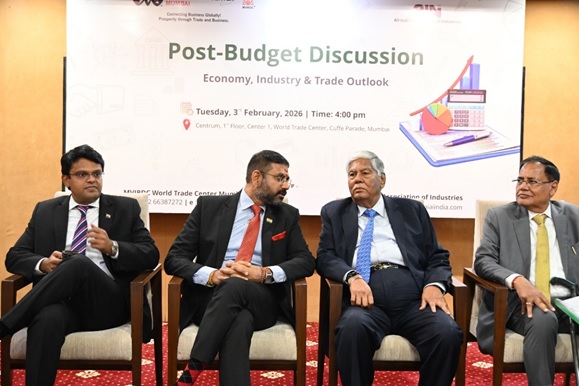
World Trade Center Mumbai, in association with the All India Association of Industries (AIAI), organised a Post-Budget Discussion Session to deliberate on the implications of the Union Budget 2026–27 for MSMEs, trade, industry, exports, and India’s long-term economic growth trajectory. The event brought together industry leaders, exporters, professionals, policy observers, and diplomats to analyse key budget announcements and their impact on the economy.
Speaking at the session, Mr. Siddhartha Rastogi, Principal Officer, Managing Director & Chief Operating Officer, Ambit Asset Management, stated that the Union Budget lays a clear roadmap for the coming years. Emphasising inclusive growth, he said that achieving a GDP growth rate of 7.2 percent requires strengthening India’s 6 crore MSMEs, which form the backbone of the economy. He highlighted that linking government spending with the TReDS platform would unlock liquidity and enhance order books for MSMEs, while promotion of digital payments and securitisation would improve credit flow and prevent capital from being stuck in the system.
Mr. Rastogi also welcomed the government’s focus on critical minerals and rare earth elements, noting that such initiatives would ensure stable supply chains, strengthen Atmanirbharta, and safeguard the economy from geopolitical risks.
Explaining indirect tax-related changes, Mr. Pranav Prakash Mehta, Partner, KJM INC and Specialist in Indirect Taxation, said that while the Budget did not introduce major taxation reforms, minor amendments would significantly improve ease of doing business. He noted that changes related to post-supply discounts would increase supplier accountability and ultimately benefit customers. He further added that clarifications on supply invoicing and invoice discounting would reduce litigation and speed up resolution of long-pending tax matters.
Sharing insights on direct taxation proposals, Mr. Arun Kumar Garodia, Former ITAT Member and Income Tax Consultant, said that the tax holiday announced for data centres would attract capital flows into new-age technology investments and strengthen India’s long-term investment climate. He added that changes in the taxation of share buybacks—now to be taxed under capital gains—would benefit both industry and shareholders. Reforms in Minimum Alternate Tax (MAT) and the decriminalisation of certain tax defaults, he said, reflect the government’s trust in the business community and promote a more collaborative growth environment.
Addressing the gathering, Dr. Vijay Kalantri, Chairman, World Trade Center Mumbai and President, All India Association of Industries, stated that the Budget provides a strong roadmap for achieving Viksit Bharat by 2047. He said that incentives for data centres, focused support for technology-driven industries, and policy clarity would help India move towards a USD 10 trillion economy by 2030. He also emphasised that simplification of taxes and resolution of legacy issues would significantly enhance ease of doing business in the country.
The annual Post-Budget Discussion at World Trade Center Mumbai witnessed participation from over 150 business leaders, MSMEs, innovators, and diplomats from several countries. The session concluded with Capt. Somesh Batra, Vice Chairman, World Trade Center Mumbai, delivering the vote of thanks.