
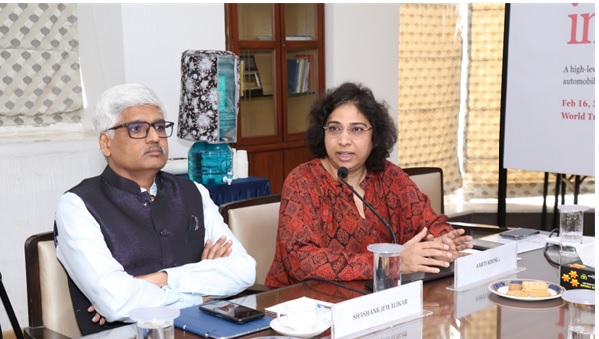
Mumbai, 16 February 2026: World Trade Center Mumbai, in association with Climate Trends, hosted a high-level roundtable on “Urban Heat Stress and Its Growing Impact on India’s Economic Sectors and Public Health” as part of Mumbai Climate Week. The discussion highlighted how rising temperatures and frequent heatwaves are increasingly affecting productivity, worker safety, electricity demand, and supply-chain efficiency across Indian cities.
Addressing the session, Vijay Kalantri, Chairman of World Trade Center Mumbai and President of the All India Association of Industries, stated that urban heat is no longer just an environmental issue but a serious development challenge. He noted that many Indian cities are already experiencing temperatures 3–8°C higher than surrounding rural areas due to the Urban Heat Island effect. With India’s urban population projected to cross 40% by 2030, rising temperatures are expected to significantly impact public health, urban liveability, and economic productivity, particularly among vulnerable communities. He also highlighted that India could lose around 5.8% of total working hours by 2030 due to extreme heat, while the World Bank has warned of potential GDP losses of up to 4.5% without adequate adaptation measures.
Aarti Khosla, Founder and Director of Climate Trends, emphasized that climate action lies at the intersection of public health and economic growth. She noted that investing in resilience is economically beneficial, as every dollar invested in climate resilience can generate significantly higher savings by preventing future losses. She also stressed the need for practical financial models that support MSMEs and protect vulnerable workers, especially those in India’s large informal workforce.
Vishwas Chitale, Head of Climate Resilience at the Council on Energy, Environment and Water (CEEW), highlighted that rapid urbanisation is contributing as much to rising urban heat as climate change itself. He stated that higher temperatures and humidity levels are already affecting productivity and industrial output, making climate-resilient adaptation measures both an environmental necessity and a sound economic investment.
The roundtable brought together representatives from industry, finance, healthcare, sustainability, and policy institutions, who agreed that urban heat is emerging as a major economic and development challenge requiring coordinated planning, integrated policy frameworks, and actionable resilience strategies for Indian cities.