
AI Powered PMC Akbar Jiwani, Special Correspondent: Real Estate for Realnewsofindia.com
Mumbai, September 13, 2026 — Maharashtra has laid out its most ambitious real estate and infrastructure roadmap yet, positioning the Mumbai Metropolitan Region (MMR) to become a $1.5-trillion economy by 2047 through a combination of global private capital, mega-infrastructure projects and an aggressive push to redevelop the city’s ageing housing stock.
The vision — branded “Mumbai 3.0” — has been built out in stages over the past several weeks. It began on August 7, when the Mumbai Metropolitan Region Development Authority (MMRDA) signed a set of memoranda of understanding with three Singapore-headquartered firms: Temasek Holdings, Mapletree and Surbana Jurong. Under one of these agreements, with the Raigad Pen Growth Center Limited (RPGCL), Mapletree committed to more than $1.1 billion in foreign direct investment to build a 100-acre mixed-use development within the Raigad-Pen Growth Center. Surbana Jurong, which had already authored the master and infrastructure plans for that growth centre, was appointed project management consultant for its execution.
Chief Minister Devendra Fadnavis said the talks that produced the agreements were first initiated at the World Economic Forum in Davos. “The MMR strategy is translating from planning into ground reality. With physical infrastructure work actively underway, global investors are demonstrating immense confidence in Maharashtra,” he said, adding that “Singapore’s extensive experience in master planning and urban development will significantly benefit the state.” A comprehensive master plan spanning 324 square kilometres is now meant to guide the area’s development — covering land use, transit, housing and industrial corridors — anchored by the under-construction Navi Mumbai International Airport and the Atal Setu sea bridge. State officials describe the long-term goal as knitting these together into a “Third Mumbai,” with a “Fourth Mumbai” envisioned beyond that.
The state government expanded on the plan on September 4 at the sixth edition of the Real Estate & Infrastructure Investors’ Summit (REIIS 2026) in Mumbai, where Fadnavis told developers that “Mumbai 3.0 is not a future. It has already begun.” He pointed to August 2026 property registration data — roughly 12,500 registrations in Mumbai for the month, among the highest on record — with cumulative registrations for the year crossing 1.06 lakh and generating close to ₹9,355 crore in government revenue.
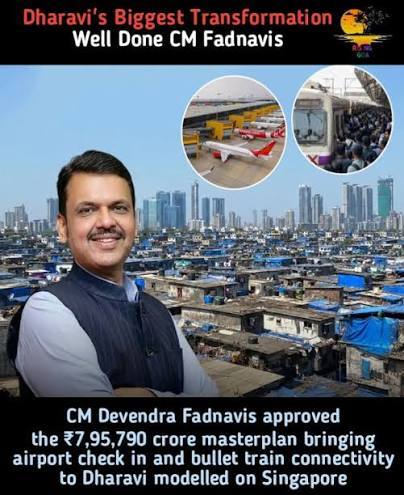
On housing, the chief minister said the government’s “cluster approach” to redevelopment would make Mumbai slum-free within a decade. “The Government worked with the developers’ fraternity and today Maharashtra has the most successful regulator in India. The trade has been cleaned up and a level playing field has been created,” he said, citing MahaRERA. For the long-delayed Dharavi redevelopment project specifically, the government has set a target of handing over keys to 10,000 rehabilitation homes by January 2029.
The infrastructure list attached to the vision is extensive: a proposed 24-km Uttan–Virar sea link intended to give Mumbai signal-free connectivity from Nariman Point to Virar; a third Mumbai airport planned near Virar, with a detailed project report expected by the end of this year; and expansion of the Vadhavan deep-draft port in Palghar, which the state hopes will rank among the world’s leading ports and anchor a new freight corridor running through Nashik and the Samruddhi Mahamarg toward Jalna, Wardha and Gadchiroli. A separate initiative under Transport Minister Pratap Sarnaik — cleared by the state cabinet on July 14 — will invite tenders within three months to redevelop 140 State Transport bus depots into mixed-use “Bus Ports,” potentially unlocking 13,000-14,000 acres of MSRTC land for private development.
Fadnavis also framed the plan in demographic and technological terms, noting that roughly 65% of India’s population is young and that Maharashtra alone has close to 3 crore residents between the ages of 18 and 28. “In the next 1,000 days, the nature of 70% of jobs will change because of AI. This is an era of disruption,” he said, positioning the Mumbai-Pune corridor as a future “Quantum Corridor” for technology and global capability centres.
For an MMR real estate market still digesting the RERA decriminalisation, self-redevelopment reforms and stalled-project rescue funds that have dominated headlines this year, Mumbai 3.0 represents a shift in scale — from fixing what exists to building an entirely new economic geography around it. Whether the ₹9,355-crore registration windfall and the Singapore FDI commitments translate into delivered infrastructure on the stated timelines will be the test developers, homebuyers and investors will be watching most closely over the next few years.