By AI-Powered PMC Akbar Jiwani, Special Correspondent – Real Estate, RealNewsofIndia.com
Mumbai, August 26, 2026
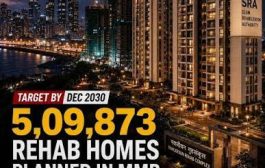
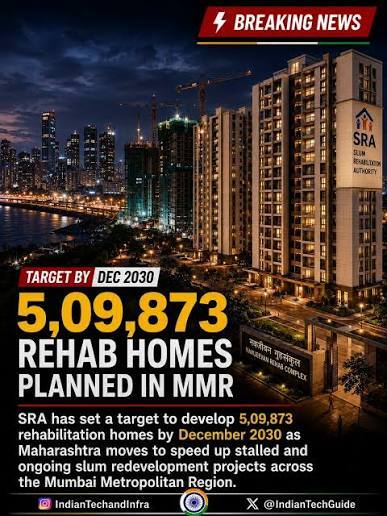
Mumbai’s Slum Rehabilitation Authority (SRA) has laid out its most ambitious housing roadmap yet, committing to deliver 5,09,873 rehabilitation homes to slum dwellers across the city by December 2030. The phased target, now formally adopted as the authority’s guiding benchmark, marks one of the largest state-led urban housing pushes in the country and signals a renewed government thrust on redevelopment as the backbone of Mumbai’s real estate growth story.
According to the roadmap, the SRA expects to hand over 90,264 homes in 2026 alone, scaling up to 1,48,219 by 2027, 2,44,356 by 2028, and 3,61,026 by 2029, before crossing the 5 lakh mark in 2030. The steep year-on-year escalation reflects the authority’s intent to compress decades of pending slum redevelopment into a single decade-end sprint, backed by faster approvals and closer coordination with allied state bodies.
Digital governance has become central to this push. Since May 2024, the SRA has rolled out 22 digital services, including online project tracking, grievance and complaint registration, and approval-status dashboards, aimed at cutting administrative delays and improving transparency for both developers and slum residents — a long-standing pain point in redevelopment projects that have historically stretched on for years.
The first wave of cluster redevelopment will focus on three high-density pockets: Behrampada in Bandra East, Majaswadi in Andheri, and Behram Baug in Oshiwara. To execute at this scale, the SRA is working in a joint-venture framework with the Mumbai Metropolitan Region Development Authority (MMRDA), the Maharashtra Housing and Area Development Authority (MHADA), and CIDCO, pooling land, funding, and planning resources across agencies that have often worked in silos.
On eligibility, the terms remain unchanged from existing SRA policy: structures established before January 1, 2000 qualify for a free 300 sq ft rehabilitation home, while those built between January 1, 2000 and January 1, 2011 are eligible for a similarly sized unit at Rs 2.50 lakh. Running alongside the citywide target, the Dharavi Redevelopment Project continues on its own separate timeline, targeting completion by 2033 and including economic rehabilitation provisions for more than 17,000 local businesses operating within the settlement.
Industry watchers, however, caution that the timeline carries real execution risk. Environmental clearances, disputed land ownership records, the cross-subsidization model that funds free rehabilitation housing through sale of surplus FSI, and the logistics of transit rent payments to displaced families remain the perennial bottlenecks that have slowed SRA projects in the past. Biometric verification of eligible slum dwellers and removal of ineligible claimants — both flagged by MHADA leadership as priorities in parallel slum-redevelopment work in Goregaon, Bandra, Kurla, and Borivali-Dahisar — will need to keep pace with the construction targets for the numbers to hold.
For Mumbai’s redevelopment ecosystem — PMCs, developers, housing societies, and legal advisors alike — the SRA’s 2030 target is a strong signal that slum rehabilitation and cluster redevelopment will remain the dominant growth engine for the city’s real estate sector through the rest of this decade. If the phased milestones are met, it would represent a step-change in how the state converts informal settlements into formal, RERA-compliant housing stock, while easing pressure on Mumbai’s chronically tight land supply.