
By AI Powered PMC Akbar Jiwani, Special Correspondent – Real Estate, Realnewsofindia.com
A new wave of investment is emerging as one of the most powerful, if underappreciated, growth engines behind India’s real estate expansion: the country’s booming data centre and AI infrastructure build-out. Where highways, metro corridors and IT parks anchored the last two decades of urban growth, industry analysts now say server farms and AI compute campuses are set to play a similar role over the next decade — and the numbers involved are staggering.
The scale of ambition was laid bare earlier this year when Adani Group chairman Gautam Adani announced a $100 billion commitment over the next decade to build AI-specialised data centres powered entirely by renewable energy, declaring that “India will not be a mere consumer in the AI age.” The plan, running through 2035, targets up to 5 gigawatts of dedicated data-centre capacity, with Adani projecting a further $150 billion in associated investment — taking the total AI infrastructure opportunity the group is chasing to roughly $250 billion. Large-scale campuses are already taking shape in Visakhapatnam and Noida, with expansion planned in Hyderabad and Pune, backed by tie-ups with global technology majors Google and Microsoft, an expanded partnership with Walmart-owned Flipkart, and a joint venture with US operator EdgeConneX that already runs 2 gigawatts of capacity. Underpinning all of it is Adani’s renewable energy portfolio, anchored by the 30-gigawatt Khavda solar project in Gujarat, with a further $55 billion earmarked for additional clean power and battery storage to keep the AI campuses running.
Adani is far from alone. India currently generates close to 20 per cent of the world’s digital data but hosts only about 4 per cent of global data centre capacity — a gap that global cloud providers, sovereign wealth funds and domestic conglomerates are racing to close as enterprise digitisation, cloud migration and AI workloads accelerate simultaneously.
For the real estate sector, the knock-on effects are now being quantified. A report by property platform Square Yards estimates that India’s data centre pipeline, currently pegged at roughly 9,030 megawatts of capacity, will generate close to 4.33 lakh jobs across the ecosystem and, in turn, drive demand for nearly 195 million square feet of residential real estate by 2030. That is a scale comparable to entire satellite townships springing up around what were, until recently, unremarkable industrial plots on city peripheries.
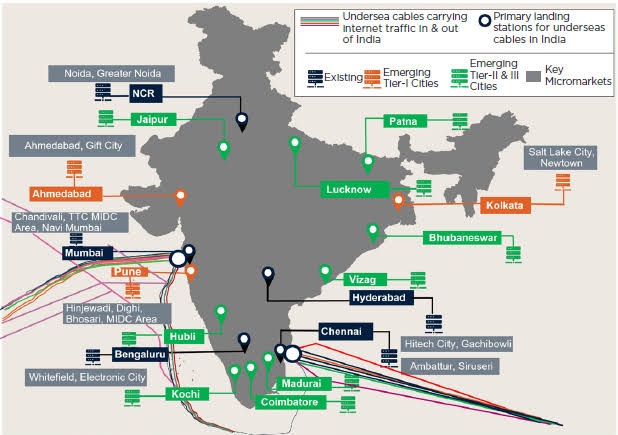
The demand is not expected to be evenly spread. Maharashtra is projected to see the single largest impact, with more than 54 million square feet of associated housing demand, reflecting Mumbai and Pune’s status as established data-centre hubs with power availability, submarine cable landing stations and connectivity infrastructure already in place. Karnataka, Andhra Pradesh, Uttar Pradesh, Telangana and Tamil Nadu are also flagged as major beneficiaries, tracking the same states where hyperscale campuses are being built out.
Rather than concentrating growth narrowly around the data centres themselves, the Square Yards report describes a “Golden Ring” effect — a belt spanning roughly 5 to 15 kilometres around major facilities where townships, mixed-use developments, retail and civic infrastructure are expected to flourish as ancillary employment (facility staff, engineers, logistics and support services) clusters nearby. Tier-2 and tier-3 locations such as Visakhapatnam, Noida and Gujarat’s GIFT City are being flagged as the next frontier of this trend, benefiting from improving connectivity, land availability and state-level incentives for digital infrastructure investment.
For developers and homebuyers alike, the implication is a structural one: digital infrastructure is emerging as a fresh anchor for real estate cycles, much as highways, airports and IT corridors were in previous booms. Analysts caution that translating power-and-compute investment into durable housing demand will still depend on states delivering the physical infrastructure — roads, water, schools and transit — needed to support new residential clusters at the pace capital is now flowing into AI infrastructure. But with tens of billions of dollars committed by a single conglomerate alone, and the broader industry racing to close India’s capacity gap with global peers, the data centre economy looks set to be one of the defining real estate growth stories of the second half of this decade.