Knight Frank data shows 80,000+ property registrations in H1 2026, the best half-year since 2013, even as MMR homebuyers spend 69% of household income servicing home loan EMIs
Introduction
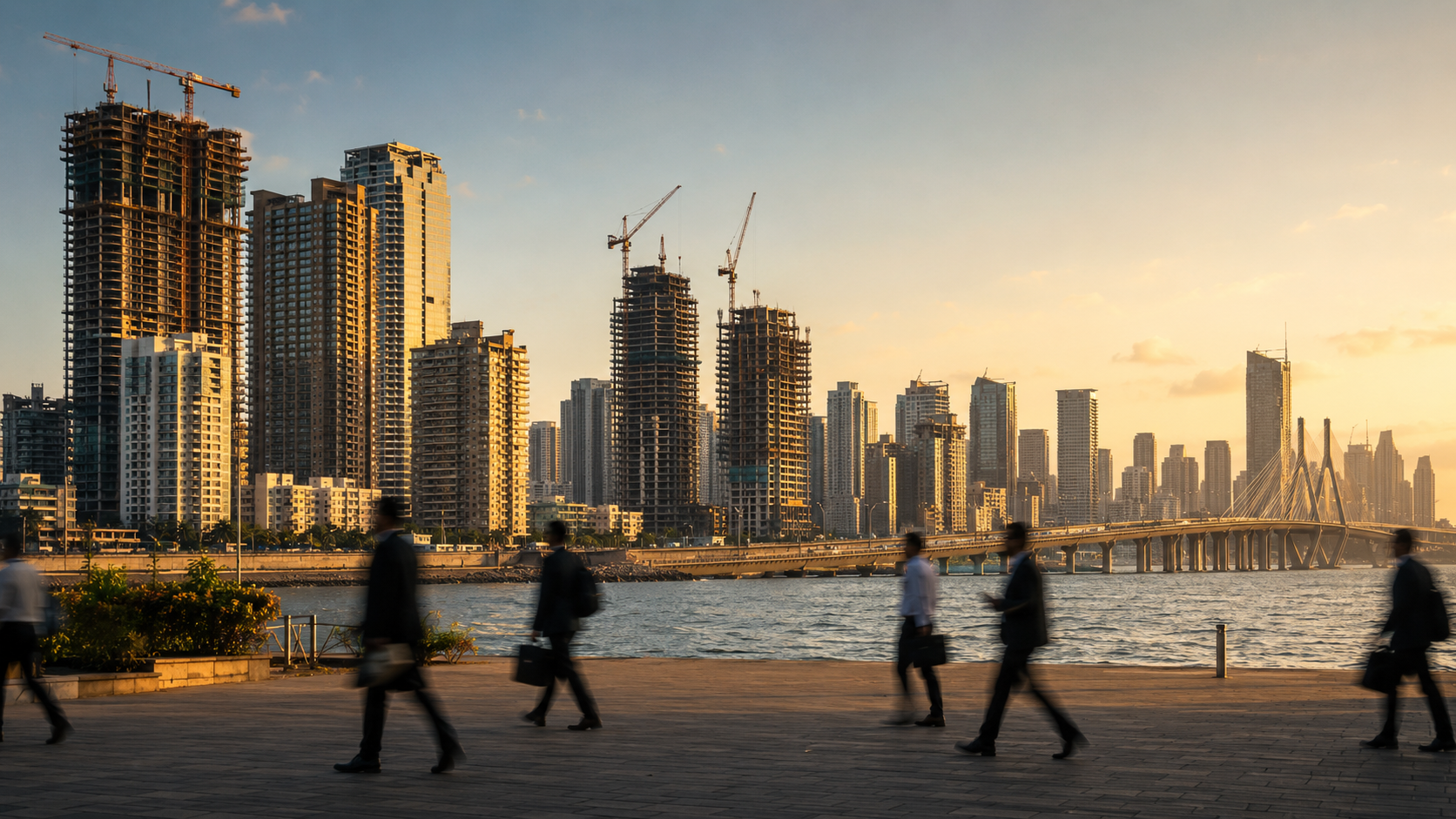
Mumbai’s residential real estate market has just delivered its best half-yearly performance in thirteen years, a milestone that on paper reads like unambiguous good news for developers, brokers and the state exchequer alike. Yet tucked inside the same data set is a more sobering reality: the city remains, by a wide margin, the least affordable housing market in India. The story of Mumbai real estate in the first half of 2026 is therefore not a simple tale of a booming market, but a study in contrast — record volumes built on a widening base of buyers, set against a home-ownership cost burden that continues to test the limits of household budgets. For anyone tracking the Mumbai Metropolitan Region, understanding both halves of this picture is essential to reading where the market goes next.
Background
Mumbai’s property registration numbers, compiled from stamp duty and registration data and analysed by property consultancy Knight Frank India, have long served as one of the most reliable real-time indicators of housing demand in the country, since every sale, resale and long-term lease above a threshold value must be registered and duty-paid with the state government. Over the past decade, this data series has captured the market’s slow climb out of the post-demonetisation and pre-RERA slowdown of 2016-2018, its pandemic-era volatility in 2020-2021, and its subsequent recovery, aided by stamp duty cuts, historically low interest rates and a wave of new project launches across the Mumbai Metropolitan Region. By 2025, registrations had already surpassed pre-pandemic peaks; the first half of 2026 has now pushed that recovery into genuinely record territory.
Current Developments
According to Knight Frank India, the city under Brihanmumbai Municipal Corporation (BMC) jurisdiction recorded 80,221 property registrations across primary and secondary segments in the six months to June 2026, up 6 percent year-on-year and the strongest first-half performance since 2013. Stamp duty collections from these transactions rose 4 percent year-on-year to Rs 6,968 crore. The momentum was especially visible in June 2026 alone, which logged 13,302 registrations, a 15 percent year-on-year jump and the highest figure for the month of June in fourteen years, with the state exchequer collecting roughly Rs 1,077 crore in stamp duty for the month. Registrations in June also rose 7 percent over May 2026, while stamp duty revenue for the month grew a more modest 2 percent, a gap that Knight Frank’s leadership flagged as significant.
Shishir Baijal, International Partner, Chairman and Managing Director of Knight Frank India, noted that Mumbai’s residential market “has maintained its strong momentum, with June 2026 recording the highest property registrations for the month in the past 14 years,” adding that this was achieved despite an already high base set in the previous year, underscoring what he called the resilience of end-user demand and sustained homebuyer confidence.
At almost the same time, Knight Frank’s H1 2026 Affordability Index delivered the other half of the story. The report found that the Mumbai Metropolitan Region’s affordability index stood at 69 percent in the first half of 2026, unchanged from 2025, meaning the average homebuyer must commit 69 percent of household income to service the EMI on a standard housing unit. Anything above 50 percent is generally regarded by lenders and analysts as financially unsustainable. MMR and the National Capital Region were the only two of India’s eight largest markets to remain above that threshold, making Mumbai officially the least affordable city in the country for home ownership, even after accounting for the Reserve Bank of India’s cumulative 125 basis points of rate cuts over the preceding year.
Detailed Analysis
Read together, these two data points describe a market where volume and value are moving in different directions. Registrations are climbing faster than stamp duty collections, a pattern Knight Frank explicitly attributes to a shift in the transaction mix toward the mid-market segment rather than high-value luxury deals. In other words, more households are transacting, but the average ticket size per transaction is not rising at the same pace, and in some readings is moderating. This is consistent with wider industry commentary suggesting the Rs 80 lakh to Rs 2 crore price band now accounts for the largest share of Mumbai’s residential transactions, with demand increasingly concentrated among salaried, aspirational buyers in the Western Suburbs, Thane, Kharghar and Panvel rather than solely in South Mumbai’s premium corridors.
At the same time, the Reserve Bank of India’s Monetary Policy Committee has held the repo rate steady at 5.25 percent through its February and June 2026 reviews, following an earlier easing cycle, a pause driven by caution around geopolitical tensions, energy prices and monsoon-linked inflation risks. Stable financing costs have removed one major source of uncertainty for both developers planning launches and buyers timing purchases, which helps explain why registration volumes have stayed close to post-pandemic highs even without further rate cuts. But stable EMIs on a high principal amount still translate into a high absolute affordability burden, particularly in a city where land scarcity, elevated construction costs and premium FSI charges keep base prices among the steepest in the country.
Benefits
The record H1 2026 numbers carry genuine, broad-based benefits. For the state government, higher registration volumes and steady stamp duty growth strengthen Maharashtra’s revenue base at a time when urban infrastructure spending, from Metro expansion to coastal road and redevelopment financing, needs sustained funding. For developers, sustained end-user demand across the mid-market segment provides more predictable absorption for new launches, reducing unsold inventory risk and supporting healthier project cash flows, which in turn can be reinvested into faster construction timelines. For genuine homebuyers, a market where demand is “broad-based across buyer segments,” as Knight Frank describes it, rather than concentrated in ultra-luxury deals, suggests a healthier, more inclusive growth pattern than one driven purely by high-net-worth or investment-led purchases. Homeowners who already hold property in Mumbai also benefit from a market that continues to demonstrate price resilience and liquidity, both important for long-term wealth preservation.
Challenges
The affordability data, however, is a genuine structural challenge rather than a cyclical blip. A 69 percent EMI-to-income ratio, held flat for two consecutive years despite meaningfully lower interest rates, indicates that price appreciation in Mumbai is effectively absorbing the entire benefit of cheaper borrowing before it reaches the ordinary buyer. This has knock-on effects: it pushes first-time buyers further into the suburbs and satellite towns of the Mumbai Metropolitan Region, sustains high rental demand from those unable to buy, and keeps home ownership skewed toward buyers with existing family wealth, dual incomes, or access to larger down payments. It also raises the stakes for redevelopment and affordable housing policy, since expanding supply within city limits, rather than only on the periphery, is one of the few levers available to meaningfully change the affordability equation without relying solely on interest-rate cycles that are, in any case, largely exhausted for now.
Expert Opinion
Industry voices broadly frame the current phase as one of resilience tempered by realism. Baijal’s own commentary captures this balance: strong registration growth reflects genuine end-user confidence, but he has also been clear that rising property prices have reduced some of the gains achieved through lower interest rates, and that stable employment, healthy income growth and balanced market fundamentals will be crucial to sustaining demand going forward, rather than financing costs alone. This view is echoed across the wider brokerage and consultancy community, where the consensus is that Mumbai’s market has matured beyond being purely rate-sensitive; today it responds more to job security, income growth and supply-side factors such as new project launches in the mid-segment corridors of the MMR.
Future Outlook
Looking into the second half of 2026, the near-term trajectory appears constructive but not without caveats. With the repo rate expected to stay steady in the immediate term amid global uncertainty, financing costs are unlikely to swing sharply in either direction, which should support continued stability in registration volumes. Developer launch pipelines across Thane, Navi Mumbai, and the Western Suburbs remain skewed toward the mid-segment, which should keep transaction volumes healthy even if average ticket sizes stay moderate. The bigger swing factor for affordability will be land and construction cost trends, along with how aggressively redevelopment policy in Mumbai — spanning cooperative housing societies, MHADA colonies and slum rehabilitation schemes — succeeds in adding usable housing stock within the city rather than only at its edges. Should that supply pipeline accelerate meaningfully, it could, over a multi-year horizon, begin to ease the affordability index in a way that rate cuts alone have not managed to achieve.
Practical Takeaways
For homebuyers, the current environment rewards patience and clarity of budget: with EMIs stable, the priority should be locking in a loan quantum that stays well within comfortable repayment capacity, rather than stretching to the affordability ceiling based on today’s rates alone. For end-users eyeing the mid-segment, the suburban and MMR-periphery micro-markets currently driving volume growth are worth close evaluation, both for pricing and for improving connectivity. For developers, the data reinforces that launches priced and sized for the Rs 80 lakh to Rs 2 crore band are likely to see the most consistent absorption in the near term. For policymakers, the flat affordability index despite lower rates is itself a signal that supply-side interventions, including faster redevelopment approvals and additional FSI for genuinely affordable projects, deserve renewed urgency.
Conclusion
Mumbai’s real estate market enters the second half of 2026 in a genuinely unusual position: simultaneously at its strongest in over a decade by volume, and at its most financially demanding by affordability. Both facts are true, and both matter. The record registrations confirm that confidence in Mumbai property as an asset class, and as a place to build a home, remains firmly intact. The stubborn 69 percent affordability ratio is a reminder that confidence and accessibility are not the same thing, and that the city’s next phase of growth will be judged not only by how many homes are sold, but by how many more households can genuinely afford to buy one.
8. Key Takeaways
Mumbai recorded 80,221 property registrations in H1 2026, up 6% year-on-year and the strongest first-half performance since 2013, per Knight Frank India. Stamp duty collections rose 4% YoY to Rs 6,968 crore over the same period. June 2026 alone saw 13,302 registrations, a 15% YoY jump and the highest June figure in 14 years. Despite the RBI holding the repo rate steady at 5.25% through H1 2026 following earlier rate cuts, Knight Frank’s Affordability Index shows MMR homebuyers still spend 69% of household income on EMIs, unchanged from 2025 and the highest ratio among India’s eight largest cities. The gap between fast-growing registration volumes and slower-growing stamp duty revenue points to a shift toward mid-market transactions rather than high-value luxury deals.
9. Conclusion
Mumbai’s property market closed the first half of 2026 on its strongest footing in thirteen years, driven by broad-based, end-user demand across the mid-market segment and supported by stable financing conditions. Yet the city’s affordability index, unchanged at 69% of household income for EMI servicing, shows that record sales volumes have not yet translated into meaningfully easier home ownership. The road ahead will depend on how effectively supply-side measures, from redevelopment to affordable housing incentives, can complement a financing environment that has already given the market most of the tailwind it is likely to offer in the near term.