
Written by Ai Powered PMC Akbar Jiwani, Special Correspondent: Realestate for Realnewsofindia.com
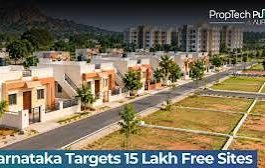
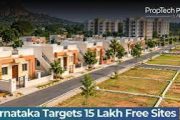
In one of the largest state-level housing decisions of the year, the Karnataka Cabinet has cleared a two-pronged plan to put land titles and roofs within reach of the state’s poorest families. Under the newly christened “Bhooguarantee” initiative, the government will distribute 15 lakh free residential sites to eligible landless households, and separately fund the construction of one lakh new houses in 2026-27 at an estimated outlay of Rs 2,241 crore.
The decisions were taken at the 26th meeting of the State Cabinet chaired by Chief Minister D.K. Shivakumar on 19 November 2026, and were publicly outlined by the Chief Minister at Vidhana Soudha on 21 November alongside a Rs 16,000 crore rural roads and panchayat infrastructure package.
The scale of the gap
The state’s own survey data explains the urgency. Going by the 2018 rural and 2016 urban demand surveys, Karnataka has roughly 14.89 lakh homeless families and around 13.36 lakh families without a residential site — together, about 28.25 lakh potential beneficiaries lacking either a house or a plot. Around 5.8 lakh rural applications have been pending with the Rajiv Gandhi Housing Corporation Limited (RGHCL) since 2018.
Bhooguarantee: how the land will be delivered
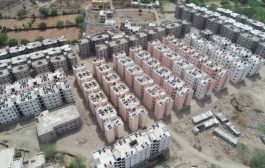
Target: 15 lakh sites — about 9 lakh in rural areas (approx. 45,000 acres) and 5 lakh urban beneficiaries housed through a G+3 model on about 5,000 acres.
Phase 1: 5 lakh sites at about Rs 20,000 per site for basic development, i.e. roughly Rs 1,000 crore. Around 40% is to come from convergence of existing funds (SC Sub-Plan, Tribal Sub-Plan, District Mineral Foundation, regional development boards and MP/MLA local area funds).
Land bank: District administrations are to reserve government land under Section 71 of the Karnataka Land Revenue Act, 1964; about 23,500 acres across all 31 districts have already been identified — enough for roughly 4.7 lakh sites.
Bigger plots: The minimum site size for poor families goes up from 20×30 ft to 30×40 ft. The Chief Minister said the aim was to leave room for growing families and to avoid creating new slums, even if it means fewer sites overall.
Zero-cost title: Stamp duty and registration charges are waived for registrations through the Kaveri 2.0 system; digital ownership documents will be issued by Tahsildars under Section 94-D, with e-Swathu auto-updating Form-9 and Form-11A records.
Infrastructure: Layouts will get roads and drainage, boundary stones at all four corners, and geo-tagged photographs captured by Village Administrative Officers.
Who qualifies
One site per family holding a Priority Household (PHH) or Antyodaya Anna Yojana (AAY) ration card, with annual income capped at Rs 1.20 lakh (rural) and Rs 2 lakh (urban). Married couples must apply jointly and titles will be issued in joint names. Proposed horizontal reservations include 3% for ex-servicemen (through the Niveshana Yojane under the Sainik Samman Yojane), 2% for senior citizens, 3% for widows, widowers and divorced persons, 5% for persons with disabilities and 1% for transgender persons, in addition to SC/ST quotas. Applications will be taken online through Nadakacheri, Bapuji Seva Kendras, Grama One and Karnataka One centres with Aadhaar e-KYC, and a Bhoomi Monitoring Cell will cross-check databases to weed out duplicates and families already housed.
One lakh new houses, with higher subsidy
For families that already own eligible land but cannot afford to build, the Cabinet approved one lakh houses under the Beneficiary-Led Construction (BLC) model across the Basava Vasati, B.R. Ambedkar Nivas, Devaraj Urs and Vajpayee Urban housing schemes — 68,000 rural and 32,000 urban. Recognising the sharp rise in material costs, assistance rises from Rs 1.20 lakh to Rs 2 lakh for general-category beneficiaries and from Rs 2 lakh to Rs 3 lakh for SC/ST beneficiaries. The enhanced rates apply only to these new sanctions. This year’s spend will be met from an existing Rs 987.50 crore allocation, with the balance of Rs 1,253.50 crore to be adjusted in later years, and stalled older sanctions may be cancelled to free up funds.
The A-Khata / B-Khata clean-up
Perhaps the most market-relevant element is the Chief Minister’s direction that Bhooguarantee also prioritise rectification of rural property records and issuance of Khata documents. He indicated that around two crore people could get an opportunity to resolve A-Khata and B-Khata issues, with officials directed to verify measurements and documents door-to-door, curb fake registrations and set up dedicated panchayat counters.
PMC View: What this means for India’s real estate
1. Titles unlock value. Clean, digital, stamp-duty-free titles convert informal occupation into bankable assets. Families with a registered plot can access home loans and state aid — the foundation of any formal housing market.
3. Construction demand at the grassroots. One lakh BLC homes at Rs 2–3 lakh assistance each, plus layout works on lakhs of plots, mean sustained demand for cement, steel, bricks and local contractors across rural Karnataka — the kind of distributed construction activity that cushions the sector from metro-centric cycles.
4. Execution is the real test. Phase 1 funding leans on fund convergence and future budgets, while the land identified so far covers under a third of the overall target. Delivery will depend on how quickly government land is surveyed, laid out and serviced — and on whether the anti-duplication systems hold.
Lesson for Maharashtra: The bundling of free land, zero stamp duty and fully digital title is a model worth studying for Maharashtra’s own affordable-housing and slum-rehabilitation framework, where title clarity and documentation delays remain the single biggest bottleneck for families and housing societies alike.
Bottom line: Bhooguarantee is ambitious in scale and progressive in design — bigger plots, joint titles, priority for the most vulnerable and paperless, cost-free registration. If Karnataka can match the intent with execution, it could become a national reference point for “land-first” affordable housing.
— Ai Powered PMC Akbar Jiwani, Special Correspondent: Realestate for Realnewsofindia.com