By Ai Powered PMC Akbar Jiwani, Special Correspondent: Realestate for Realnewsofindia.com
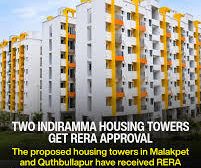
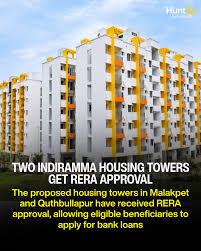
HYDERABAD / MUMBAI: In a move that could reset the standard for affordable housing delivery across India, the Telangana government has registered its Indiramma Towers project with the Telangana Real Estate Regulatory Authority (TG-RERA) — the first time a state-built housing project for the poor has been placed under the RERA regime in Telangana. Alongside, the state has announced it will absorb the full property registration costs for beneficiaries.
The announcement was made by Telangana Housing and Revenue Minister Ponguleti Srinivasa Reddy, who said the homes being allotted in the Hyderabad metropolitan area carry an estimated market value of ₹50–60 lakh each. Beneficiaries will receive possession without paying stamp duty and registration charges out of their own pockets.
What the announcement means
According to the minister, RERA registration will bring transparency and accountability to every stage of the project. Crucially, it gives beneficiaries a legal forum: if construction is delayed or prescribed norms are violated, allottees can file complaints before TG-RERA — the same remedy private homebuyers have enjoyed since the Real Estate (Regulation and Development) Act, 2016 came into force.
The minister said the government, under Chief Minister A. Revanth Reddy, is committed to transparency from beneficiary selection through construction to final handover, and assured that houses would be completed and handed over within one year of the foundation stone being laid.
Why it matters for India’s housing sector
1. Accountability for the State as a “promoter”. Government agencies building mass housing have often operated outside the disclosure and timeline discipline that RERA imposes on private developers. Voluntary registration sends a clear signal that the State is willing to be held to the same yardstick — quarterly progress updates, approved plans on record, and penalties for delay.
2. Waiving registration costs removes a hidden barrier. For low-income families, stamp duty and registration charges on a ₹50–60 lakh asset can be a significant out-of-pocket burden, frequently delaying formal title transfer. Absorbing these costs means beneficiaries get clean, registered ownership from day one — which in turn opens access to formal credit and secure inheritance.
3. A template for other states. With the Centre having recently cleared an additional tranche of urban homes under PMAY-U 2.0, the scale of government-led affordable housing is set to grow sharply. Telangana’s model — RERA registration plus State-borne registration costs — offers a ready template that other states, including Maharashtra, can evaluate for their own public housing pipelines.
PMC Perspective: Lessons for Mumbai’s MHADA and SRA ecosystem
From the vantage point of a Project Management Consultant who has worked across MHADA, SRA, BMC and Collector-land redevelopment schemes in Mumbai for over three decades, this development deserves close attention. Slum rehabilitation and transit-camp tenants in the MMR have long faced open-ended delays, with limited avenues for time-bound redress. Bringing every rehabilitation component and public housing project firmly within RERA’s disclosure and complaint framework — and easing the registration-cost burden on rehab tenants — would strengthen trust between government agencies, developers and the families they serve.
The real test for Telangana will be execution: whether the one-year handover commitment is met, and whether TG-RERA’s grievance mechanism proves accessible to first-time owners. If it works, Indiramma Towers could become a case study in how regulation and welfare can reinforce each other.
Key Takeaways
Indiramma Towers is the first government housing project in Telangana registered with TG-RERA.
The State will bear property registration costs; homes are valued at roughly ₹50–60 lakh each.
Beneficiaries can approach TG-RERA over construction delays or violations.
Government promises handover within one year of foundation stone-laying.
The model could guide other states as PMAY-U 2.0 scales up.
This article is written by Ai Powered PMC Akbar Jiwani, Special Correspondent: Realestate for Realnewsofindia.com. Akbar Jiwani is Founder & Principal Consultant, Universal Buildtech Development (MSME-certified PMC) and Founder of RealEstate Gurukul.ai.
Suggested tags: Telangana Housing, RERA, TG-RERA, Indiramma Towers, Affordable Housing, PMAY-U 2.0, Hyderabad Real Estate, Public Housing