Families searching from hospital to hospital as blood stocks run low; REAL NEWS OF INDIA appeals to every eligible citizen to come forward and donate
MUMBAI | November 26, 2026
By S. M. Fanus | REAL NEWS OF INDIA
A UNIT OF BLOOD CAN MAKE THE DIFFERENCE BETWEEN LIFE AND DEATH. WHY ARE WE WAITING?
Mumbai, the city that never stops, is facing a serious challenge in maintaining adequate blood supplies. Behind the daily rush of hospitals, emergency wards and operation theatres, patients and their families are facing an alarming question: Will the required blood be available when they need it most?
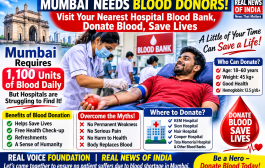
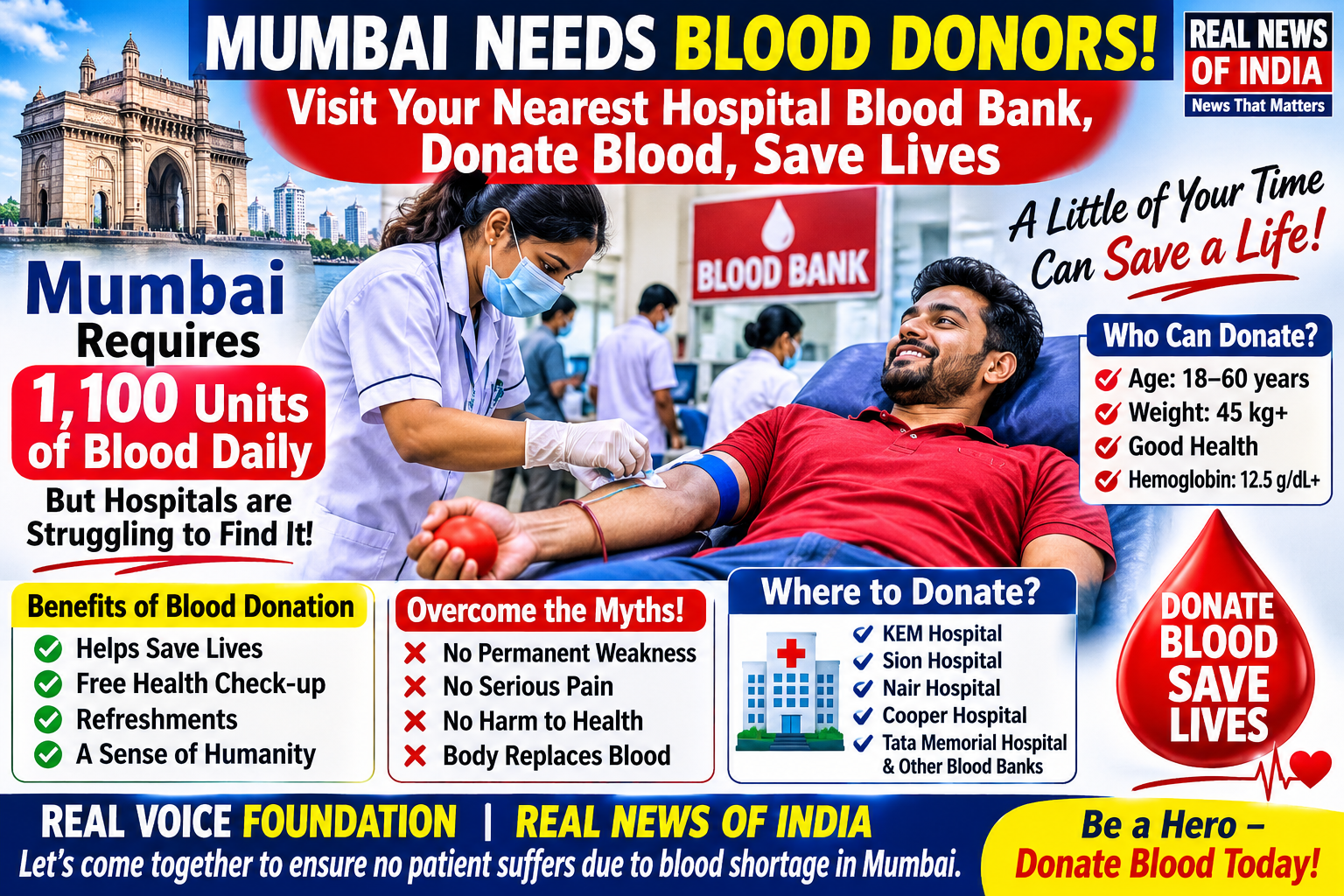
According to the Maharashtra State Blood Transfusion Council (SBTC), Mumbai requires approximately 1,100 units of blood every day to meet the needs of patients across the city.
But recent reports have highlighted serious difficulties in maintaining sufficient stocks, particularly at some government and BMC-run hospitals. The situation becomes more challenging during festival and holiday periods, when regular voluntary donations tend to decline.
This is not merely a hospital management issue. It is a public health concern that demands the attention and participation of every responsible citizen.
PATIENTS’ FAMILIES FORCED TO TRAVEL UP TO 50 KILOMETRES IN SEARCH OF BLOOD
A Times of India report published on November 22, 2026, described the difficulties faced by families trying to arrange blood for their loved ones. In some cases, relatives reportedly travelled as far as 50 kilometres to find the required blood group.
The report highlighted the pressure on public hospitals, where daily requirements can be around 100–200 units, while stocks on certain days were reported to be as low as 20–50 units.
At KEM Hospital, the reported stock of packed red blood cells was just 63 units, against a daily requirement of approximately 100–200 units.
The report also highlighted difficulties faced by families at Sion Hospital and the desperate efforts of relatives trying to arrange compatible blood.
These are reported figures from particular periods, not a live inventory of every hospital. Nevertheless, they reveal the seriousness of the problem and the need for a stronger, more reliable voluntary blood donation network.
Imagine a parent searching through the night for blood for a child. Imagine a family waiting for an operation while trying to arrange a compatible blood unit. No family should have to face such uncertainty alone.
WHY DOES MUMBAI NEED SO MUCH BLOOD?
Blood is required every day for a wide range of medical emergencies and treatments, including:
- Road accident victims and patients with serious injuries.
- Patients undergoing major operations and emergency surgeries.
- Mothers facing childbirth-related complications.
- Cancer patients undergoing treatment.
- Children suffering from thalassemia and other blood disorders.
- Patients with severe anaemia and conditions requiring repeated transfusions.
- Patients requiring platelets, plasma and other blood components.
Blood cannot be manufactured in a factory. It can only be collected from eligible donors, tested, processed and supplied through authorised blood centres.
That is why regular voluntary blood donation is essential.
A MAJOR APPEAL: YOU CAN DONATE BLOOD DIRECTLY AT AUTHORISED HOSPITAL BLOOD BANKS
Many people believe that blood donation is possible only during special camps. This is a misconception.
Citizens can approach authorised hospital blood banks and enquire about donating blood directly, subject to the centre’s timings, requirements and medical screening.
People can enquire at blood banks associated with hospitals such as:
- KEM Hospital, Parel.
- Lokmanya Tilak Municipal General Hospital, Sion.
- BYL Nair Hospital, Mumbai Central.
- HBT Medical College and Dr. R. N. Cooper Hospital, Juhu.
- Tata Memorial Hospital, Parel.
Important: Please contact the hospital blood bank before visiting to confirm its donation timings and whether it is accepting walk-in voluntary donors that day.
You can also use the Government of India’s e-RaktKosh portal to search for blood banks and check reported blood availability:
https://www.eraktkosh.mohfw.gov.in/BLDAHIMS/bloodbank/stockAvailability.cnt
WHO CAN DONATE BLOOD? KNOW THE BASIC ELIGIBILITY RULES
Under India’s blood donation criteria, a prospective whole-blood donor generally needs to meet these requirements:
- Age: 18 to 65 years.
- Weight: At least 45 kg, subject to the volume collected.
- Haemoglobin: At least 12.5 g/dL.
- Health: Must be in good general health and physically fit.
- Medical screening: Blood pressure, pulse, temperature, medical history and other eligibility factors are assessed.
For first-time donors, the upper age limit is generally 60 years. Repeat donors may be eligible up to 65 years, subject to medical assessment.
Some medicines, illnesses, recent procedures and other health circumstances may require temporary or permanent deferral.
The final decision to accept a donor rests with the authorised blood bank’s medical team. Never hide medical information during screening.
AFRAID OF BLOOD DONATION? LET’S CLEAR THE COMMON MISCONCEPTIONS
Fear and misinformation stop many healthy people from donating blood. Here are some important facts.
MYTH 1: Blood donation causes permanent weakness.
FACT: Healthy, eligible donors generally recover well after donating. The body replaces the donated fluid relatively quickly, while red blood cells take several weeks to recover. Some people may experience temporary tiredness or dizziness.
MYTH 2: Blood donation weakens the immune system.
FACT: There is no established evidence that routine blood donation by medically eligible people permanently weakens their immune system.
MYTH 3: Blood donation is a very painful procedure.
FACT: Donors generally experience only a brief pinprick when the needle is inserted. The procedure is carried out by trained professionals using sterile, single-use equipment.
MYTH 4: Donating blood takes the entire day.
FACT: The actual blood collection usually takes around 6–10 minutes. The complete process, including registration, medical screening and recovery, takes longer. Government e-RaktKosh guidance describes the overall experience as usually taking around 30 minutes.
MYTH 5: Only people with a particular blood group can donate.
FACT: People with different blood groups can donate. Blood centres test and match blood components according to the patient’s medical requirements. Rare blood groups may require special donor coordination.
DOES BLOOD DONATION BENEFIT THE DONOR’S HEALTH?
Blood donation is primarily an act of helping patients. It should not be presented as a medical treatment, a weight-loss method or a guaranteed way to improve health.
However, eligible donors can receive certain practical benefits:
- Basic pre-donation health assessment.
- Haemoglobin screening.
- Pulse, blood pressure and temperature checks.
- An opportunity to learn about possible health concerns identified during screening.
- The satisfaction of contributing to a life-saving public health service.
The most important benefit is to the recipient: donated blood can provide essential treatment to someone facing a medical emergency or serious illness.
HOW SAFE IS THE BLOOD DONATION PROCESS?
When conducted at an authorised blood centre, blood donation is a medically supervised procedure.
The usual process includes:
- Donor registration.
- Medical history and confidential health questions.
- Basic physical examination and haemoglobin screening.
- Collection of blood using sterile, single-use equipment.
- A short recovery period with refreshments and post-donation advice.
After donation, donors should drink sufficient fluids, eat balanced meals and avoid heavy lifting or strenuous exercise with the donation arm for approximately five hours. Follow the blood bank’s instructions.
If you feel dizzy or faint, lie down and inform the medical staff.
Under the applicable Indian rules, whole-blood donation must not take place more frequently than once every three months. Your blood centre will advise you about the appropriate interval.
WHY BLOOD DONATION MUST CONTINUE THROUGHOUT THE YEAR
The Maharashtra State Blood Transfusion Council has directed blood banks and collection centres to organise special voluntary donation camps and review their stocks ahead of the November–December holiday period.
But temporary donation drives alone cannot solve a recurring shortage.
Hospitals need a steady supply of voluntary donations throughout the year. Blood components also have limited storage periods, so blood cannot simply be collected in unlimited quantities and stored indefinitely.
The answer is sustained public participation, better coordination and responsible blood stock management.
REAL NEWS OF INDIA AND REAL VOICE FOUNDATION RAISE FIVE IMPORTANT DEMANDS
Through this public awareness initiative, REAL NEWS OF INDIA and REAL VOICE FOUNDATION appeal to the Maharashtra Government, Brihanmumbai Municipal Corporation (BMC), Health Department and hospital administrations to take coordinated action.
We urge the authorities to:
- Publish regular blood stock updates: Make reliable, easy-to-understand blood availability information accessible to the public.
- Strengthen voluntary donation drives: Organise regular camps in housing societies, colleges, offices, railway stations and community centres.
- Improve coordination: Strengthen communication between government and private blood banks so patients can locate compatible blood more easily.
- Support emergency patients: Establish effective coordination systems to help hospitals arrange required blood components without unnecessary delays.
- Increase public awareness: Run sustained campaigns explaining eligibility, safety, donation procedures and the importance of regular voluntary donation.
We also appeal to responsible citizens, NGOs, social organisations, educational institutions and corporate establishments to become active partners in this mission.
AN EMOTIONAL APPEAL TO EVERY MUMBAIKAR
Dear citizens,
Today, someone may be waiting in a hospital for a unit of blood. Tomorrow, that person could be someone from your own family.
Do not wait for a tragedy to understand the importance of blood donation.
If you are medically eligible, visit an authorised blood bank and donate voluntarily. Encourage your friends, relatives, colleagues and neighbours to participate.
Do not allow fear, rumours or misinformation to stop you from helping someone in need.
Your blood group may be exactly what another patient is waiting for.
A FEW MINUTES OF YOUR TIME CAN HELP GIVE SOMEONE ANOTHER CHANCE AT LIFE.
THE MESSAGE IS SIMPLE: DONATE BLOOD. SAVE LIVES. STAND WITH HUMANITY.
Mumbai needs approximately 1,100 units of blood every day. Behind every unit is a patient, a family and a hope for survival.
Let us turn public concern into public action.
DON’T WAIT FOR A BLOOD EMERGENCY. BECOME A VOLUNTARY BLOOD DONOR TODAY!
S. M. FANUS
Reporter – REAL NEWS OF INDIA
President – REAL VOICE FOUNDATION
Social Worker
REAL NEWS OF INDIA – NEWS THAT INFORMS, AWARENESS THAT SAVES LIVES.
Editorial note: Blood donation eligibility and medical fitness must always be determined by an authorised blood bank. Hospital stock figures mentioned above are attributed to published reports and should not be interpreted as live availability.