Cabinet approval for the 34.2-km integrated Metro Line 5 and 5A network promises a 90-to-25-minute commute revolution — and a fresh wave of transit-oriented development across Mumbai’s eastern suburbs
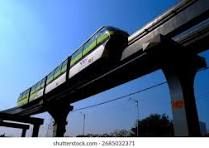
A photorealistic, ultra-HD 16:9 landscape editorial photograph shot at golden hour, showing an elevated metro rail viaduct with a sleek modern train curving through a rapidly developing Indian suburban corridor. In the foreground, construction cranes and partially built high-rise residential towers rise beside older low-rise buildings, symbolizing urban transformation. The middle ground shows a wide arterial road with light traffic, pedestrians, and greenery-lined footpaths beneath the metro pillars. In the background, a hazy skyline of Thane-Kalyan style suburban Mumbai with water bodies and hills is visible under a warm orange-blue sky. The image should feel optimistic, dynamic, and aspirational, capturing the intersection of infrastructure development and urban housing growth. No text, no watermarks, no logos, photorealistic architectural and infrastructure photography style, ultra-detailed, sharp focus, natural lighting.
Introduction
Mumbai Metropolitan Region’s eastern growth corridor has just received its biggest infrastructure endorsement in years. On April 22, 2026, the Maharashtra Cabinet Infrastructure Committee, chaired by Chief Minister Devendra Fadnavis and attended by Deputy Chief Minister Eknath Shinde, approved a massive expansion of Mumbai Metro Line 5 together with a new integrated corridor, Metro Line 5A. Together, the two lines will form a continuous 34.2-kilometre, 19-station network stitching together Thane, Bhiwandi, Kalyan and Ulhasnagar — one of the most densely populated, yet historically under-served, transit belts in the region. The combined project cost has been revised sharply upward, from an earlier ₹8,416 crore to approximately ₹18,130.55 crore, reflecting both the scale of the expansion and the escalation in construction and land costs. For a real estate market that has long watched infrastructure announcements with a mix of hope and caution, this approval carries unusually concrete details — alignment, station count, cost and construction status — making it a genuine inflection point rather than another proposal on paper.
Background
Metro Line 5, connecting Thane to Kalyan via Bhiwandi, was originally conceived as a 24.9-kilometre elevated corridor designed to cut the Kalyan-to-Thane commute from roughly 90 minutes by road to about 25 minutes by rail. Bhiwandi, one of the largest logistics and warehousing hubs in the Mumbai Metropolitan Region, has for years suffered a mismatch between its enormous workforce and the quality of its public transport access. The newly approved Metro Line 5A extends this vision further, running 11.83 kilometres from Durgadi through Aadharwadi and Khadakpada to Kalyan, with a further extension proposed toward Ulhasnagar, terminating near Sindhu Nagar. Line 5A alone is estimated to cost around ₹4,063 crore and will add seven stations, with an interchange planned at Durgadi connecting it to the main Line 5 corridor. The extension to Ulhasnagar has been a long-standing demand of residents in that part of the MMR, who have historically depended on overcrowded suburban rail and road transport.
Current Developments
The Mumbai Metropolitan Region Development Authority, the executing agency for the project, has reported that Phase 1 of Metro Line 5 — the stretch from Kapurbawdi in Thane to Dhamankar Naka in Bhiwandi — is targeted for public launch by late 2026, with more than 99 percent of piling, pier and girder works already completed on that segment. This puts the project well ahead of many other MMR transit corridors still in early construction stages. The cabinet’s April approval effectively locks in funding and alignment for the remaining stretches, including the Bhiwandi-to-Kalyan segment and the new 5A extension, giving developers, planners and homebuyers a far more concrete timeline to work with than the indicative dates that typically accompany metro announcements in the region.
Detailed Analysis
For the real estate sector, metro connectivity has historically been one of the most reliable single predictors of localised price appreciation in the Mumbai Metropolitan Region, and the Thane-Bhiwandi-Kalyan-Ulhasnagar corridor illustrates why. Kalyan East, positioned at the convergence point of Metro Line 5 from Thane, the proposed Metro Line 12 link toward Navi Mumbai, and now Metro Line 5A toward Ulhasnagar, is emerging as a de facto transit hub for the eastern MMR. Current entry-level residential pricing in Kalyan East is estimated in the range of ₹7,500 to ₹9,000 per square foot — substantially below comparable transit-linked micro-markets in Thane — which industry observers describe as a “catch-up effect” that could support a steeper appreciation curve once the corridor becomes operational. Bhiwandi’s transformation is arguably even more structurally significant. As a logistics and warehousing hub employing a large blue- and grey-collar workforce, reliable rail connectivity is expected to expand the radius from which employers can draw labour, while simultaneously making residential development in and around Bhiwandi more attractive to first-time homebuyers priced out of Thane and central Mumbai.
There is also a regulatory dimension worth noting. Under the Development Control and Promotion Regulations 2034 for Greater Mumbai, plots falling within 500 metres of a proposed metro or monorail station are eligible for significantly enhanced Floor Space Index — up to 7.0, subject to plot area and road width, excluding fungible FSI — under the Transit Oriented Development zone provisions. While DCPR 2034 technically governs Greater Mumbai, the underlying planning philosophy of higher density clustered around transit nodes is increasingly being mirrored in MMRDA and municipal planning frameworks for corridors like Thane, Bhiwandi and Kalyan, which fall under their respective municipal corporations and the Kalyan-Dombivli Municipal Corporation’s own development control regulations. This alignment between transit investment and permissible density is precisely the mechanism through which metro announcements translate into redevelopment activity and fresh housing supply along a corridor, rather than merely improving commute times for existing residents.
Benefits
The most immediate and tangible benefit of the Metro Line 5/5A network is time. Cutting the Kalyan-Thane commute from around 90 minutes to approximately 25 minutes fundamentally changes the calculus for households deciding where to live relative to where they work, effectively pulling Kalyan, Bhiwandi and Ulhasnagar into commuting range of Thane and, by extension, the wider Mumbai job market. This has a cascading effect on housing demand: areas that were previously considered peripheral become viable primary residences rather than distant, affordable-but-inconvenient alternatives. For Bhiwandi specifically, improved connectivity is likely to formalise and professionalise what has historically been an industrial and logistics-first local economy, potentially drawing ancillary commercial and retail investment around future station areas. For the state and MMRDA, the project also represents a rare instance of transit infrastructure being planned as an integrated network — with the Durgadi interchange linking Line 5 and 5A, and future connections proposed to Line 12 toward Navi Mumbai — rather than as disconnected, single-corridor projects, which should improve overall network efficiency once operational.
Challenges
The scale of the cost escalation, from ₹8,416 crore to ₹18,130 crore for the combined project, underscores the execution risk that has historically dogged MMR infrastructure projects: land acquisition delays, utility shifting, and construction cost inflation. MMRDA has separately acknowledged facing land acquisition challenges on parts of the Metro Line 5 corridor, a reminder that cabinet approval and even advanced construction progress on one phase do not guarantee an unimpeded path for the rest of the alignment. There is also the familiar pattern in MMR real estate of speculative price increases outpacing actual project delivery timelines, with brokers and developers marketing “metro-proximate” projects years before a line is operational — a dynamic that can leave early buyers exposed if construction or commissioning slips. Finally, absorption of the additional density that transit-oriented development regulations permit will depend on parallel investment in water supply, drainage, schools and other civic infrastructure in Bhiwandi and Kalyan, areas that have not historically received the same municipal investment as Thane or central Mumbai.
Expert Opinion
Real estate consultants tracking the eastern MMR corridor note that the “catch-up effect” in micro-markets like Kalyan East is a well-established pattern in Mumbai’s metro history — Thane itself saw comparable price appreciation in the years following the commissioning of earlier metro and rail connectivity improvements. Industry analysts also caution, however, that appreciation tends to front-load around confirmed construction milestones such as the Phase 1 launch expected in Bhiwandi later this year, with subsequent gains more gradual and contingent on actual ridership and last-mile connectivity around stations, rather than automatic once a cabinet approval is announced.
Future Outlook
With Phase 1 between Kapurbawdi and Dhamankar Naka approaching public launch and over 99 percent of civil work already complete on that stretch, 2026 is likely to be remembered as the year the Thane-Bhiwandi-Kalyan corridor moved from planning documents to operational reality. The extension into Ulhasnagar via Metro Line 5A, while comparatively early stage, gives the state a credible basis to plan integrated station-area development, densification and affordable housing supply along one of MMR’s most populous but underserved belts. If execution stays on track, the coming three to five years should see a steady rise in organised residential and mixed-use development activity clustered around confirmed station locations, particularly in Kalyan East and along the Bhiwandi stretch, with Ulhasnagar likely to see a longer-tail effect given its later position in the construction sequence.
Practical Takeaways
Homebuyers and investors evaluating this corridor would do well to distinguish between segments with confirmed, funded construction — such as the Kapurbawdi-Dhamankar Naka Phase 1 — and segments like the Ulhasnagar extension that remain at an earlier planning stage, since price appreciation and delivery risk differ meaningfully between the two. Verifying a project’s actual distance from a confirmed station location, rather than relying on marketing claims of “metro proximity,” remains essential, as does checking whether a project is registered with MahaRERA and reviewing its disclosed timelines against the metro’s own construction milestones. Buyers should also factor in that enhanced FSI and transit-oriented development benefits typically accrue to redevelopment and new-launch projects near stations over time, rather than instantly upon a cabinet approval, meaning the most attractive entry points may still be a few years from full realisation.
Conclusion
The Maharashtra government’s approval of the ₹18,130-crore integrated Metro Line 5 and 5A network is one of the more consequential infrastructure decisions for Mumbai’s eastern suburbs in recent years, precisely because it arrives with the kind of specificity — alignment, station count, cost, and construction progress — that gives both planners and property buyers something concrete to plan around. Bhiwandi’s logistics workforce, Kalyan’s relatively affordable housing stock, and Ulhasnagar’s long-pending connectivity demand all stand to benefit if execution matches ambition. The real test, as with most MMR transit projects, will be whether construction timelines hold and whether civic infrastructure keeps pace with the additional density that transit-oriented planning is designed to unlock.
8. Key Takeaways
Maharashtra’s Cabinet Infrastructure Committee approved the integrated Metro Line 5 and 5A network on April 22, 2026, at a revised cost of approximately ₹18,130.55 crore, up from ₹8,416 crore.
The combined network spans 34.2 km with 19 stations, connecting Thane, Bhiwandi, Kalyan and Ulhasnagar, with an interchange at Durgadi.
Metro Line 5A alone covers 11.83 km from Durgadi to Kalyan (with a further extension toward Ulhasnagar/Sindhu Nagar), adding seven stations at an estimated cost of ₹4,063 crore.
Phase 1 (Kapurbawdi to Dhamankar Naka, Bhiwandi) is over 99 percent complete on piling, pier and girder work and is targeted for public launch by late 2026.
The corridor is expected to cut Kalyan-Thane commute times from around 90 minutes to about 25 minutes.
Kalyan East residential entry prices, currently around ₹7,500–₹9,000 per sq. ft, are seen as having a “catch-up” appreciation potential relative to Thane.
DCPR 2034’s Transit Oriented Development provisions allow FSI up to 7.0 within 500 metres of a metro station, subject to plot area and road width, though this framework technically applies to Greater Mumbai.
Execution risks include land acquisition delays and the historical gap between metro announcements and commissioning.
9. Conclusion
The integrated Metro Line 5/5A approval gives Mumbai’s eastern MMR corridor — Thane, Bhiwandi, Kalyan and Ulhasnagar — its most concrete transit-led growth opportunity in years, with real construction progress backing the announcement. For the real estate sector, the project underscores a familiar but reliable pattern: confirmed connectivity precedes sustained, if gradual, appreciation, provided civic infrastructure and execution timelines keep pace with the ambition.
Mumbai Metro Line 5 Thane Bhiwandi Kalyan
MMRDA metro corridor 2026
Kalyan East property prices
Transit Oriented Development DCPR 2034
Ulhasnagar Metro connectivity
14. URL Slug
metro-line-5a-thane-bhiwandi-kalyan-ulhasnagar-real-estate-impact
15. Excerpt
Maharashtra’s cabinet has approved an ₹18,130-crore expansion of Metro Line 5 and a new Line 5A, linking Thane, Bhiwandi, Kalyan and Ulhasnagar. With Phase 1 construction over 99% complete, the corridor is set to reshape commute times, property demand and transit-oriented development across Mumbai’s eastern suburbs.