
By Special Correspondent – Real Estate
AI Powered PMC Akbar Jiwani
For The Real News of India
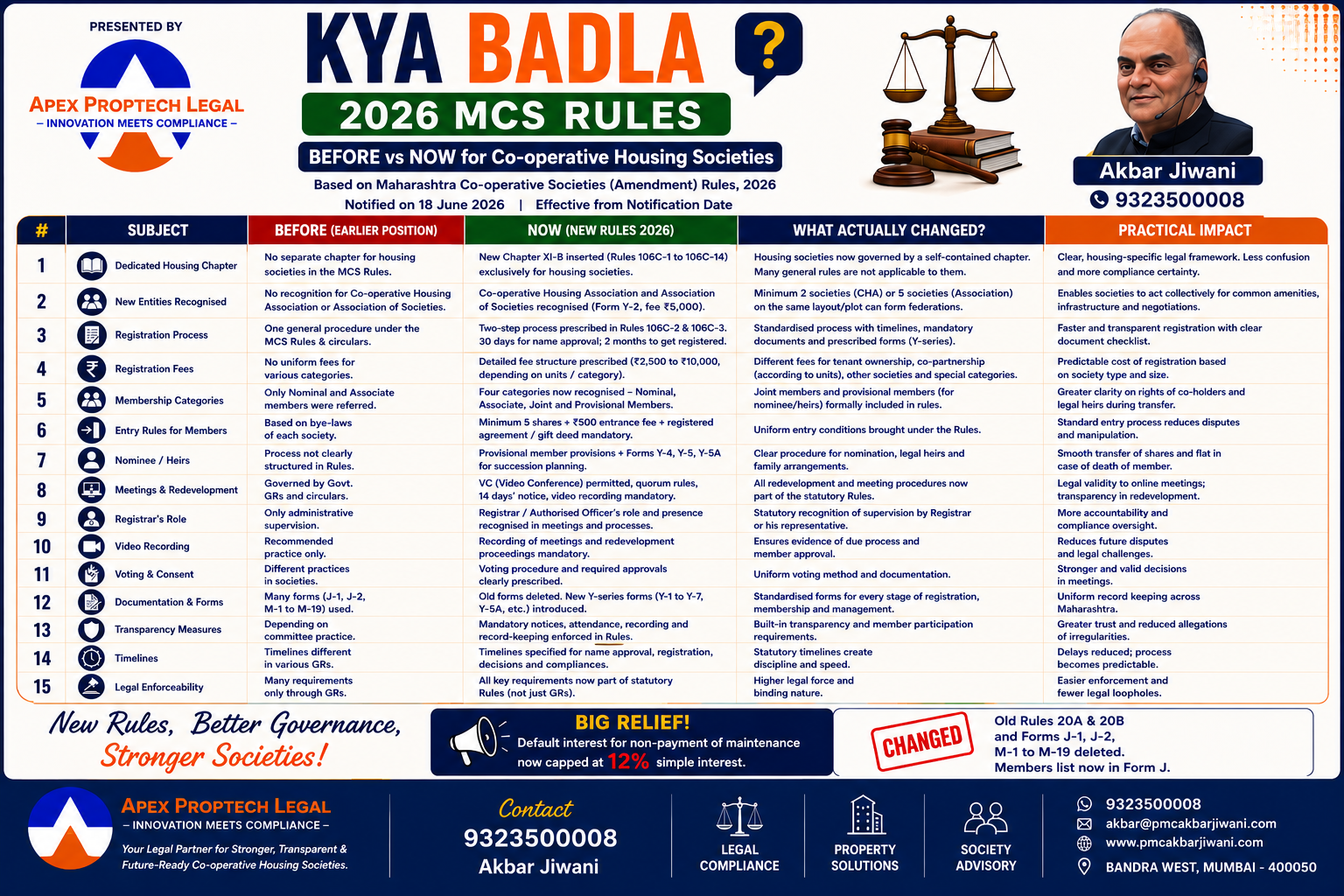
Mumbai has entered a new era of co-operative housing governance. In one of the most significant reforms in decades, the Government of Maharashtra has unveiled a comprehensive housing policy alongside sweeping amendments to the Maharashtra Co-operative Societies Rules, 1961. These reforms are aimed at making housing societies more transparent, accountable, digitally enabled and redevelopment-friendly while empowering millions of flat owners across the State.
For nearly six decades, housing societies were governed under general provisions of the Maharashtra Co-operative Societies Rules, with no exclusive legal framework dedicated to their unique needs. The 2026 reforms have fundamentally changed that position by introducing an entirely new chapter exclusively for co-operative housing societies.
A Landmark Reform
The Maharashtra Co-operation Department has inserted a dedicated Chapter XI-B into the Maharashtra Co-operative Societies Rules, creating a separate legal code exclusively for housing societies. This marks a historic departure from the earlier framework where housing societies were merely one category among various co-operative institutions.
The reforms provide clarity on:
Registration
Membership
Redevelopment
Governance
Financial management
Meetings
Elections
Documentation
Legal compliance
For over 1.25 lakh housing societies and millions of residents in Maharashtra, this represents a structural legal transformation rather than a routine amendment.
Housing Policy Focus: Housing for All
The broader Maharashtra Housing Policy complements these reforms by targeting affordable housing, faster redevelopment, sustainable urban planning and improved housing infrastructure. The policy envisages construction of millions of affordable homes by 2030 while encouraging redevelopment of ageing buildings, digital governance and private sector participation.
The government’s vision is to ensure that every citizen has access to safe, affordable and well-managed housing while improving the quality of urban living.
Major Changes Every Housing Society Must Know
The new Rules introduce several path-breaking provisions.
Separate Legal Chapter
Housing societies now enjoy an independent statutory framework rather than depending on scattered Government Resolutions and circulars.
Recognition of Housing Associations
The Rules now formally recognise:
Co-operative Housing Associations
Associations of Housing Societies
This enables multiple societies to work collectively for common infrastructure, redevelopment and civic issues.
Transparent Registration
Registration procedures have been standardised with defined timelines, prescribed forms and fee structures, making the entire process more transparent.
Four Categories of Membership
Earlier only nominal and associate members were recognised.
The Rules now recognise:
Nominal Members
Associate Members
Joint Members
Provisional Members
This provides greater clarity in ownership and succession matters.
Digital Governance
Video conferencing for General Body Meetings and redevelopment meetings has received statutory recognition, bringing societies into the digital era.
Mandatory Video Recording
Important meetings, particularly redevelopment meetings, must now be video recorded to improve transparency and reduce future disputes.
Nomination & Legal Heirs
The Rules introduce detailed procedures for nomination, family arrangements and succession planning, significantly reducing litigation after the death of members.
Standardised Documentation
The old J-series and M-series forms have largely been replaced by a new Y-series of statutory forms to simplify compliance.
Big Relief for Members
Among the most welcomed reforms is the reduction in the rate of interest on maintenance arrears.
Previously many societies charged interest up to 21% annually.
The new Rules cap the interest at 12% simple interest, providing substantial financial relief to flat owners.
Major Boost for Self Redevelopment
Perhaps the biggest beneficiary of these reforms is self redevelopment.
The Rules now:
recognise redevelopment procedures within the statutory framework,
prescribe meeting procedures,
strengthen member participation,
improve documentation,
increase transparency,
reduce disputes.
In parallel, the State has also simplified several redevelopment-related processes and continues to encourage timely execution of housing projects.
Mandatory Education and Training
One of the most progressive reforms is compulsory co-operative education and training.
Every housing society is expected to organise annual education programmes for members, office bearers and employees through recognised training institutions. This reflects the Government’s recognition that informed members lead to better governance and fewer disputes.
Greater Accountability
The amended Rules significantly strengthen the role of the Registrar and authorised officers in ensuring statutory compliance.
They introduce:
clearer timelines,
mandatory record keeping,
structured approvals,
greater supervision,
improved governance.
These measures are expected to reduce administrative ambiguity and improve confidence among society members.
Impact on Redevelopment Projects
The reforms are likely to accelerate redevelopment across Maharashtra by:
reducing procedural ambiguity,
improving transparency,
encouraging digital meetings,
strengthening member confidence,
simplifying approvals,
improving legal certainty.
Separately, the State leadership has also emphasised timely completion of housing and redevelopment projects, with strict accountability for delays and construction quality.
Expert View
According to AI Powered PMC Akbar Jiwani, Project Management Consultant specialising in redevelopment of co-operative housing societies:
“These amendments represent the most comprehensive reform in Maharashtra’s co-operative housing sector in several decades. By introducing a dedicated legal framework, strengthening governance, recognising digital administration, and supporting transparent redevelopment, the Government has laid the foundation for a more accountable and future-ready housing ecosystem. The real beneficiaries will be millions of society members who will now enjoy greater legal certainty, better governance and smoother redevelopment processes.”
Conclusion
The Maharashtra Government’s new housing policy and the 2026 amendments to the Maharashtra Co-operative Societies Rules signal a decisive shift towards modern, transparent and citizen-centric housing governance.
While implementation will require awareness, training and professional guidance, these reforms have the potential to transform the functioning of housing societies across the State.
For housing societies contemplating redevelopment, self redevelopment or governance reforms, the message is clear: the regulatory landscape has fundamentally changed. Understanding and implementing these new provisions will be essential for every managing committee, office bearer and society member in Maharashtra.