By AI Powered PMC Akbar Jiwani, Special Correspondent: Real Estate for Realnewsofindia.com
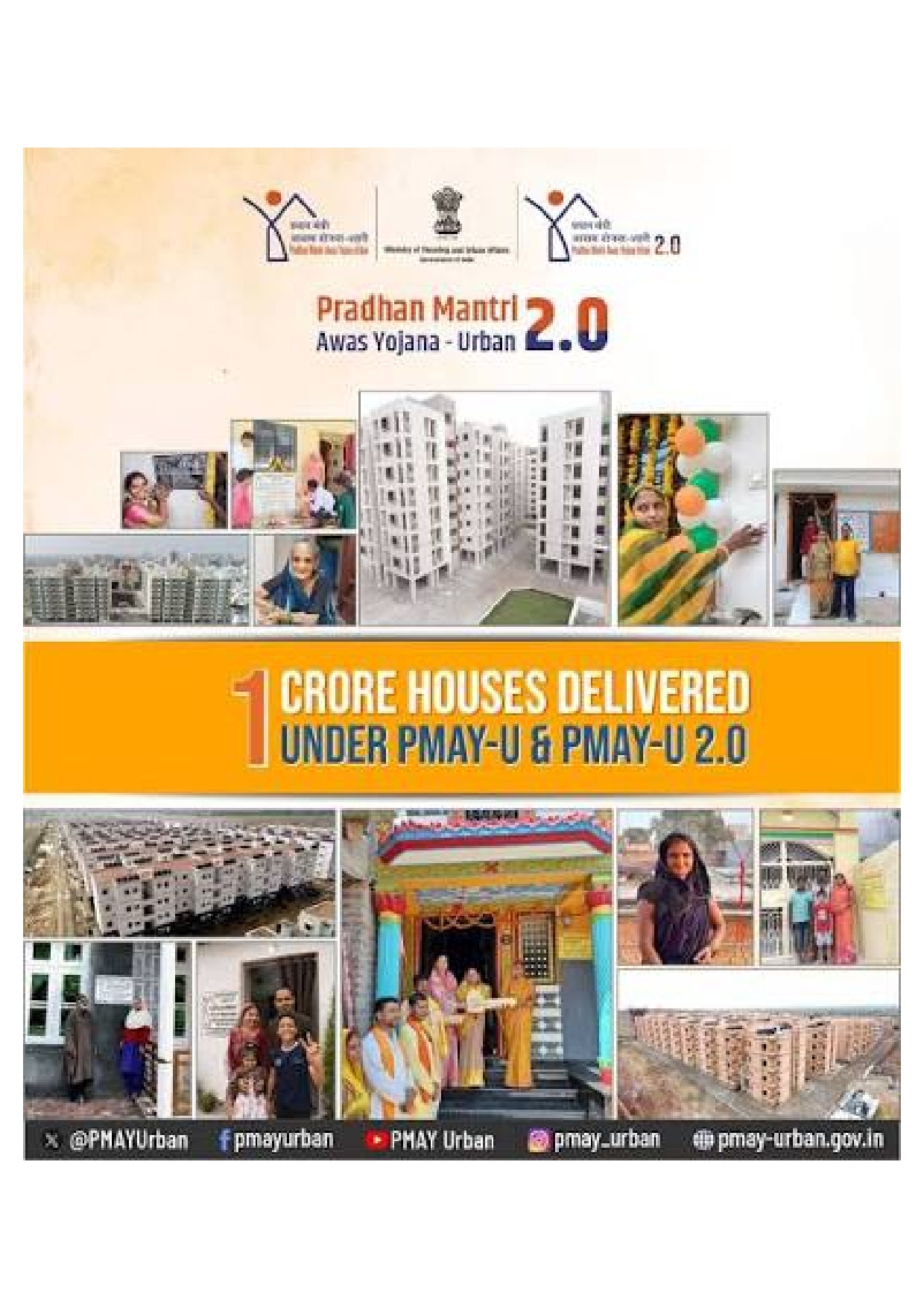
India’s flagship affordable housing programme, the Pradhan Mantri Awas Yojana-Urban (PMAY-U), has crossed a landmark milestone, with the Ministry of Housing and Urban Affairs (MoHUA) confirming that more than 1.25 crore houses have now been sanctioned and over 1 crore houses have been fully completed and handed over to beneficiaries across the country, in one of the clearest signals yet of the depth and pace of India’s urban housing growth story.
The update, issued by MoHUA on August 9, 2026 following a review of the Central Sanctioning and Monitoring Committee (CSMC) held on August 6, adds fresh momentum to the scheme even as it approaches a decade in operation. Of the 1 crore-plus homes delivered so far, a full 1 crore have been allotted to women beneficiaries, either solely or jointly — underlining the programme’s deliberate design to advance women’s asset ownership alongside its core goal of “Housing for All.”
At the same CSMC meeting, chaired by Satendra Singh, Secretary, Department of Urban Development, the government approved 2.09 lakh additional houses spread across 16 states and Union Territories, including Andhra Pradesh, Bihar, Gujarat, Jammu & Kashmir, Madhya Pradesh, Maharashtra, Odisha, Rajasthan, Tamil Nadu, Telangana, Uttar Pradesh and Uttarakhand. Of this fresh sanction, 1.42 lakh houses fall under the Beneficiary Led Construction (BLC) vertical — where individual households build or expand their own homes with government support — while 67,045 houses are being built under the Affordable Housing in Partnership (AHP) vertical, which brings in private and public developers to construct housing stock at scale.
The numbers also offer the first detailed look at how PMAY-U 2.0, the scheme’s second and more ambitious phase, is scaling up. Total sanctions under Phase 2.0 now stand at 18.38 lakh houses, comprising 14.40 lakh under BLC, 2.48 lakh under AHP, 1.36 lakh under the Interest Subsidy Scheme (ISS) for home loan borrowers, and 13,046 under the Affordable Rental Housing (ARH) component aimed at migrant and urban poor workers who need housing near job centres rather than ownership.
Secretary Singh used the occasion to press implementing agencies on execution discipline, calling for “faster implementation, timely release of funds, effective monitoring and closer coordination among government agencies, beneficiaries and other stakeholders” — a reminder that in a scheme of this scale, the gap between sanction and delivery is where most delays and cost overruns occur.
For India’s real estate sector, this update matters well beyond the affordable housing segment. PMAY-U’s AHP and private-partnership components have functioned as a steady demand driver for developers, materials suppliers, and construction contractors in Tier 2 and Tier 3 cities, even during periods when premium and mid-income housing sales have been more cyclical. The ARH push, though still modest in absolute numbers, also signals a policy direction that Mumbai and other high-cost metros should watch closely: rental housing stock built specifically for urban migrant workers, rather than relying solely on informal or slum settlements, is likely to become a bigger part of state and central housing strategy as urbanisation continues.
With 1 crore homes now physically delivered and women holding full or joint ownership of every one of them, PMAY-U has moved from a policy promise to a measurable asset base — one that developers, PMCs, and urban planners will increasingly need to factor into their own project pipelines, land-use planning and financing models over the next phase of India’s housing growth.