December 2025 announcement signals the most significant urban housing reform in decades
# Maharashtra’s Historic Move to End the Pagdi Deadlock: A New Era for Mumbai’s Ageing Housing Stock
**December 2025 announcement signals the most significant urban housing reform in decades**
—
## The Announcement That Changed Everything
In a landmark statement made before the Maharashtra Legislative Assembly on December 11, 2025, Deputy Chief Minister Eknath Shinde — who also holds the Housing portfolio — announced a dedicated regulatory framework aimed at dismantling Mumbai’s century-old Pagdi system and accelerating the large-scale redevelopment of the city’s ageing rental housing stock. Calling it a “historic decision” aimed at eventually making the city free of such properties, Shinde said the move would expedite redevelopment of old buildings, prevent collapses, and reduce the loss of life and property.
The announcement came after years of policy paralysis, dangerous building conditions, and a judicial logjam that had effectively frozen the future of hundreds of thousands of Mumbai residents.
—
## Understanding the Pagdi System: A Legacy of Pre-Independence India
The Pagdi system is a uniquely Mumbai institution with roots stretching back to the pre-Independence era. The system emerged widely before the 1940s, especially in the island city areas, and though informal in origin, it later received legal recognition under the Maharashtra Rent Control Act.
Under this arrangement, a tenant pays a large one-time amount, known as pagdi, to the landlord at the time of moving in. Unlike regular tenants, pagdi occupants have rights that resemble partial ownership — they can often sublet the property or even sell their tenancy rights, usually with the landlord receiving a share of the transaction. The monthly rent, however, remains frozen at levels set decades ago, completely disconnected from market realities.
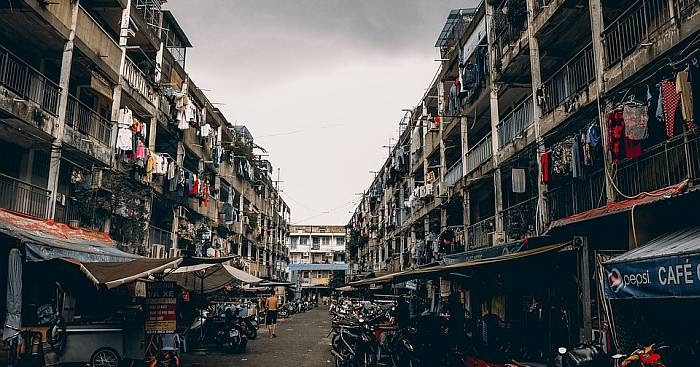
This created an urban paradox: tenants with near-permanent occupancy rights living in structurally deteriorating buildings, while landlords had neither the income nor the legal leverage to maintain or redevelop their own properties.
—
## The Scale of the Problem
The numbers are staggering. Mumbai has over 19,000 rent-controlled buildings operating under the Pagdi arrangement, with many built before 1960. More than 13,000 buildings are still awaiting redevelopment, while some have partially collapsed or deteriorated beyond repair.
Negligible rent income made upkeep financially impossible, causing buildings to fall into disrepair and structural risk. Redevelopment deadlocks arose due to fear of displacement or unclear rights, while black money transactions from informal tenancy sales and legal ambiguities led to prolonged disputes and court cases.
Nearly 28,000 cases between tenants and landlords are pending in small-cause courts, delaying redevelopment for decades. Neighbourhoods like Lalbaug, Parel, Dadar, and Byculla — once the heartbeat of working-class Mumbai — have been caught in this limbo, their residents simultaneously too protected to be evicted and too poorly housed to live safely.
—
## Key Provisions of the New Framework
The proposed regulatory framework introduces a multi-pronged approach designed to balance the competing interests of tenants, landlords, and developers. The key provisions, as announced by Deputy CM Shinde, are as follows:
**FSI-Based Entitlements:** Tenants will receive FSI equal to their current occupied area, landlords will receive FSI corresponding to their land-ownership entitlement, and economically weaker and low-income Pagdi occupants will be given incentive FSI to cover free reconstruction. This ensures no tenant is displaced without receiving an equivalent new home.
**TDR as a Safety Valve:** If height or other restrictions prevent utilisation of full FSI, the remaining balance will be provided as Transferable Development Rights (TDR). This is a critical mechanism, especially for plots in heritage precincts or areas with height restrictions under DCPR 2034, where vertical development may be curtailed.
**Continuation of Existing Schemes:** Existing redevelopment options such as 33(7) and 33(9) will continue to be available, and the new framework will serve as an additional route for buildings that have not yet benefited from these schemes. This is a pragmatic design — it does not disrupt ongoing projects but opens a fresh pathway for the thousands of buildings that have remained outside the redevelopment pipeline.
**Fast-Track Courts:** The government will, with the High Court’s approval, set up additional fast-track courts to dispose of tenant-landlord cases within three years. This addresses perhaps the most chronic bottleneck — litigation that has paralysed redevelopment for decades.
**Ownership-Based Homes:** Shinde stated that this initiative will finally pave the way for lakhs of Mumbai residents living in Pagdi buildings to get ownership-based homes, ensuring that neither tenants nor landlords will face injustice.
—
## What This Means for Tenants: Protections and Rights
A key concern among tenant advocacy groups has historically been that redevelopment displaces original tenants — sometimes permanently — to distant suburbs while developers profit in prime locations. Vinita Rane, General Secretary of the Pagdi Ekta Sangh, noted: “In the past we have seen how during the redevelopment the tenants were thrown out of the city to suburbs for years. Now with this change in rules we hope for the redevelopment to take place and tenants’ rights are protected.”
The new framework appears to address this directly. Tenants are to receive rebuilt homes of equivalent area, and economically weaker sections will benefit from cost-free reconstruction — not just FSI entitlement. The shift from informal occupancy to formal ownership is perhaps the most transformative element: for the first time, generations of pagdi tenants living in a legal grey zone may receive full property ownership.
—
## What This Means for Landlords and Developers
For landlords, the reform delivers long-overdue recognition of their ownership rights. Many have been caught in a situation where they owned the land on paper but had no practical ability to develop, sell, or maintain it. The new framework grants clear FSI entitlements tied to land ownership, providing both legal clarity and financial viability for redevelopment participation.
For the real estate development community, the implications are equally significant. Over 13,000 buildings in some of Mumbai’s most prime and centrally located neighbourhoods — South Mumbai, Dadar, Byculla, Parel — could now enter the redevelopment pipeline. The relaxation of consent requirements, combined with fast-track dispute resolution, transforms what were previously unviable projects into bankable ones.
—
## Implications Under DCPR 2034 and Regulatory Architecture
From a regulatory standpoint, this announcement integrates with the broader framework of DCPR 2034. The provisions for FSI allocation and TDR utilisation align with existing tools under the Development Control and Promotion Regulations, which already provide incentives for landlords undertaking redevelopment. The new Pagdi-specific framework effectively creates a dedicated channel — a Regulation 33-type provision exclusively for Pagdi buildings — that can work in tandem with or independently of Regulations 33(7) and 33(9).
Project Management Consultants and developers must note that the consent thresholds, FSI calculations, and TDR balance provisions will require detailed scrutiny once the formal Government Resolution (GR) is issued. The devil, as always in Mumbai redevelopment, will be in the implementation details — specifically around how the “equivalent area” of tenant entitlement is calculated, how multiple ownership claims within a single building are adjudicated, and how the fast-track courts will interact with existing Small Cause Court proceedings.
—
## Challenges Ahead
While the announcement is historic in intent, the road to implementation will be complex. Several challenges remain:
The formal GR and legislative amendments have yet to be notified. Until the regulatory text is published, the exact consent thresholds, documentation requirements, and procedural timelines remain unclear. Past GRs on Pagdi redevelopment have been challenged in courts precisely because of drafting ambiguities.
The creation of fast-track courts — while welcome — requires High Court approval and judicial appointments. A three-year timeline for 28,000 pending cases is ambitious and will require substantial institutional capacity.
Additionally, many pagdi buildings involve multiple heirs, subletting arrangements, and undocumented transfers — all of which create title complexity that no regulatory framework can fully pre-empt.
—
## A Transformative Opportunity
Despite the challenges, the announcement represents a genuine policy inflection point. If implemented effectively, the reforms could transform ageing neighbourhoods such as Lalbaug, Parel, Dadar and Byculla, replacing unsafe housing with modern, secure homes while bringing long-delayed clarity to one of Mumbai’s most complex property challenges.
For the thousands of families — tenants and landlords alike — who have waited decades for resolution, this reform offers something that has been in short supply: hope backed by policy. The government’s stated goal of a “Pagdi-Mukt Mumbai” is ambitious. Whether it becomes reality will depend on the speed and quality of implementation, the robustness of the GR that follows, and the willingness of all stakeholders to move beyond decades of mutual suspicion toward a shared vision of safer, more equitable housing.
—
*This article is prepared by PMC Akbar Jiwani, RERA-Registered Project Management Consultant (Reg. No. A51800001057), Apex Proptech Legal, Mumbai. For strategic guidance on Pagdi redevelopment feasibility, documentation, and compliance under the new regulatory framework, contact our office.*